1. Introduction: The Foundation of Precision
In the hierarchy of machine tool design, the Machine Bed represents the fundamental structural loop that connects the tool to the workpiece. While high-speed spindles and nanometer-resolution feed systems often capture the most attention, their performance is ultimately capped by the physical properties of the base upon which they are mounted. In precision grinding, where tolerances are measured in sub-microns, the bed must act as a rigid, thermally inert, and vibration-dampening platform. Selecting the right material is the first deterministic decision in achieving long-term Quality Stability.
Static Rigidity and Dynamic Damping
A grinding machine bed must fulfill two conflicting mechanical requirements: high Static Stiffness to resist deformation under heavy component loads, and high Dynamic Damping to dissipate the energy generated by high-frequency cutting forces. Traditional materials like Gray Cast Iron provide excellent rigidity through engineered ribbing, but modern high-speed grinding requires the superior damping ratios found in composite materials. The ability of the bed to absorb vibrations before they reach the grinding interface is the primary defense against chatter and poor Surface Integrity.
The Challenge of Thermal Inertia
Beyond mechanical strength, Thermal Stability is perhaps the most critical attribute of a modern machine base. As motors, spindles, and hydraulic systems generate heat, the bed can undergo non-uniform thermal expansion, leading to geometric “bending” that shifts the tool-tip position. Materials with high thermal inertia and low expansion coefficients, such as natural granite or polymer concrete, ensure that the machine’s Dimensional Accuracy remains consistent throughout an 8-hour production shift, even in environments with fluctuating ambient temperatures.
Edynamic = f(Stiffness, Damping, Mass)
Equation 1.1: The Interdependence of Structural Variables in Machine Base Design
This article provides an exhaustive comparison of the three dominant materials used in contemporary grinding machine beds: Gray Cast Iron, Natural Granite, and Polymer Concrete (Mineral Casting). By analyzing their physical data sheets and operational performance, we provide a technical framework for engineers to evaluate which structural foundation best aligns with their specific accuracy and productivity goals.
| Property Class | Technical Indicator | Impact on Grinding Quality |
|---|---|---|
| Mechanical | Young’s Modulus & Damping Ratio. | Determines resistance to chatter and vibration marks. |
| Thermal | Coefficient of Thermal Expansion (CTE). | Governs dimensional drift over long production cycles. |
| Structural | Long-term Creep & Stability. | Ensures the machine maintains geometric alignment for years. |
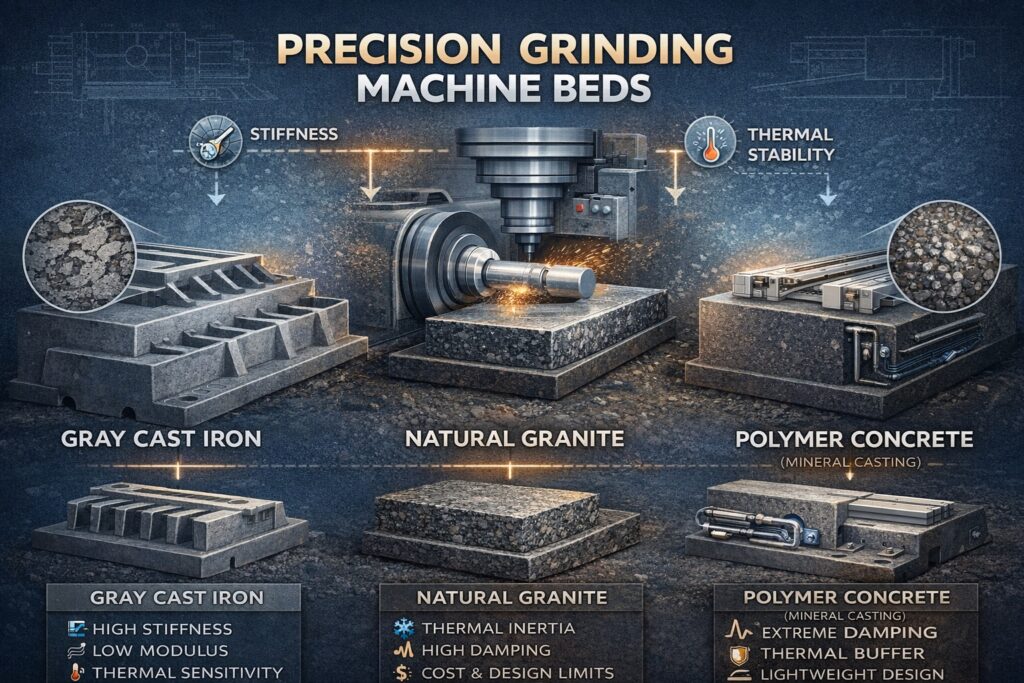
2. Gray Cast Iron (GG25/GG30): The Traditional Standard
Gray Cast Iron, specifically grades such as GG25 or GG30 (equivalent to ASTM Class 35/45), has been the backbone of the machine tool industry for over a century. Its dominance is not merely a result of tradition but stems from a unique combination of Castability, Machinability, and Structural Rigidity. For grinding machines, gray iron provides a robust framework capable of supporting heavy spindle assemblies while maintaining the necessary geometric alignment under static loads.
Design Flexibility through Engineered Ribbing
One of the greatest advantages of cast iron is the freedom it offers in Structural Geometry. Through the sand-casting process, engineers can design complex internal ribbing structures—such as honeycomb or diagonal cross-ribs—that maximize the moment of inertia while minimizing total weight. This ability to place material exactly where the stress concentrations occur allows for a bed with exceptional Specific Stiffness, ensuring that the machine does not flex during heavy stock removal passes.
Damping Properties and the Graphite Flake Effect
Gray iron possesses a natural Damping Mechanism due to its microstructure. The presence of interconnected graphite flakes within the iron matrix acts as a microscopic internal friction source, absorbing energy from forced vibrations better than steel. However, while superior to steel, the damping ratio of cast iron (typically ζ ≈ 0.002 to 0.004) is often insufficient for modern High-Speed Grinding. Excessive vibration can still resonate through the casting, leading to visible chatter marks that compromise Surface Integrity.
σstatic = (F × L) / Zsection ≤ σallowable
Equation 2.1: Bending Stress vs. Section Modulus in Ribbed Cast Structures
Thermal Sensitivity and Long-term Aging
The primary drawback of cast iron in ultra-precision applications is its high Coefficient of Thermal Expansion (CTE) and relatively high thermal conductivity. A cast iron bed reacts quickly to temperature changes, leading to expansion or contraction that directly affects the Dimensional Accuracy of the workpiece. Furthermore, raw castings possess significant internal residual stresses. To ensure Quality Stability, high-end manufacturers must subject these beds to long-term “seasoning” or vibratory stress relief to prevent the bed from warping over several years of service.
| Technical Attribute | Typical Value (GG25/30) | Impact on Grinding |
|---|---|---|
| Density | 7,100 – 7,250 kg/m³ | Provides high mass for stability, but increases logistics costs. |
| Modulus of Elasticity | 100 – 120 GPa | Excellent static rigidity for heavy components. |
| Damping Ratio (ζ) | ~0.003 | Moderate damping; may require external dampers for chatter. |
| Thermal Expansion | 10 – 12 μm/m⋅K | Sensitive to ambient temperature; needs climate control. |
3. Natural Granite: The Benchmark for Metrology
For applications requiring the highest levels of geometric fidelity, Natural Granite stands as the ultimate reference material. Unlike cast metals, granite is an igneous rock that has been naturally aged and stress-relieved over millions of years. This intrinsic stability makes it nearly immune to the long-term warping or creeping that can plague even the most well-seasoned cast iron beds. In the realm of ultra-precision grinding, a granite base provides the Dimensional Accuracy necessary for nanometer-level resolution.
Exceptional Thermal Inertia and Low Expansion
The primary technical advantage of natural granite is its exceptionally low Coefficient of Thermal Expansion (CTE), which is roughly half that of steel or cast iron. Furthermore, granite possesses high thermal inertia; it reacts very slowly to ambient temperature fluctuations. This slow reaction time prevents the thermal bowing effect that occurs when one side of a machine bed warms faster than the other. For shops maintaining Quality Stability in non-climate-controlled environments, granite offers a significant buffer against external heat sources.
Vibration Damping and Surface Hardness
Granite’s crystalline structure provides superior dynamic damping compared to cast iron, effectively suppressing high-frequency vibrations that can lead to chatter. Additionally, its high surface hardness and lack of magnetic properties make it an ideal platform for mounting air-bearing guideways. However, because granite is a brittle material, it lacks the tensile strength of metals. This necessitates a design approach where the bed is heavily over-engineered in terms of mass to compensate for its structural limitations, ensuring Surface Integrity during the grinding cycle.
ΔL = L × αgranite × ΔT (Where α ≈ 5.5 μm/m⋅K)
Equation 3.1: Minimum Thermal Displacement in Granite Structures
Limitations: Geometry and Integration
Despite its precision, granite presents significant manufacturing challenges. Unlike cast iron, which can be molded into complex ribbed shapes, granite must be quarried and machined using diamond-tipped tools. This limits the design to relatively simple, solid blocks, which significantly increases the total weight of the machine. Furthermore, integrating metal components like linear motors or guideways requires specialized epoxy-bonding techniques or threaded inserts, as granite cannot be tapped or welded, adding complexity to the overall assembly.
| Technical Attribute | Typical Value (Granite) | Impact on Grinding Stability |
|---|---|---|
| Density | ~3,000 kg/m³ | High mass provides passive stability against external vibrations. |
| Modulus of Elasticity | 50 – 75 GPa | Lower than iron; stiffness is achieved through block thickness. |
| Damping Ratio (ζ) | ~0.015 | Superior damping to cast iron; suppresses tool-tip resonance. |
| Thermal Expansion | ~5.5 μm/m⋅K | Exceptional dimensional control in fluctuating environments. |
4. Polymer Concrete (Mineral Casting): The High-Damping Evolution
In the evolution of machine tool structures, Polymer Concrete (often referred to as Mineral Casting) represents a significant leap forward in vibration management. Composed of approximately 90% mineral aggregates (such as quartz and gravel) bonded with a high-performance epoxy resin, this composite material is specifically engineered to overcome the limitations of metallic castings. In high-speed grinding operations where spindle frequencies can trigger resonant modes, polymer concrete acts as a critical filter for mechanical noise, ensuring Quality Stability.
Superior Dynamic Damping Capacity
The primary technical driver for adopting mineral casting is its Damping Ratio, which is roughly 6 to 10 times higher than that of gray cast iron. This high internal friction allows the machine bed to dissipate kinetic energy from the grinding process almost instantaneously. As a result, the tool-tip experiences significantly lower vibration amplitudes during aggressive infeed cycles. This damping characteristic is the foundation of superior Surface Integrity, as it prevents the formation of micro-chatter marks even when using large, high-inertia grinding wheels.
Thermal Inertia and Precision Cold-Casting
Unlike cast iron, which requires high-energy melting and results in significant residual stress, polymer concrete is manufactured through a Cold-Casting Process at room temperature. This eliminates internal stresses from the outset, ensuring that the bed remains geometrically stable for its entire Life-cycle. Furthermore, the material’s high specific heat capacity and low thermal conductivity provide exceptional thermal inertia. It effectively insulates the machine’s critical alignments from short-term temperature spikes, maintaining Dimensional Accuracy.
Logarithmic Decrement (δ) ≈ 2πζ (Where ζmineral ≈ 0.02 – 0.03)
Equation 4.1: High Vibration Decay Rate in Polymer Composite Structures
Integration of Precision Components
One of the most innovative features of mineral casting is the ability to Integrate Functional Elements directly during the casting process. Fluid channels for coolant, electrical conduits, and precision-machined steel inserts for guideways can be cast-in with extreme accuracy. This reduces the need for subsequent machining and ensures a more monolithic structure. While the modulus of elasticity is lower than that of cast iron, the increased wall thickness made possible by the casting process provides the necessary static stiffness for high-end CNC grinding applications.
| Technical Attribute | Typical Value (Mineral) | Impact on Grinding Performance |
|---|---|---|
| Density | 2,300 – 2,500 kg/m³ | Lightweight but thick-walled; provides high structural damping. |
| Modulus of Elasticity | 35 – 45 GPa | Lower stiffness; compensated by mass and internal ribbing. |
| Damping Ratio (ζ) | 0.020 – 0.030 | Optimal vibration absorption; eliminates regenerative chatter. |
| Thermal Expansion | 12 – 14 μm/m⋅K | Matches steel components well; prevents localized stress. |
5. Comparative Analysis: Mechanical & Thermal Properties
To select the optimal foundation for a grinding machine, engineers must evaluate the trade-offs between stiffness, damping, and thermal response. While Gray Cast Iron excels in static rigidity and cost-effectiveness, Natural Granite and Polymer Concrete offer superior performance in vibration absorption and thermal stability. The following analysis provides a deterministic comparison of these materials based on their standardized physical data sheets.
Static vs. Dynamic Stiffness
The Young’s Modulus of cast iron (approx. 110 GPa) is significantly higher than that of polymer concrete (approx. 40 GPa), meaning iron structures can be thinner while maintaining the same resistance to bending. However, in precision grinding, Dynamic Stiffness—the ability to resist vibration during cutting—is more critical. Polymer concrete’s high damping ratio compensates for its lower modulus by rapidly extinguishing the energy of chatter. This makes it the preferred choice for high-speed finishing where Surface Integrity is the primary goal.
Thermal Response and Dimensional Stability
When evaluating Dimensional Accuracy over long shifts, thermal conductivity and expansion are the decisive factors. Granite’s extremely low expansion coefficient makes it the benchmark for metrology-grade grinding. In contrast, while polymer concrete has an expansion coefficient similar to steel, its extremely low thermal conductivity acts as a Thermal Buffer. This prevents localized heat from spindles or pumps from causing rapid, non-linear distortions in the machine bed, ensuring Quality Stability regardless of the duty cycle.
Material Merit Index (M) = √E / α ρ
Equation 5.1: Performance Index for High-Precision Structural Bases (E: Modulus, α: Expansion, ρ: Density)
| Property | Gray Cast Iron | Natural Granite | Polymer Concrete |
|---|---|---|---|
| Density (kg/m³) | 7,150 | 3,000 | 2,400 |
| Modulus (GPa) | 110 (High) | 60 (Med) | 40 (Low) |
| Damping Ratio (ζ) | 0.003 | 0.015 | 0.025 (Highest) |
| Exp. Coeff (μm/mK) | 11.0 | 5.5 (Lowest) | 12.0 |
| Thermal Conduct. | High | Low | Extremely Low |
6. Conclusion: Choosing the Right Base for Future Accuracy
The selection of a machine bed material is not merely a choice of substrate, but a strategic decision that defines the performance envelope of a grinding center. As we have analyzed, there is no “universal” material; rather, the choice depends on the specific balance between Structural Rigidity, Dynamic Damping, and Thermal Stability. In the era of sub-micron manufacturing, the foundation of the machine must be as precisely engineered as the control system itself.
Summary of Material Selection Criteria
For heavy-duty, large-scale grinding where static stiffness and cost-efficiency are paramount, Gray Cast Iron remains the industry standard. However, for ultra-precision applications such as semiconductor wafer grinding or optical glass processing, Natural Granite provides the unmatched dimensional stability required. Meanwhile, Polymer Concrete has emerged as the modern favorite for high-speed, high-precision CNC grinding, offering the best compromise between design flexibility and vibration absorption to ensure Quality Stability.
The Future: Hybrid Structures and Advanced Composites
The next frontier in machine tool design lies in Hybrid Bed Technologies. These structures combine the high modulus of cast iron with the damping properties of polymer concrete, often by filling hollow iron castings with mineral composites. This approach seeks to maximize Surface Integrity while maintaining the ease of assembly found in metallic frames. Additionally, research into carbon-fiber-reinforced polymers (CFRP) and ultra-high-performance concrete (UHPC) promises to further push the boundaries of Dimensional Accuracy and energy efficiency in the next generation of grinding machines.
The Science of Structural Foundations
“In precision grinding, the quality of the finish is a direct reflection of the stability of its base. A superior machine bed is the silent partner in every micron of accuracy achieved.”
References & Technical Resources
- • McKeown, P. A. (1987). High Precision Manufacturing and the British Machine Tool Industry. Proceedings of the Institution of Mechanical Engineers.
- • Möhring, H. C., et al. (2015). Materials in Machine Tool Structures. CIRP Annals – Manufacturing Technology.
- • Slocum, A. H. (1992). Precision Machine Design. Society of Manufacturing Engineers.
Internal Technical Deep-Dive
To further integrate your understanding of machine foundations and their impact on grinding precision, please refer to the following technical modules from our library:
STRUCTURAL RIGIDITY:
Machine Stiffness in Grinding: Why Structural Rigidity Affects Surface Quality
THERMAL STABILITY:
Thermal Stability of Grinding Machines: How Temperature Drift Impacts Accuracy
VIBRATION CONTROL:
Grinding Machine Vibration Sources: Structural vs Process-Induced Effects
EQUIPMENT SELECTION:
Hydrostatic vs Rolling Guideways in Grinding Machines: Practical Differences