1. Introduction: The Spine of the Machine Tool
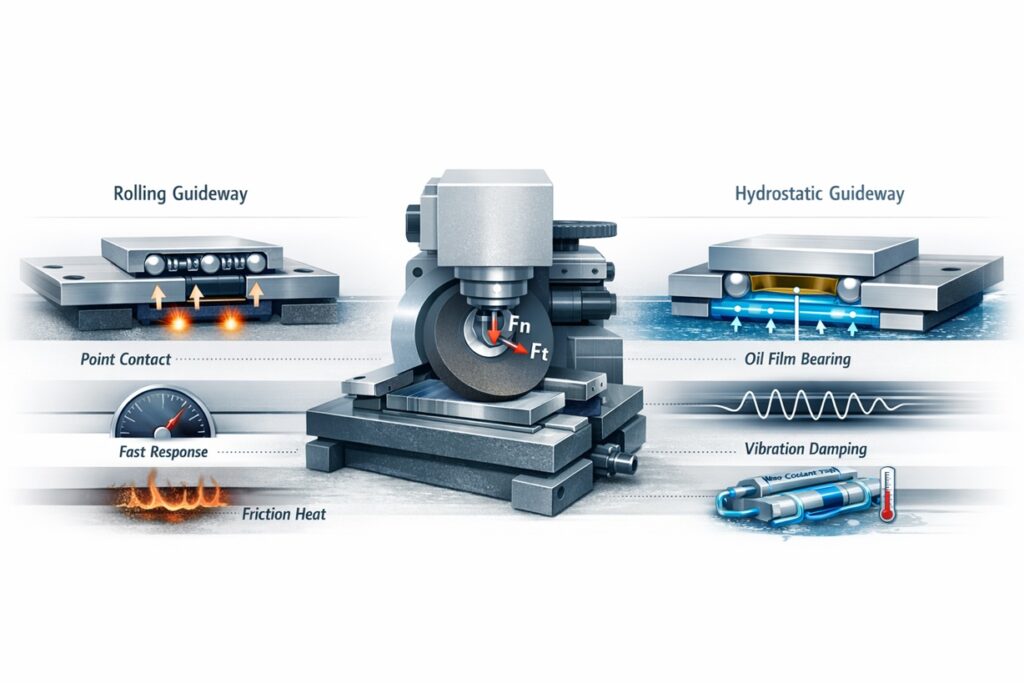
The guideway system is the fundamental Structural Mechanism that defines the precision and load-bearing capacity of a grinding machine. Often referred to as the “spine” of the machine tool, the guideway’s primary function is to provide highly accurate linear motion while resisting the intense Grinding Forces (Fn, Ft) generated at the contact zone. The choice between Hydrostatic and Rolling Guideways is not merely a preference but a strategic decision that dictates the machine’s dynamic stiffness and long-term Quality Stability.
The Role of Guidance in Machine Architecture
In modern machine architecture, the guideway acts as the interface between the stationary bed and the moving axes (spindle head or worktable). This Interface Mechanism must fulfill two conflicting requirements: minimum friction for high-speed positioning and maximum damping to suppress vibration. A failure in the guideway’s structural integrity leads to the Stick-Slip Mechanism, where the axis “jerks” during micro-feeding, making sub-micron tolerances impossible to achieve.
Static vs. Dynamic Load Support
When evaluating Machine Structures, engineers must analyze how the guideway distributes loads. Rolling guideways utilize point or line contact through high-precision rollers, offering exceptional Static Stiffness. In contrast, hydrostatic guideways utilize a pressurized oil film to separate surfaces, providing a unique Viscous Damping Mechanism that is superior for absorbing the high-frequency energy of the grinding process.
The Structural Axiom: “The quality of the part begins with the stability of the slide. In the Mechanism of machine design, the guideway determines whether the machine is a high-speed athlete or a high-precision surgeon.”
2. The Rolling Guideway Mechanism: High Rigidity and Responsiveness
Rolling guideways, utilizing high-precision balls or rollers, are the workhorses of modern CNC grinding machines. Their primary Mechanism of Operation is based on rolling friction, which is significantly lower than sliding friction. This allows for high-speed axis acceleration and rapid positioning, making them ideal for high-volume production environments where Cycle Time Mechanism is a critical performance indicator.
The Preload and Contact Rigidity Mechanism
Unlike hydrostatic systems, rolling guideways achieve their Structural Rigidity through “Preloading.” By using oversized rolling elements within the carriage, a deliberate internal compressive stress is applied. This Preload Mechanism eliminates internal clearances and ensures that the carriage maintains Line Contact (in roller types) with the rail, providing high resistance to the Normal Grinding Force (Fn).
δ ∝ F2/3 (Ball) / δ ∝ F0.9 (Roller)
Equation 2.1: The Hertzian Contact Mechanism for Elastic Deformation
Responsiveness and Energy Efficiency
The low coefficient of friction (typically 0.002 to 0.005) in the Rolling Mechanism minimizes the “breakaway force” required to start an axis movement. This high responsiveness is vital for Contouring Accuracy during complex grinding paths. Furthermore, the lack of a continuous hydraulic pump requirement enhances the machine’s Energy Efficiency Mechanism, reducing the overall carbon footprint of the facility.
The Rolling Axiom: “In the Mechanism of throughput, responsiveness is king. Rolling guideways provide the structural agility needed for high-dynamic grinding without sacrificing the static rigidity required for precision.”
3. The Hydrostatic Guideway Mechanism: Infinite Life and Damping
While rolling guideways rely on mechanical contact, the Hydrostatic Guideway Mechanism utilizes a pressurized film of oil to separate the carriage from the rail. This non-contact approach fundamentally changes the Tribological Mechanism of the machine tool. Because there is no metal-to-metal contact during motion, wear is theoretically eliminated, ensuring that the machine maintains its Geometric Accuracy for decades, regardless of the duty cycle.
The Viscous Damping and Surface Averaging Mechanism
The most significant structural advantage of hydrostatic systems is their Damping Mechanism. The oil film acts as a high-viscosity shock absorber between the machine’s moving parts. This allows the machine to dissipate the energy from Grinding Chatter much more effectively than rolling elements. Furthermore, the oil film performs a Surface Averaging Mechanism, where microscopic irregularities in the guide rail are “smoothed out” by the fluid pressure, resulting in superior straightness of travel.
Q = (b · h3 · ΔP) / (12 · η · L)
Equation 3.1: The Flow-Pressure Mechanism (where h is the oil gap thickness)
Zero-Wear and Micro-Feeding Mechanism
In ultra-precision grinding, the ability to move an axis in increments of 0.1 μm is mandatory. Hydrostatic ways excel here by eliminating the Stick-Slip Mechanism. Since the static friction is nearly identical to the dynamic friction, the axis moves smoothly from a standstill without the “jumping” effect seen in contact-based systems. This Frictionless Mechanism is the key to achieving mirror-like surface finishes (Ra < 0.01 μm).
The Hydrostatic Axiom: “In the Mechanism of ultra-precision, physical contact is the enemy. By floating the machine on oil, we replace mechanical limitations with the predictable physics of fluid dynamics.”
4. Structural Comparison: Load Distribution and Thermal Stability
The fundamental difference in Machine Architecture between these two systems lies in how they distribute the Normal Grinding Force (Fn). This Load Distribution Mechanism directly influences the elastic deformation of the machine bed and the thermal growth of the axes, both of which are critical for long-term Quality Stability.
The Contact Surface Area Mechanism
Rolling guideways operate on a Line Contact Mechanism (for rollers) or Point Contact Mechanism (for balls). While preloading increases stiffness, the stress is concentrated on a very small area. In contrast, hydrostatic guideways utilize the entire pocket area to support the load. This Surface Area Distribution Mechanism allows hydrostatic ways to support massive workpieces without the risk of localized material fatigue or deformation of the guide rail.
The Thermal Stability Mechanism
Thermal growth is a major contributor to Process Instability. Rolling guideways generate localized friction heat at the contact points, which can lead to axial expansion. Hydrostatic systems, however, utilize a Thermal Management Mechanism through the circulation of oil. By controlling the temperature of the hydrostatic oil, the entire machine bed can be kept at a constant temperature, effectively acting as a heat exchanger that stabilizes the Geometric Loop.
Qheat = f · Fn · vf (Rolling) vs. Qviscous = η · A · (vf2 / h) (Hydrostatic)
Equation 4.1: Heat Generation Mechanism (where vf is feed velocity)
The Thermal Axiom: “Rigidity is useless if the machine grows out of tolerance. In the Mechanism of high-precision grinding, the ability to maintain thermal equilibrium via the guideway oil is as important as the stiffness of the bed itself.”
5. Practical Selection Guide: Matching Spec to Application
Selecting the ideal guideway system is an exercise in Mechanism Optimization. While hydrostatic ways offer unparalleled damping, they come with increased complexity and higher Total Cost of Ownership (TCO). Conversely, rolling guideways provide a lean, high-dynamic solution but may struggle in applications requiring extreme vibration suppression. The decision must be based on the specific Material Removal Mechanism of the application.
The High-Dynamic vs. Ultra-Precision Choice
For high-volume automotive or standard industrial components, the Rolling Guideway Mechanism is often the superior choice. Its high acceleration capability reduces non-cutting time, and the Maintenance Mechanism is straightforward—typically involving simple grease or oil lubrication. For aerospace alloys or mirror-finish mold tools, the Hydrostatic Mechanism becomes mandatory to eliminate the sub-surface micro-cracks caused by axis vibration.
Cost Architecture and Long-term Stability
A critical factor in Specification Selection is the “Precision Lifecycle.” Rolling elements will eventually wear, requiring replacement to maintain Quality Stability. Hydrostatic ways, although more expensive initially due to the hydraulic unit and chilling requirements, maintain their Initial Accuracy Mechanism indefinitely. This makes them more cost-effective for machines intended to run high-precision parts for over 15–20 years.
The Selection Axiom: “Do not buy a hydrostatic machine for a rolling-element job, and never expect a rolling-element machine to provide a hydrostatic finish. The Mechanism of the guideway must be the twin of the Mechanism of the cut.”
6. Conclusion: The Optimal Structural Choice for Grinding
The choice between hydrostatic and rolling guideways is a fundamental decision in Machine Architecture that dictates the long-term success of the grinding process. While rolling guideways offer a high-dynamic Mechanism for productivity and energy efficiency, hydrostatic ways provide the ultimate Damping Mechanism required for sub-micron surface integrity. For a machine to deliver consistent Quality Stability, the guideway’s structural characteristics must align perfectly with the intended Material Removal Mechanism.
Summary of Structural Suitability
To ensure the highest Process Capability (Cpk), engineers should consider the following structural pillars:
- For High Dynamics: Utilize the Rolling Mechanism to achieve rapid axis responsiveness and lower maintenance complexity.
- For Vibration Suppression: Leverage the Hydrostatic Damping Mechanism to eliminate chatter and achieve mirror-like finishes.
- For Thermal Precision: Implement Oil Temperature Control in hydrostatic systems to maintain the Geometric Loop under continuous load.
Ultimately, the optimal structural choice is one that balances the initial investment with the total lifecycle precision. In the world of high-end grinding, the guideway is not just a track; it is the Structural Mechanism that guarantees excellence.
The Architecture of Precision
“Machine architecture is the silent governor of quality. Whether you choose the direct rigidity of rollers or the fluid stability of oil, the Mechanism of the guideway must serve the Mechanism of the finish.”
References & Technical Resources
Primary Engineering References
- • Rowe, W. B. (2014). Principles of Modern Grinding Technology. William Andrew. (Analysis of hydrostatic and rolling bearing stiffness).
- • Slocum, A. H. (1992). Precision Machine Design. Society of Manufacturing Engineers. (Fundamental guideway mechanisms).
- • Mankwitz, K. (2018). Evaluation of Guideway Systems for High-Precision Machine Tools. Journal of Manufacturing Systems.
Internal Technical Deep-Dive
For further exploration of machine architecture and process stability, please refer to the following internal technical modules: