1. Introduction: The Thermal Challenge in Sub-Micron Precision
In the realm of high-precision grinding, the pursuit of sub-micron accuracy is constantly threatened by a silent and pervasive enemy: Thermal Drift. While modern CNC systems can command movements with nanometric resolution, the physical Machine Structure is subject to the laws of thermodynamics. Even a minor temperature fluctuation can cause the structural loop to expand or contract, leading to a Dimensional Instability Mechanism that accounts for up to 70% of the total geometric error in finished workpieces.
The Complexity of Accuracy vs. Temperature
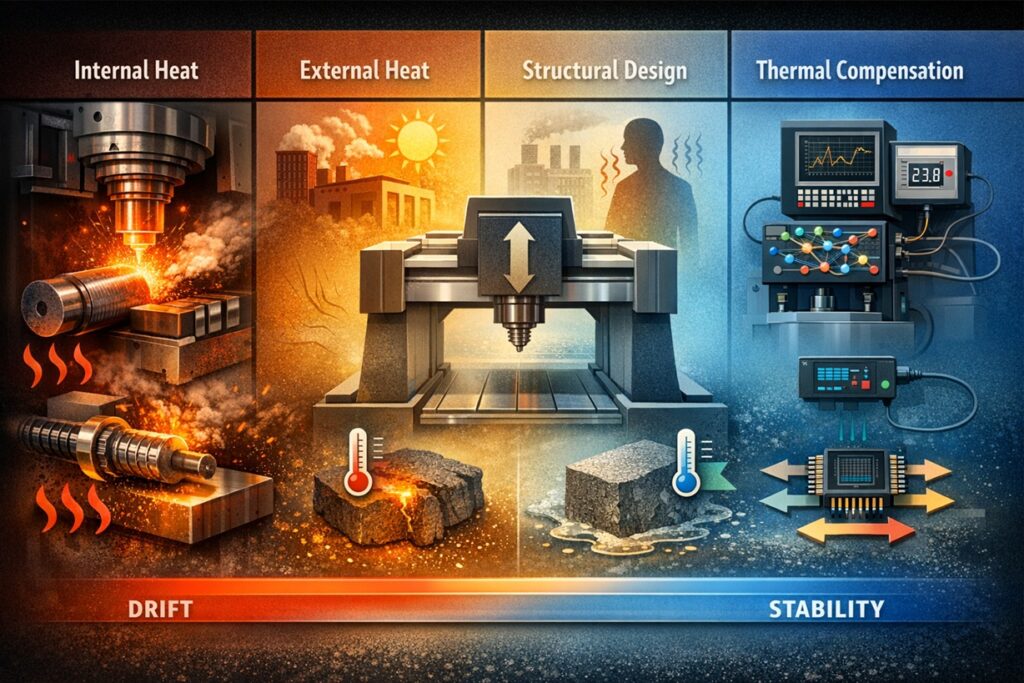
Achieving Quality Stability requires more than just high-resolution encoders; it demands a deterministic understanding of the Thermal Expansion Mechanism. As a machine runs, internal friction from the spindle bearings and hydraulic systems generates heat, while external environmental shifts alter the ambient temperature. This results in a non-linear “warm-up” period where the tool-center point (TCP) shifts relative to the workpiece, creating a direct conflict with the Process Capability (Cpk) required for high-tolerance components.
Quantifying the Precision Deficit
The impact of thermal instability on precision is often underestimated because it is time-dependent. Unlike static errors that can be easily calibrated, thermal errors are part of a Dynamic Drift Mechanism. To maintain Geometric Integrity, we must analyze the total error as a sum of static, dynamic, and thermal components.
Etotal = Estatic + Edynamic + Ethermal(t, T)
Equation 1.1: Total Volumetric Error Mechanism in Precision Grinding
Where Ethermal(t, T) is a function of both time (t) and temperature distribution (T). As global manufacturing moves toward Industry 4.0 standards, managing this variable is no longer an option but a necessity. This article will dissect the Heat Transfer Mechanisms within the machine tool and explore how advanced structural design and active compensation can defend sub-micron Precision against the volatility of thermal drift.
The Precision Axiom: “In the Mechanism of ultra-precision, stability is not just about rigidity; it is about thermal mastery. A machine that cannot manage its heat is a machine that cannot guarantee its accuracy.”
2. The Thermal Expansion Mechanism: Internal vs. External Heat Sources
To achieve high-precision grinding, one must first identify the thermal energy distribution within the machine tool. Every joule of energy wasted as heat acts as a catalyst for a Structural Deformation Mechanism. These sources are broadly classified into internal heat—generated by the machine’s own movements—and external heat, which originates from the surrounding factory environment.
Internal Heat: The Friction and Power Mechanism
The most significant internal heat source is the Spindle Assembly. At high rotational speeds, friction within the bearings and the electrical resistance of the motor create a localized heat zone. This energy flows through the spindle housing into the machine column, triggering a Thermal Tilt Mechanism. Similarly, the hydraulic systems powering the tool changers and the friction from the 이송계(Feed systems) generate heat that can expand the ball screws, leading to direct Positioning Errors.
External Heat: The Environmental Flux Mechanism
A machine tool is rarely in a state of thermal isolation. External heat sources include sunlight, HVAC cycles, and even the proximity of other machinery. The Convective Heat Transfer Mechanism at the machine surface causes the outer skin to expand at a different rate than the core, resulting in a “bending” effect. In ultra-precision grinding, even the body heat of an operator standing near the machine can induce a Thermal Drift of several microns.
ΔL = L0 · α · ΔT
Equation 2.1: The Linear Thermal Expansion Mechanism
Equation 2.1 defines the fundamental challenge: where α is the Coefficient of Thermal Expansion (CTE). For a 1-meter steel bed, a temperature change (ΔT) of just 1°C results in an 11.7 μm expansion. In a sub-micron grinding Mechanism, this level of drift is catastrophic for Quality Stability.
The Expansion Axiom: “Heat is inevitable, but its impact is a choice of design. To maintain Precision, we must either eliminate the heat source or master the Mechanism of its dissipation.”
3. Structural Symmetry and Geometric Stability Mechanism
When heat is present, the machine’s Structural Architecture determines how that energy is translated into dimensional error. The Geometric Stability Mechanism is a proactive design strategy that focuses on Symmetry. By designing the machine bed and column to expand uniformly around a central axis, engineers can ensure that even as the machine grows thermally, the Tool Center Point (TCP) remains aligned with the workpiece datum.
The Symmetric Design Mechanism
Asymmetric machine structures (such as C-frame designs) tend to “yaw” or “pitch” as one side heats up faster than the other. In contrast, Symmetric Portal or Bridge Designs utilize a Thermal Balance Mechanism. When heat is generated, the twin columns expand at the same rate, effectively lifting the spindle assembly straight up in the Y-axis without inducing angular tilt. This Self-Compensating Mechanism is the foundation of high-end grinding Precision.
Thermal Inertia and Material Mechanism
The choice of base material is critical for Thermal Damping. Conventional Cast Iron (GG25/30) has a high Thermal Diffusivity Mechanism, meaning it reacts quickly to temperature changes. Modern high-precision grinders often employ Mineral Casting (Polymer Concrete). This material has a much higher Thermal Inertia, meaning it absorbs and releases heat slowly, providing a Low-Pass Filter Mechanism against short-term ambient temperature fluctuations.
a = k / (ρ · Cp)
Equation 3.1: Thermal Diffusivity (a) and Structural Response Mechanism
The Structural Axiom: “Symmetry is the architecture of stability. In the Mechanism of thermal growth, if the machine must expand, it must do so without losing its Geometric Center.”
4. The Coolant-Base Synchronization Mechanism
In high-power grinding, the coolant is not just a lubricant; it is the primary Thermal Management Mechanism. However, a common Precision Gap occurs when the coolant temperature fluctuates independently of the machine bed’s temperature. To maintain sub-micron Accuracy, the coolant temperature must be synchronized with the machine’s structural temperature to prevent Thermal Shock and localized distortion.
The Thermal Equilibrium Mechanism
The Coolant-Base Synchronization Mechanism involves an active chiller system that references the machine bed’s temperature rather than a fixed ambient setpoint. By circulating coolant that is ±0.1°C of the bed temperature, the machine achieves a state of Thermal Equilibrium much faster. This eliminates the “Drift Curve” typically seen during the first two hours of production, ensuring that the first part produced is as accurate as the last.
Bed Showering and Internal Flushing Mechanism
Advanced grinding machines utilize a Structural Flushing Mechanism, where temperature-controlled coolant is pumped through internal cavities of the bed and column. This “Bed Showering” technique ensures that the entire Geometric Loop is kept at a constant temperature, effectively neutralizing the heat generated by the grinding wheel and spindle. This Active Cooling Mechanism is a prerequisite for Quality Stability in 24/7 automated production.
Qconv = h · A · (Tcoolant – Tbed)
Equation 4.1: Convective Heat Exchange Mechanism (where h is the heat transfer coefficient)
The Synchronization Axiom: “In the Mechanism of thermal stability, the absolute temperature is less important than the temperature difference. Stability is achieved when the coolant and the machine speak the same thermal language.”
5. Active Thermal Compensation: The Software Mechanism
Despite the most advanced symmetric designs and material choices, some level of thermal expansion is physically inevitable. In the pursuit of sub-micron Precision, manufacturers utilize an Active Thermal Compensation Mechanism. This is a software-driven strategy that uses real-time sensor data to predict and counteract thermal drift before it manifests as a dimensional error on the workpiece.
The Sensor-Based Feedback Mechanism
Modern grinding machines are embedded with multiple RTD (Resistance Temperature Detector) sensors at critical nodes: the spindle housing, the machine column, and the ambient environment. The Data Acquisition Mechanism continuously feeds this temperature map into the CNC controller. By applying a pre-calibrated Thermal Transfer Function, the controller calculates the expected expansion in real-time and applies an inverse offset to the machine axes.
The Predictive Modeling Mechanism
Advanced systems go beyond simple linear offsets by employing a Predictive Neural Mechanism. These models account for the Thermal Time Constant of the machine—the delay between a heat spike (e.g., a heavy roughing cycle) and the resulting structural expansion. This Anticipatory Mechanism ensures that the compensation remains accurate even during rapid process transitions, maintaining a stable Geometric Loop throughout the entire production shift.
δcomp = Σ [ Ki · (ΔTi) · (1 – e-t/τi) ]
Equation 5.1: Dynamic Thermal Compensation Mechanism (where τ is the time constant)
The Software Axiom: “If physics dictates that the machine will move, software must dictate that the axes follow. Compensation is the Mechanism that bridges the gap between mechanical reality and digital precision.”
6. Conclusion: Achieving Consistent Accuracy through Thermal Mastery
Thermal stability is not a static feature of a machine tool; it is a dynamic Mechanism that must be managed to ensure Precision in every cycle. As we have explored, the journey to sub-micron accuracy involves a multi-layered approach—from the fundamental Structural Architecture and symmetric design to the active synchronization of coolant and sophisticated software compensation.
The Roadmap to Thermal Excellence
To maintain high Process Capability (Cpk) and quality stability, manufacturers should prioritize the following thermal pillars:
- Structural Integrity: Choosing materials with high thermal inertia, such as mineral casting, to dampen the effect of environmental fluctuations.
- Active Control: Implementing the Coolant-Base Synchronization Mechanism to minimize the warm-up period and ensure Geometric Stability.
- Digital Defense: Utilizing the Software Compensation Mechanism to neutralize the final microns of inevitable thermal drift.
Ultimately, mastering temperature drift is about creating a predictable environment where the Material Removal Mechanism can operate without interference. In the world of high-end grinding, thermal mastery is the ultimate metric of a machine’s true Accuracy.
The Precision Standard
“Precision is the child of stability. A machine that masters its thermal Mechanism does not just measure quality—it guarantees it.”
References & Technical Resources
Primary Engineering References
- • Bryan, J. B. (1990). International Status of Thermal Error Research. CIRP Annals. (The foundational study on thermal drift mechanisms).
- • Slocum, A. H. (1992). Precision Machine Design. SME. (Principles of symmetric structural architecture).
- • Weck, M. (1984). Handbook of Machine Tools: Accuracy and Automation. Wiley. (Analysis of thermal compensation algorithms).
Internal Technical Deep-Dive
For a deeper understanding of how machine structure and process variables impact overall precision, explore the following resources from our technical library:
MACHINE STRUCTURE:
Machine Stiffness in Grinding: Why Structural Rigidity Affects Surface Quality
QUALITY & YIELD:
Process Capability (Cp, Cpk) in Grinding: Why Surface Integrity Matters for Yield
AEROSPACE TECHNOLOGY:
Grinding of Aerospace Alloys: Thermal Challenges and Process Solutions
GUIDEWAY SYSTEMS:
Hydrostatic vs Rolling Guideways in Grinding Machines: Practical Differences