1. Introduction: The Heart of the Grinding Process
In the architecture of a grinding machine, the spindle is more than just a motor—it is the primary Structural Interface that dictates the precision of the entire abrasive process. As the component responsible for holding and rotating the grinding wheel at extreme velocities, the spindle’s performance directly governs the Surface Integrity Mechanism and dimensional accuracy of the workpiece. Mastering the nuances of Grinding Spindle Design is essential for any manufacturer seeking to bridge the gap between theoretical specifications and real-world Quality Stability.
Rotational Fidelity and Dynamic Force
The core challenge in spindle engineering is maintaining Rotational Fidelity under heavy load. A grinding spindle must resist not only the static Grinding Forces but also the dynamic centrifugal forces generated by wheels rotating at peripheral speeds often exceeding 120 m/s. Any deviation in “Run-out” or “Thermal Growth” acts as a Disturbance Mechanism, leading to chatter marks, out-of-roundness, and a premature degradation of Process Capability (Cpk).
The Interplay of Bearings, Speed, and Heat
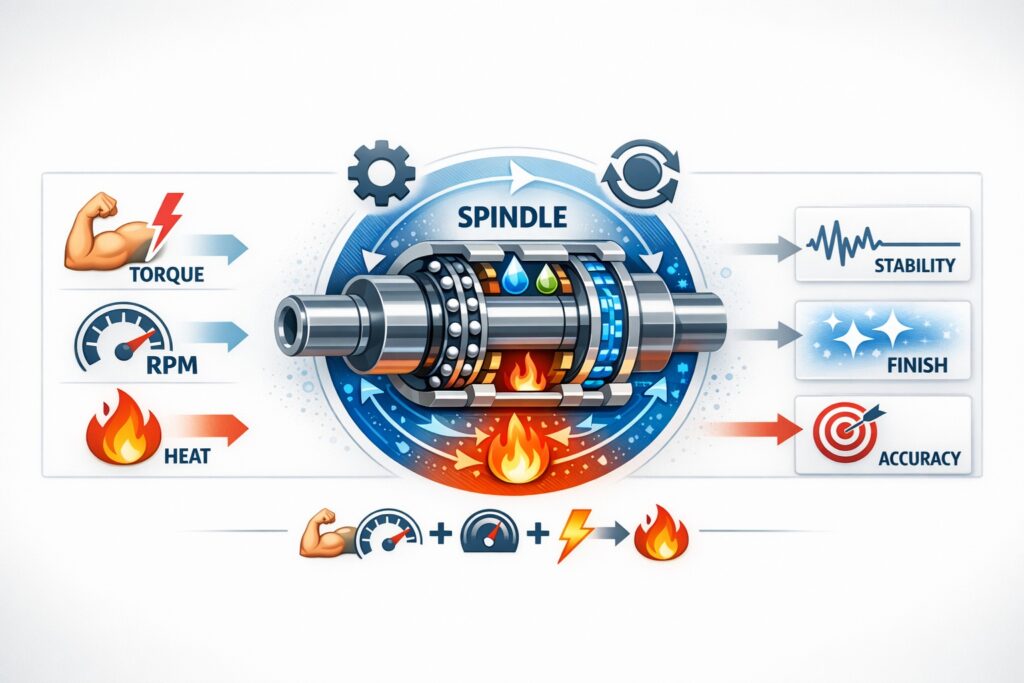
To understand the spindle is to understand the trade-offs between bearing technology and heat management. The choice of the Bearing Support Mechanism—whether rolling, hydrostatic, or aerodynamic—defines the spindle’s speed range and load capacity. However, as speed increases, so does the Heat Generation Mechanism. Managing this thermal flux is the final frontier in maintaining a stable Geometric Loop, ensuring that the spindle remains precise from the first part to the last in a 24/7 production cycle.
Pspindle = (T · n) / 9550 + Qloss
Equation 1.1: Spindle Power Balance and Heat Loss Mechanism
Where Pspindle represents the total input power, and Qloss is the energy converted into heat within the bearings and motor windings. As global engineering pushes toward higher productivity and tighter tolerances, analyzing these variables becomes a deterministic necessity. This article will dissect the Internal Mechanisms of spindle design, providing a practical guide to selecting the right technology for your precision requirements.
2. Spindle Bearing Mechanisms: Selecting the Support System
The bearing system is the primary Load-Bearing Mechanism that defines the spindle’s stiffness and rotational accuracy. In grinding, where radial and axial forces fluctuate rapidly, the choice of bearing determines the Dynamic Stability of the process. Each bearing type operates on a distinct physical principle—ranging from mechanical contact to fluid film separation—directly impacting the machine’s Precision Lifecycle.
Rolling Element Bearings: The Rigidity Mechanism
High-precision Angular Contact Ball Bearings are the industry standard for versatile grinding spindles. The use of Ceramic (Silicon Nitride) Balls has revolutionized this mechanism by reducing centrifugal forces and friction at high RPMs. These bearings provide exceptional Static Stiffness through controlled preloading. However, because they rely on Point Contact, they have a finite fatigue life and lower vibration damping compared to fluid-based systems.
Hydrostatic and Hydrodynamic Mechanisms
For ultra-precision and heavy-duty applications, Fluid Film Bearings offer a superior Damping Mechanism. Hydrostatic bearings utilize externally pressurized oil to float the spindle shaft, ensuring zero metal-to-metal contact even at zero RPM. This Non-Contact Mechanism eliminates mechanical wear and provides a “Surface Averaging” effect that minimizes run-out. Hydrodynamic bearings, conversely, generate their own pressure through rotation, making them highly effective for high-speed, constant-load operations where vibration suppression is critical for Surface Integrity.
Kbearing = dF / dδ
Equation 2.1: Bearing Stiffness Mechanism (Force per unit deflection)
Aerostatic (Air) Bearing Mechanisms
In micro-grinding and semiconductor processing, where speeds exceed 100,000 RPM, Air Bearings represent the pinnacle of Rotational Precision. Using a thin film of pressurized air, this Aerostatic Mechanism offers the lowest possible friction and zero thermal contamination from lubricant. While their load capacity is lower than oil-based systems, their ability to maintain sub-micron run-out at extreme velocities is unmatched for Ultra-Precision Grinding.
3. The Speed-Torque Mechanism: Matching Power to the Cut
In grinding, the spindle motor must deliver a precise balance of rotational speed and twisting force. This Speed-Torque Mechanism is the engine of productivity, defining how much material can be removed without stalling the spindle or compromising Surface Integrity. The relationship between these two variables is non-linear and is governed by the electromagnetic limits of the motor drive and the mechanical capabilities of the spindle assembly.
Constant Torque vs. Constant Power Regions
A high-performance grinding spindle operates across two distinct zones. In the Constant Torque Mechanism (at lower RPMs), the motor provides maximum force for heavy-duty roughing or creep-feed grinding where the contact area is large. As the RPM increases beyond the “Base Speed,” the motor enters the Constant Power Mechanism. Here, the torque drops as the speed rises, which is ideal for finishing operations where high Peripheral Wheel Speeds are required but the cutting forces are relatively low.
High-Speed Grinding (HSG) and Centrifugal Mechanism
As global manufacturing pushes toward High-Speed Grinding, the centrifugal forces within the spindle become a critical Failure Mechanism. At speeds exceeding 30,000 RPM, the physical expansion of the spindle shaft can alter bearing preloads, potentially leading to thermal seizure. Managing the Dynamic Balancing Mechanism is therefore mandatory; even a few grams of imbalance at high velocity can generate vibration forces that bypass the machine’s damping systems and appear as “shadow marks” on the finished surface.
P (kW) = (T (Nm) · n (rpm)) / 9550
Equation 3.1: The Fundamental Spindle Power Mechanism
Motor Inertia and Acceleration Mechanism
The responsiveness of the spindle—how quickly it reaches its target RPM—is a function of the Inertia Matching Mechanism. In automated lines where “air-cutting” time must be minimized, low-inertia motors provide rapid acceleration. However, for heavy-duty grinding of hardened alloys, a higher-inertia spindle provides a “Mechanical Flywheel” effect that stabilizes the Rotational Velocity against the intermittent shock loads of the abrasive grains hitting the workpiece.
4. Heat Generation and Dissipation Mechanisms
Thermal management is the final frontier in Grinding Spindle Design. Because a spindle is a high-speed rotating mass with tight internal clearances, it acts as a Heat Generation Mechanism through both mechanical friction and electrical resistance. If this thermal energy is not actively dissipated, the spindle shaft will undergo Axial Thermal Expansion, shifting the grinding wheel position by several microns and destroying the Dimensional Precision of the process.
The Friction and Viscous Shear Mechanism
In rolling-element spindles, heat is primarily generated by the Rolling Friction Mechanism within the bearing raceways. As the RPM increases, the lubricant (grease or oil-air) is subjected to Viscous Shearing, further contributing to the thermal load. In fluid-film spindles (hydrostatic), the heat generation is even more pronounced due to the constant shearing of the oil film between the stationary housing and the rotating shaft, requiring a high-capacity Thermal Chilling Mechanism.
The Motorized Spindle Heat Mechanism
Built-in or motorized spindles introduce an additional heat source: the Electromagnetic Loss Mechanism. Both copper losses (I2R) in the stator windings and iron losses in the rotor generate significant heat directly inside the spindle housing. Without an integrated Liquid Cooling Jacket, this heat would flow directly into the bearings, leading to premature failure and Thermal Drift of the spindle nose.
Qtotal = Qbearing + Qmotor + Qcutting
Equation 4.1: Total Thermal Flux Mechanism of a Grinding Spindle
Active Dissipation and Thermal Synchronization
To counter these effects, high-precision spindles employ a Controlled Dissipation Mechanism. This typically involves a recirculating chiller system that pumps oil or water-glycol through the spindle sleeve. The most advanced systems utilize Differential Temperature Control, where the spindle temperature is synchronized with the machine bed’s temperature. This Thermal Equilibrium Mechanism ensures that the entire machine expands and contracts as a single unit, preserving the Geometric Integrity of the grinding path.
5. Spindle Integration: Belt-Driven vs. Built-in Motors
The method of delivering power to the spindle shaft is a fundamental Machine Architecture decision. This Integration Mechanism determines the spindle’s vibration profile, its ability to damp harmonic frequencies, and the overall complexity of its thermal management. Choosing between a traditional Belt-Driven Mechanism and a modern Built-in (Motorized) Mechanism requires a strategic trade-off between torque amplification and rotational precision.
The Belt-Driven Mechanism: Vibration Isolation
In a belt-driven configuration, the motor is mounted externally, and power is transferred via high-tension reinforced belts. This provides a natural Vibration Isolation Mechanism, as the belt material acts as a damping buffer that prevents motor electrical noise and rotor vibrations from reaching the grinding wheel. Furthermore, by varying the pulley ratios, this system offers a Torque Multiplication Mechanism, making it ideal for heavy-duty grinding applications where high force at low RPM is required.
The Built-in Motorized Mechanism: High-Dynamic Response
In a motorized spindle, the motor’s rotor is shrunk-fit directly onto the spindle shaft, creating a single Integrated Rotating Mass. This Direct-Drive Mechanism eliminates the side-loading forces of belts, allowing for superior Rotational Accuracy and higher maximum RPMs. Because there is no mechanical transmission loss, the Dynamic Response Mechanism is exceptionally fast, which is critical for high-speed “peel grinding” or applications requiring rapid spindle indexing.
ηtotal = ηmotor · ηtransmission
Equation 5.1: Efficiency Mechanism of Spindle Power Transmission
The Bearings-Motor Interface Challenge
While built-in spindles offer compactness and precision, they introduce a significant Structural Challenge: the motor’s heat is generated in close proximity to the bearings. This necessitates a sophisticated Thermal Isolation Mechanism. Belt-driven spindles, by contrast, keep the primary heat source (the motor) away from the precision bearings, naturally enhancing Geometric Stability without the need for complex internal cooling jackets.
6. Conclusion: Choosing the Right Spindle for Quality Stability
The selection of a grinding spindle is a deterministic decision that defines the boundaries of your Process Capability (Cpk). As we have explored, the spindle is not a standalone component but a complex Integration Mechanism of bearing technology, electromagnetic power, and thermal management. Understanding these internal dynamics is the only way to ensure Quality Stability in a high-precision manufacturing environment.
A Strategic Selection Framework
To achieve consistent Accuracy, the spindle specification must be matched to the Material Removal Mechanism of the application:
- For High-Volume Industrial Parts: Prioritize the Belt-Driven Mechanism with ceramic rolling bearings for a balance of torque, vibration isolation, and ease of maintenance.
- For Ultra-Precision & Mirror Finishes: Invest in the Hydrostatic Damping Mechanism to eliminate rotational run-out and maximize surface integrity.
- For High-Speed & Micro-Grinding: Utilize Built-in Motorized Spindles with aerostatic bearings to reach extreme RPMs without thermal contamination.
Ultimately, the “best” spindle is the one that maintains its Geometric Loop under the specific thermal and mechanical stresses of your production floor. By mastering the Mechanism of Spindle Design, manufacturers can transition from reactive troubleshooting to proactive precision management.
The Heart of Precision
“In the Mechanism of grinding, the spindle is where power meets precision. A well-designed spindle does not just rotate a wheel; it stabilizes the entire future of the product.”
References & Technical Resources
Primary Engineering References
- • Gieras, J. F. (2008). Advancements in Electric Machines. Springer. (Design of high-speed built-in spindle motors).
- • Rowe, W. B. (2014). Principles of Modern Grinding Technology. William Andrew. (Comprehensive analysis of spindle bearing stiffness and damping).
- • Altintas, Y. (2012). Manufacturing Automation: Metal Cutting Mechanics, Machine Tool Vibrations, and CNC Design. Cambridge University Press.
Internal Technical Deep-Dive
To further integrate your understanding of spindle performance within the broader machine structure and operational limits, please refer to the following modules from our library:
SPECIFICATION SELECTION:
Grinding Machine Power and Spindle Torque: How Much Is Really Needed?
OPERATIONAL LIMITS:
Wheel Speed Limits in Grinding Machines: Safety, Heat, and Productivity Trade-Offs
ACCURACY MASTERY:
Thermal Stability of Grinding Machines: How Temperature Drift Impacts Accuracy
STRUCTURAL RIGIDITY:
Machine Stiffness in Grinding: Why Structural Rigidity Affects Surface Quality