1. Introduction: The Paradigm Shift in Grinding Safety
In the modern landscape of high-speed manufacturing, the Grinding Machine Enclosure has evolved from a passive sheet-metal barrier into a sophisticated, integrated Safety System. As abrasive technologies push the boundaries of peripheral speeds—often exceeding 60-120 m/s—the kinetic energy stored within a rotating grinding wheel presents a significant ballistic risk. This chapter explores the fundamental tension between the escalating demands of Global Compliance and the economic realities of Total Manufacturing Cost, establishing safety not as a burden, but as a prerequisite for precision.
Beyond Containment: The Holistic Safety System
Traditional safety perspectives often viewed the machine enclosure as a mere “splash guard” intended to contain coolant. However, in the context of Industry 4.0, an enclosure is the primary interface for Environmental Control. It must manage the Mechanism of energy dissipation during a wheel burst while simultaneously providing a sealed environment for high-pressure mist collection and noise attenuation. A failure to recognize the enclosure as a multi-functional component leads to a dangerous compromise in Process Reliability and operator well-being.
The Convergence of Law and Engineering
The intersection of Compliance and machine design is no longer optional. Regulatory frameworks such as ISO 16089 and OSHA guidelines dictate specific Performance Levels (PL) for interlocking systems and impact resistance. For a manufacturer, “Compliance” represents a legal shield against the catastrophic Non-compliance Costs associated with workplace accidents, including litigation, downtime, and insurance premiums. Thus, the engineering of a safety system is a deterministic exercise in risk mitigation that directly impacts the company’s ESG (Environmental, Social, and Governance) standing.
Ek = ½ × I × ω² → Fimpact = Δ(mv) / Δt
Equation 1.1: Kinetic Energy and Impact Force Mechanism during Wheel Fragmentation
Defining the Scope: Cost vs. Compliance
The central challenge for operations managers is the optimization of Capital Expenditure (CAPEX) versus the mandatory requirements of safety standards. High-end enclosures featuring reinforced polycarbonate viewing windows and automated fire suppression systems represent a significant investment. However, when analyzed through the lens of Quality Stability and long-term Operational Efficiency, these systems often yield a superior ROI by preventing the “hidden costs” of atmospheric contamination and unplanned machine stoppages.
In the following sections, we will dissect the technical Mechanisms of safety enclosures, analyze the global regulatory landscape, and provide a quantitative framework for balancing safety investments against operational performance. By establishing a clear understanding of these variables, we can move toward a manufacturing environment where Safety Systems are viewed as a driver of competitive advantage rather than a mere regulatory hurdle.
| Safety Domain | Technical Core Mechanism | Compliance Objective |
|---|---|---|
| Mechanical Safety | Impact-resistant containment walls & Interlocks. | Prevention of ballistic injury from wheel burst. |
| Health & Environment | Aerosol filtration & Mist collection systems. | Adherence to PEL (Permissible Exposure Limits). |
| Fire Suppression | Automatic CO2 or Dry-powder trigger mechanism. | Risk mitigation in Oil-based grinding processes. |
| Acoustic Control | Sound-dampening insulation & vibration isolation. | Compliance with Noise-at-Work regulations. |
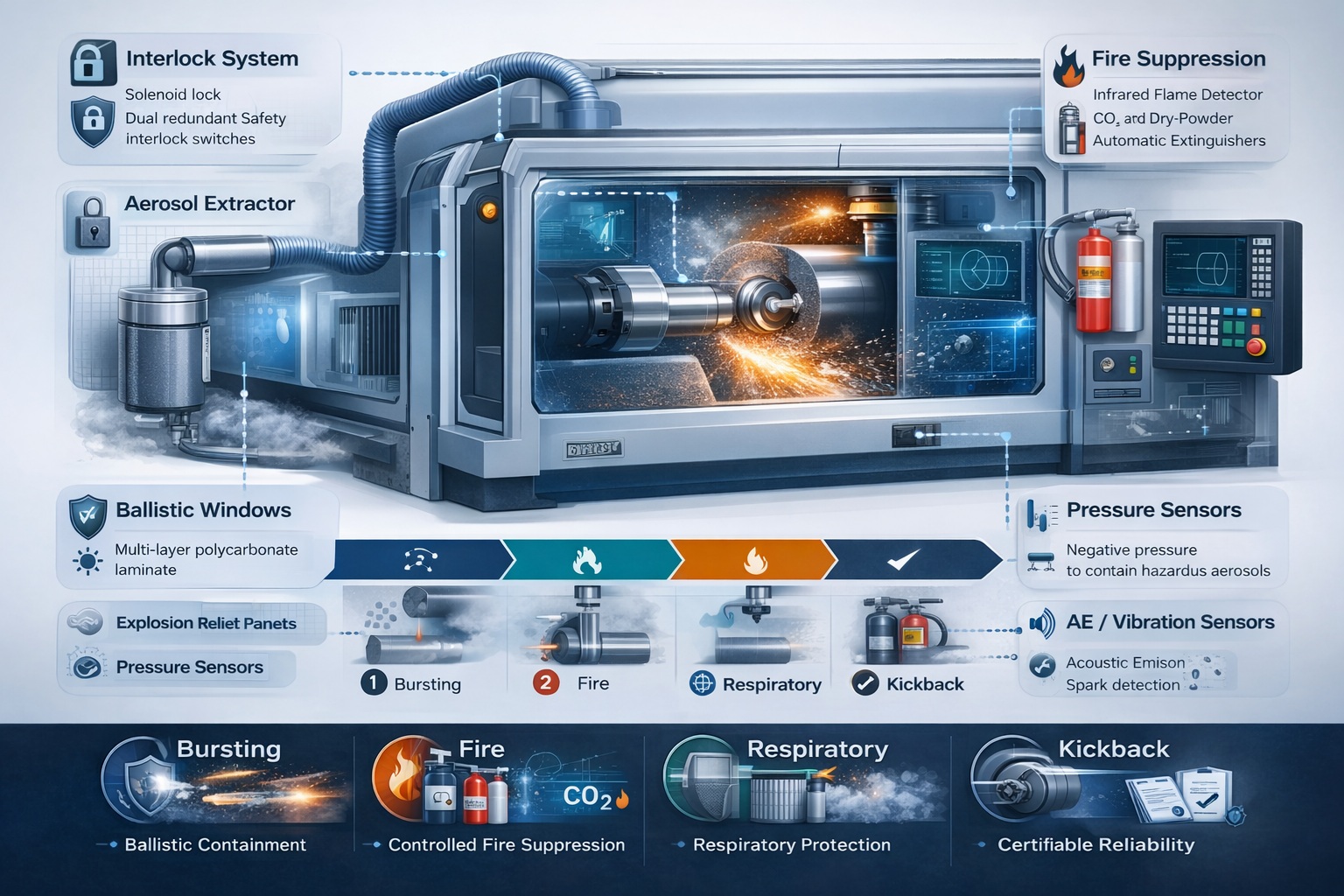
2. Major Hazards and Accident Mechanisms in Grinding Operations
The grinding process is characterized by extremely high Rotational Energy and the generation of localized high-temperature zones. Unlike conventional cutting tools, a grinding wheel is a composite structure held together by bonding agents, making it susceptible to Brittle Fracture under excessive centrifugal or thermal stress. Understanding the fundamental Mechanism of these hazards is the first step in designing an effective Compliance strategy that addresses both immediate physical risks and long-term health hazards.
The Mechanism of Wheel Burst (Bursting)
The most catastrophic event in a grinding shop is a Wheel Burst. When a wheel rotating at 60 m/s or higher fails, it releases its stored Kinetic Energy instantaneously, effectively turning into high-velocity shrapnel. The primary Mechanism of failure is often linked to centrifugal hoop stress exceeding the tensile strength of the bond. Factors such as improper mounting, unbalanced wheels, or undetected micro-cracks from previous impacts act as catalysts. Without a robust Enclosure, these fragments can penetrate standard workspace barriers, leading to fatal consequences.
σmax = ρ · vs² · [(3 + ν) / 8]
Equation 2.1: Maximum Hoop Stress (σ) in a Rotating Disk based on Density (ρ) and Peripheral Speed (vs)
Thermal Hazards and Grinding Mist Flammability
Grinding generates significant Specific Energy, much of which is converted into heat at the grinding zone. In oil-based grinding operations, this heat can reach the flashpoint of the coolant, creating a highly flammable Oil Mist. The Mechanism of ignition often involves “grinding sparks”—incandescent metal particles—interacting with a saturated mist environment within the enclosure. Advanced Safety Systems must therefore include not only physical containment but also specialized Fire Suppression sensors to detect and extinguish flames before they escalate into a factory-wide fire.
Respiratory Risks: The Mechanism of Fine Dust Propagation
Beyond immediate physical trauma, the Health Hazards associated with grinding dust are a critical focus of Global Compliance. The abrasive grains and metal chips are pulverized into Particulate Matter (PM2.5 and PM10). The air-flow Mechanism created by the high-speed rotation of the wheel (the “pumping effect”) carries these particles out of the grinding zone. If the Enclosure is not properly sealed or vented, these particulates pose severe respiratory risks, necessitating Integrated Filtration to maintain Environmental Safety.
Workpiece Ejection and Mechanical Kickback
Mechanical Kickback occurs when the friction force between the wheel and the workpiece suddenly increases, often due to an excessive Infeed Rate or a power failure. This force can eject the workpiece at lethal speeds. A compliant Safety System must account for this Mechanism by ensuring that the clamping systems are interlocked with the spindle and that the Enclosure materials are rated for Impact Resistance against the specific mass and geometry of the parts being processed.
| Hazard Category | Failure Mechanism | Enclosure Mitigation Requirement |
|---|---|---|
| Kinetic (Bursting) | Centrifugal stress exceeding bond strength. | Ballistic-rated steel or reinforced polycarbonate. |
| Thermal/Fire | Ignition of oil mist via grinding sparks. | Explosion relief panels & fire suppression. |
| Respiratory | Airborne propagation of PM2.5/PM10. | Negative pressure seals & mist extraction. |
| Acoustic | High-frequency vibration & air turbulence. | Sound-dampening composite layering. |
3. Technical Configuration of Enclosures and Safety Systems
A modern grinding machine enclosure is a multi-layered Engineered Barrier designed to manage extreme energy states. Beyond simple containment, the technical configuration must integrate structural integrity with automated Safety Systems. This ensures that the machine remains a closed ecosystem, protecting the operator from mechanical, chemical, and acoustic hazards while maintaining the Process Reliability required for high-precision manufacturing.
Structural Design and Material Impact Resistance
The primary Mechanism for protecting against wheel fragmentation is the energy-absorbing capability of the enclosure walls. For high-speed grinding, standard sheet metal is insufficient. Engineers utilize a combination of Reinforced Steel and Laminated Polycarbonate viewing windows. The thickness of these materials is calculated based on the maximum kinetic energy of the wheel. The design must ensure that in the event of a burst, the enclosure undergoes Plastic Deformation to absorb the impact without catastrophic breach or fragment penetration.
The Interlock System: Logic and Control Mechanism
The Interlock System is the critical link between the enclosure’s physical state and the CNC’s operational logic. Using redundant Safety Limit Switches, the controller prevents the spindle from starting if the door is ajar. More importantly, it manages the Mechanism of “Inertial Rundown.” Since a large grinding wheel can take minutes to stop, the interlock must include a Solenoid Locking Bolt that prevents the door from being opened until the spindle has reached a zero-speed state, as verified by a safety-rated frequency inverter.
tsafe_open = tstop + tmargin (Where fspindle < 0.1 Hz)
Equation 3.1: Safety Interlock Timing Logic for Delayed Door Opening
Mist Extraction and Negative Pressure Management
To prevent the escape of oil mist and dust, the enclosure must operate under constant Negative Pressure. The extraction Mechanism involves high-efficiency centrifuges or electrostatic precipitators that pull contaminated air through a multi-stage filtering process. By maintaining a pressure differential between the interior and the shop floor, the system ensures that hazardous aerosols are contained even during small seal leaks, directly supporting Environmental Compliance standards.
Integrated Monitoring and Fire Detection Sensors
Advanced enclosures are equipped with “Digital Senses”—a suite of sensors that monitor the internal environment. Acoustic Emission (AE) Sensors can detect the vibration frequency of a failing bond before a burst occurs, allowing the CNC to initiate an Emergency Stop. Simultaneously, infrared Flame Detectors monitor the grinding zone. If a fire starts due to coolant ignition, the system instantaneously closes the extraction dampers and triggers a CO2 suppression sequence, minimizing damage to the machine’s Dimensional Accuracy and internal hardware.
| Component | Technical Mechanism | Operational Benefit |
|---|---|---|
| Ballistic Windows | Multi-layer polycarbonate laminate. | Safe visibility without risk of fragment penetration. |
| Safety Controller | Redundant Dual-Channel I/O monitoring. | Prevention of accidental startup (PLd/PLe compliance). |
| Aerosol Extractor | Centrifugal air-oil separation. | Clean work environment and coolant recycling. |
| Pressure Sensors | Real-time differential pressure tracking. | Verification of containment integrity during operation. |
4. Global Safety Regulations and Standards Analysis
Navigating the complex landscape of Global Compliance is a fundamental requirement for machine tool manufacturers and end-users alike. Safety standards are not merely suggestions but strictly enforced legal frameworks that define the minimum Technical Configuration for hazardous equipment. For grinding machines, these regulations focus on the containment of kinetic energy and the reliability of electronic control systems, ensuring a deterministic level of Operational Safety across international borders.
ISO 16089: The Universal Standard for Grinding Machine Safety
The ISO 16089 standard is the specialized “Type-C” standard that governs the safety of stationary grinding machines. It provides the definitive Mechanism for risk assessment, specifically addressing the hazards of wheel fragmentation. A key requirement of ISO 16089 is the mandatory Impact Test for enclosures, where the barrier must prove its ability to contain a fragment of a specific mass traveling at 1.1 times the maximum peripheral speed. Compliance with this standard is the primary benchmark for achieving Quality Stability in safety engineering.
CE Marking and the Machinery Directive (2006/42/EC)
For machines operating within the European Economic Area, the CE Mark is a mandatory declaration of conformity. The Machinery Directive dictates the essential health and safety requirements (EHSR) that must be met. A critical technical aspect under this directive is the Functional Safety of the control system, typically measured by Performance Levels (PL) according to EN ISO 13849-1. For grinding machines, safety-related parts of the control system must often reach PLd or PLe to ensure that a single component failure does not lead to the loss of a safety function.
Risk Score = S (Severity) × F (Frequency) × P (Probability)
Equation 4.1: Quantitative Risk Assessment Mechanism for Safety Integrity Level (SIL)
OSHA Standards and KOSHA Guidelines
In the United States, OSHA 1910.215 provides specific requirements for abrasive wheel machinery, focusing on the maximum allowable Guard Opening and the structural integrity of work rests. Similarly, in South Korea, KOSHA (Korea Occupational Safety and Health Agency) provides detailed guidelines that align with international norms but emphasize localized Compliance procedures. Failure to meet these workplace-specific standards can result in severe Non-compliance Costs, including legal penalties and mandatory operational shutdowns.
Harmonization of Safety and Environmental Regulations
Modern regulations increasingly overlap with Environmental Compliance. Standards such as the ATEX Directive (for explosive atmospheres) become relevant when grinding metals like aluminum or magnesium, where the dust can become combustible. Therefore, the safety Mechanism of the machine must be harmonized across multiple regulatory layers—mechanical, electrical, and environmental—to provide a comprehensive Safety Shield for the enterprise.
| Standard / Regulation | Core Technical Focus | Compliance Outcome |
|---|---|---|
| ISO 16089 | Ballistic impact containment & risk assessment. | Global benchmark for grinding machine safety. |
| EN ISO 13849-1 | Functional safety & Performance Levels (PL). | Deterministic reliability of safety electronics. |
| OSHA 1910.215 | Mechanical guarding and work rest adjustment. | Legal compliance for U.S. manufacturing sites. |
| ATEX 2014/34/EU | Combustible dust & explosive atmosphere control. | Prevention of catastrophic secondary explosions. |
5. Cost vs. Compliance: Economic Feasibility Analysis
In the competitive world of precision manufacturing, the decision to invest in advanced Safety Systems is often viewed through the lens of Capital Expenditure (CAPEX). However, a purely cost-driven approach that neglects Compliance can lead to catastrophic financial liabilities. This chapter performs a deterministic analysis of the Economic Feasibility of safety investments, contrasting the upfront costs of high-end enclosures with the long-term ROI derived from risk mitigation and operational uptime.
Breakdown of Safety Investment Costs (CAPEX & OPEX)
The Total Cost of Ownership (TCO) for a compliant safety system includes more than just the purchase price. CAPEX encompasses the structural reinforcement of the enclosure, high-speed interlocking hardware, and integrated fire suppression modules. Meanwhile, Operating Expenditure (OPEX) involves the periodic Mechanism of sensor calibration, HEPA filter replacement, and safety software updates. While these costs can increase the initial machine price by 15-25%, they are essential for maintaining Quality Stability and avoiding unplanned maintenance cycles.
The Hidden Costs of Non-Compliance
The “Cost of Non-compliance” is a lagging indicator that often surfaces only after a failure. When a Mechanism fails in a non-compliant machine—such as a wheel burst breaching a weak enclosure—the financial impact is exponential. This includes direct costs (legal fines, medical compensation, machine repair) and indirect costs (production downtime, loss of reputation, and increased insurance premiums). In high-volume sectors like automotive components, a single week of Shutdown Downtime can exceed the entire cost of the safety system itself.
ROIsafety = (Σ Expected Lossunmitigated – Σ Costsafety) / Σ Costsafety
Equation 5.1: Return on Investment Logic for Safety and Compliance Systems
Strategic Benefits: Productivity and Employee Retention
Beyond risk avoidance, advanced Enclosure Systems contribute to Process Reliability. A clean, quiet, and vibration-isolated environment allows the machine to operate at higher Cutting Velocities without endangering the operator. Furthermore, a commitment to Global Compliance enhances Employee Retention by fostering a culture of safety. In the modern labor market, the perceived safety of a facility is a key factor in attracting highly skilled CNC technicians, indirectly reducing Total Manufacturing Cost through increased efficiency.
Quantifying the ROI of Compliance
A comprehensive Economic Analysis must account for the extension of machine life-cycle. A fully enclosed and filtered system prevents the Mechanism of abrasive dust contamination on sensitive linear guides and spindles. By reducing wear on these high-precision components, the Dimensional Accuracy of the machine is preserved for a longer duration. Thus, the investment in Compliance acts as a form of “Insurance Policy” for the machine’s most critical assets, ensuring long-term Quality Stability.
| Economic Factor | Investment Requirement | Financial Outcome (Benefit) |
|---|---|---|
| Direct Investment | High-impact materials & Interlocks. | Zero legal penalties & reduced insurance costs. |
| Health & Environment | Mist extraction & HEPA filtration. | Minimal sick leave & high workplace morale. |
| Machine Longevity | Sealed environment & thermal control. | Reduced OPEX for component repair/replacement. |
| Brand Equity | Adherence to ISO/CE standards. | Preferential status in Tier-1 supply chains. |
6. Industrial Case Studies: Safety in Practice
Theoretical Compliance and technical specifications reach their true value when tested in the rigorous environment of the factory floor. This chapter examines real-world Case Studies across diverse sectors, illustrating the Mechanism by which integrated Safety Systems prevent catastrophic failures and enhance Process Reliability. These examples serve as a benchmark for organizations seeking to balance Total Manufacturing Cost with uncompromising safety standards.
Case Study A: High-Speed Turbine Blade Grinding (Aerospace)
In the aerospace sector, nickel-based superalloys are ground at extremely high peripheral speeds. A Tier-1 supplier implemented an ISO 16089 compliant enclosure featuring 50mm reinforced ballistic glass and a dual-channel Interlock System. During a routine production run, a structural flaw in a vitrified CBN wheel caused a high-energy Wheel Burst at 100 m/s. The Mechanism of energy absorption within the enclosure prevented any external fragment penetration, allowing the machine to be safely shut down by the CNC’s Emergency Logic without injury to the operator.
Case Study B: High-Volume Crankshaft Grinding (Automotive)
An automotive engine plant utilized oil-based coolant for crankshaft grinding, leading to persistent issues with Oil Mist accumulation. By upgrading to an enclosure with an integrated Mist Extraction system and negative pressure monitoring, the facility achieved Environmental Compliance with OSHA’s PEL (Permissible Exposure Limits). The data-driven Mechanism of air-quality monitoring reduced respiratory-related sick leave by 40%, while the Fire Suppression sensors successfully intercepted a localized ignition event, preventing a total loss of the Capital Expenditure (CAPEX) asset.
MTBFsafety-enhanced / MTBFstandard ≈ 1.35 (35% Improvement in Mean Time Between Failures)
Equation 6.1: Impact of Integrated Safety Systems on Machine Uptime and Process Reliability
Case Study C: SMEs and Low-Cost Safety Retrofitting
Small and Medium Enterprises (SMEs) often face challenges with the high cost of new Enclosure Systems. A specialized tool-and-die shop implemented a Retrofitting Strategy, adding modular guarding and safety-rated light curtains to legacy manual grinding machines. This Mechanism allowed for Global Compliance at a fraction of the cost of a new machine. The result was not only a safer work environment but also an improvement in Quality Stability, as the reduction in ambient noise and vibration improved operator focus during the Fine-Feed grinding stages.
Lessons Learned: The Predictive Power of Compliance
The common thread in these success stories is the transition from reactive to Predictive Safety. By utilizing Acoustic Emission (AE) and vibration sensors within the enclosure, these companies were able to identify the Mechanism of impending failure before an accident occurred. This synergy between Safety Systems and machine diagnostics proves that Compliance is the primary driver of a “Zero-Defect” and “Zero-Accident” manufacturing philosophy, significantly lowering the Total Manufacturing Cost over the machine’s life-cycle.
| Industry Sector | Safety Challenge | Implemented Solution & Outcome |
|---|---|---|
| Aerospace | Extreme kinetic energy during wheel burst. | Ballistic enclosure; 100% containment of fragments. |
| Automotive | Toxic mist & high fire risk in oil grinding. | Mist extraction & CO2 fire suppression; 40% health improvement. |
| Medical/Tooling | Micro-dust exposure in cleanroom environments. | HEPA-filtered enclosures; maintained sub-micron purity. |
| General Precision | Excessive high-frequency noise & vibration. | Composite sound-dampening panels; achieved < 75dB(A). |
7. Conclusion and Future Outlook: The Evolution of Smart Safety
As we have analyzed through the preceding chapters, the Grinding Machine Enclosure and its associated Safety Systems are no longer auxiliary components but central pillars of modern manufacturing. The deterministic Mechanism of risk mitigation—balancing high-speed kinetic containment with sophisticated electronic Compliance—is the only sustainable path to Quality Stability and long-term Economic Feasibility. In an era of increasing regulatory scrutiny, safety is the ultimate driver of Process Reliability.
The Paradigm of Smart Safety and AI Integration
The future of grinding safety lies in the transition from passive containment to Predictive Intelligence. Emerging Smart Safety systems utilize AI-driven Algorithms to monitor the Mechanism of vibration and acoustic emissions in real-time. By training neural networks on thousands of hours of grinding data, these systems can predict a Wheel Burst seconds before it occurs, initiating a controlled deceleration that prevents a catastrophic event entirely. This move toward “Self-Aware” machinery will redefine Global Compliance standards in the coming decade.
Digital Twins: Simulating Safety Before the Cut
The implementation of Digital Twin technology allows engineers to simulate the Mechanism of energy dissipation within an enclosure before the physical machine is even built. Virtual Impact Tests can optimize the thickness and material composition of Safety Barriers, reducing Capital Expenditure (CAPEX) while ensuring maximum protection. This digital-first approach ensures that Dimensional Accuracy and Surface Integrity are never compromised by the structural vibrations of the safety enclosure itself.
Safety as a Competitive Advantage
“In high-precision grinding, the boundary between a high-performance machine and a hazardous tool is defined by its Safety System. True engineering excellence lies in the master of the enclosure that protects the creator as much as the creation.”
References & Technical Resources
- • ISO 16089:2015. Machine tools — Safety — Stationary grinding machines. International Organization for Standardization.
- • Malkin, S., & Guo, C. (2008). Grinding Technology: Theory and Applications of Machining with Abrasives. Industrial Press Inc.
- • EN ISO 13849-1. Safety of machinery — Safety-related parts of control systems — Part 1: General principles for design.
- • Klocke, F. (2009). Manufacturing Processes 2: Grinding, Honing, Lapping. Springer Science & Business Media.
- • OSHA 1910.215. Abrasive wheel machinery – Guarding and Safety Standards. Occupational Safety and Health Administration.
Internal Technical Deep-Dive
To further integrate your understanding of how machine structures and safety compliance impact overall production efficiency, please refer to the following specialized modules from our library:
SYSTEM CONTROL:
CNC Control Functions That Matter in Grinding Applications
REGULATION & COST:
Environmental Compliance Cost: Quantifying Coolant Waste and Safety Regulation Expenses
RISK ANALYSIS:
High-Speed Grinding vs Conventional Grinding: Cost and Risk Trade-Offs
FUTURE TECHNOLOGY:
Sensor-Based Grinding Monitoring: Cost vs Benefit Analysis