1. Introduction: The Dynamic Pulse of Precision Grinding
In the realm of high-precision manufacturing, the stability of the grinding process is dictated by the harmonic relationship between the machine structure and the rotating abrasive tool. At the core of this relationship is the Grinding Wheel Balance. Even a microscopic mass asymmetry in a wheel rotating at high peripheral speeds (30–120 m/s) generates significant centrifugal forces, leading to synchronous vibrations that compromise Surface Integrity. The introduction of Automatic Wheel Balancing Systems represents a shift from reactive manual adjustment to proactive, real-time Process Reliability management.
The Invisible Enemy: Unbalance-Induced Vibration
Unbalance is an inherent characteristic of all grinding wheels, stemming from non-uniform density, geometric eccentricity, or uneven coolant absorption. This unbalance acts as a forcing Mechanism that drives the spindle assembly into a state of forced vibration. When the frequency of this vibration aligns with the machine’s natural frequency, resonance occurs, manifesting as visible “chatter marks” on the workpiece. For industries targeting sub-micron Dimensional Accuracy, failing to address this dynamic pulse results in high scrap rates and inconsistent Quality Stability.
Manual vs. Automatic: The Productivity Gap
Traditional manual balancing—using static weights on a stand—is a time-consuming Mechanism that requires highly skilled operators and significant machine downtime. Furthermore, manual balancing cannot account for “dynamic unbalance” that shifts during the grinding cycle due to wheel wear or coolant loading. Automatic Wheel Balancing Systems solve this by integrating vibration sensors and motorized counterweights directly into the spindle. This allows for “In-Process” correction, eliminating the need to stop the machine and directly impacting the Total Manufacturing Cost through increased uptime.
U = m × r (Where U is Unbalance, m is mass, and r is eccentricity)
Equation 1.1: Fundamental Definition of Static Unbalance in Rotating Systems
The Core Focus: Strategic ROI Decisions
Despite their technical superiority, automatic balancers represent a substantial Capital Expenditure (CAPEX). The primary challenge for production managers is determining the tipping point where the investment becomes economically viable. Is the system necessary for a standard surface grinding operation, or is it reserved for high-value aerospace components? By analyzing the Economic Feasibility alongside the physics of vibration, this guide aims to provide a deterministic framework for evaluating when an automatic system actually improves performance enough to justify its cost.
In the following chapters, we will perform a deep-dive into the mechanics of vibration, the various Technical Configurations of balancing hardware, and the quantitative impact on Process Capability (Cpk). By the end of this analysis, the role of automatic balancing will be established not just as a luxury feature, but as a strategic asset for achieving peak manufacturing efficiency.
| Balancing Method | Control Mechanism | ROI Impact Factor |
|---|---|---|
| Manual Static | Offline weight adjustment via trial and error. | High labor cost & massive downtime. |
| Auto-Mechanical | Motorized internal counterweights. | Fast ROI in high-volume production. |
| Auto-Hydrodynamic | Differential fluid injection into chambers. | Precision for ultra-high speed (aerospace). |
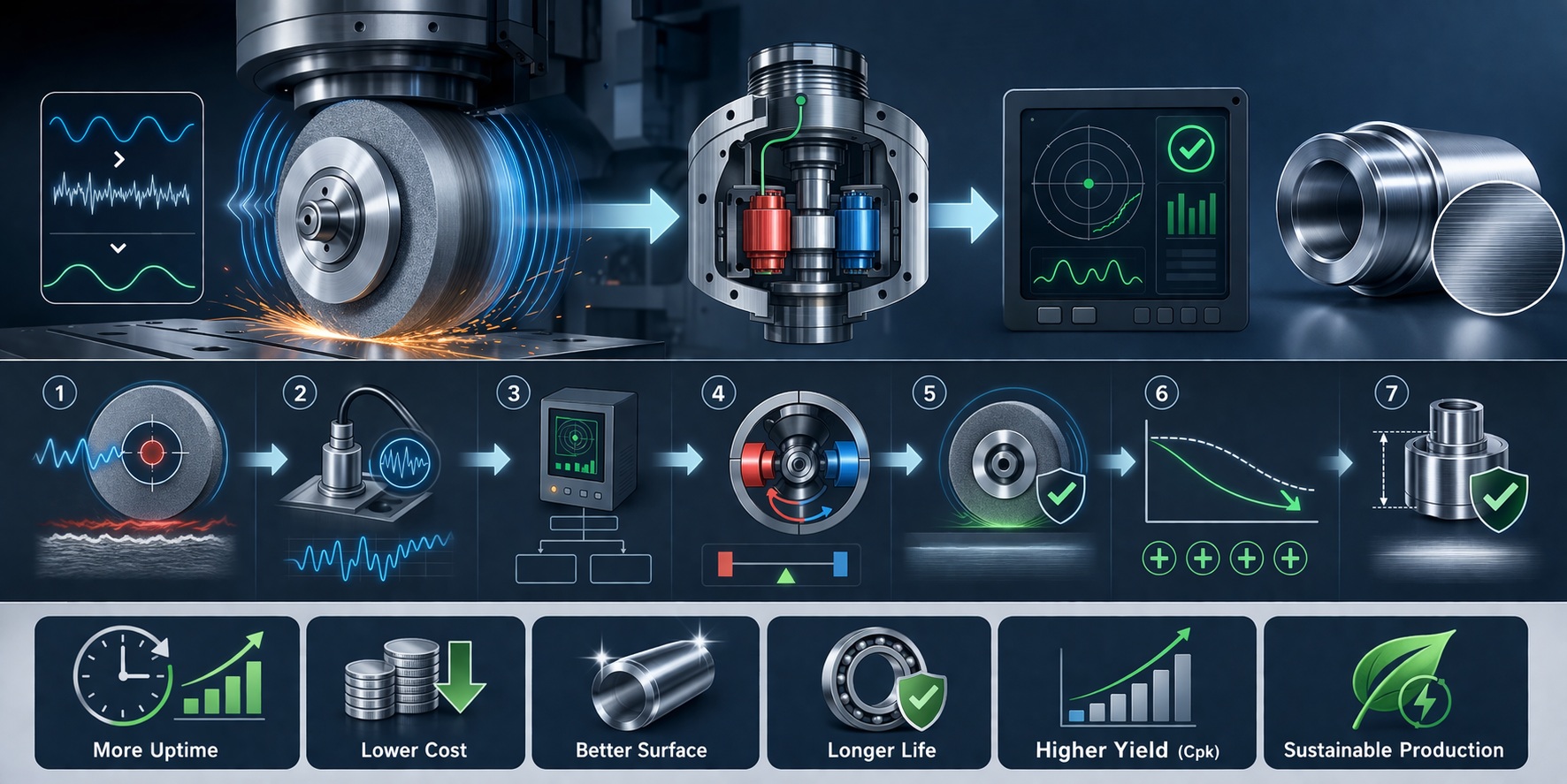
2. The Physics of Unbalance: Vibration Mechanisms
To determine the ROI of an automatic balancing system, one must first understand the fundamental Mechanism by which a minor mass asymmetry translates into a major process instability. In high-precision grinding, unbalance is not merely a static weight error; it is a dynamic source of Centrifugal Force that scales exponentially with rotational speed. This vibration energy propagates through the spindle to the grinding zone, directly dictates the Surface Integrity, and ultimately governs the economic output of the machine.
The Mechanism of Centrifugal Force Generation
The physical core of the problem lies in the displacement of the wheel’s Center of Mass (CoM) from its Geometric Center. As the wheel rotates, this offset creates a rotating vector of centrifugal force. At conventional speeds (e.g., 45 m/s), a few grams of unbalance might be tolerable, but as modern processes move toward High-Speed Grinding (HSG), the force increases by the square of the angular velocity. This Mechanism generates a synchronous vibration (1X frequency) that acts as a continuous hammering effect on the workpiece surface.
Stiffness, Damping, and Resonance
The magnitude of the resulting vibration is not only a function of the unbalance itself but also of the Machine Tool Stiffness. A rigid, well-damped machine bed (e.g., polymer concrete) can absorb more energy than a lightweight structure. However, every machine has Natural Frequencies. If the spindle RPM corresponds to one of these frequencies, the Resonance Mechanism amplifies the vibration amplitude, leading to severe chatter. Automatic Wheel Balancing Systems prevent this by ensuring the vibration amplitude remains below a deterministic threshold, typically measured in microns or mm/s.
Fc = m · e · ω2
Equation 2.1: Centrifugal Force (Fc) as a function of Mass (m), Eccentricity (e), and Angular Velocity (ω)
Chatter Marks and Surface Roughness (Ra)
The operational outcome of unbalance is the generation of Chatter Marks—periodic undulations on the ground surface. These marks are a direct result of the fluctuating Depth of Cut (ae) caused by the wheel’s oscillation. This Mechanism destroys the Geometric Fidelity of the part and spikes the Surface Roughness (Ra) values. In high-volume production, these ripples necessitate rework or lead to total scrap, a significant factor when calculating the Total Manufacturing Cost of non-balanced systems.
Thermal and Structural Impacts on Bearings
Beyond the workpiece, vibration acts as a destructive Mechanism for the spindle bearings. Constant radial loading from unbalance creates localized heat and accelerates Fatigue Wear in the bearing races. This reduces the Life-cycle of the spindle, leading to high Operating Expenditure (OPEX). By maintaining perfect balance, the system preserves the Dimensional Accuracy of the spindle over thousands of hours, ensuring that the machine’s Process Capability (Cpk) remains stable over time.
| Vibration Source | Technical Mechanism | Quality/Cost Impact |
|---|---|---|
| Static Unbalance | CoM offset from rotation axis. | Primary cause of 1X synchronous chatter. |
| Dynamic Unbalance | Asymmetric mass distribution along spindle length. | Moment unbalance; causes wobbling & bearing heat. |
| Coolant Loading | Non-uniform fluid absorption in porous wheels. | Unbalance that changes mid-process; requires “Auto” correction. |
| Structural Resonance | Amplification at natural frequency. | Catastrophic finish failure & potential machine damage. |
3. Technical Configuration of Auto-Balancing Systems
Modern auto-balancing technology has evolved from simple counterweights into a sophisticated Mechanism that integrates high-speed sensing with real-time actuation. To achieve an effective ROI, the system must be capable of identifying and correcting unbalance while the spindle is at full operational speed. This “In-Process” capability is what separates advanced CNC grinding from traditional manual setups, ensuring constant Process Reliability.
Precision Sensing: The Accelerometer Interface
The foundation of any balancing system is the Sensing Mechanism. High-sensitivity piezoelectric accelerometers are mounted directly onto the spindle housing to detect microscopic displacements. These sensors capture vibration signals in real-time, which the control unit then filters to isolate the 1X Synchronous Frequency—the specific signature of mass unbalance. By comparing this signal with a tachometer or encoder pulse, the system determines the exact angular position of the “heavy spot” on the wheel.
Balancing Actuators: Mechanical vs. Hydrodynamic
There are two primary Mechanisms for physical correction:
- Electromechanical Balancers: These utilize two internal motorized counterweights (masses) located within the spindle or a specialized flange. The system moves these weights independently to create a counter-vector that cancels out the wheel’s unbalance.
- Hydrodynamic (Liquid) Balancers: These inject a precise volume of coolant or specialized fluid into four or more chambers within the balancing flange. By selectively filling the chamber opposite the heavy spot, the system achieves a perfect balance state without moving mechanical parts, offering high reliability at ultra-high speeds.
Utarget = Uwheel + Ubalancer = 0
Equation 3.1: Vector Compensation Logic where U represents the unbalance vector
The CNC Control Loop and Logic
The “Brain” of the system is the Control Algorithm integrated into the CNC. When the vibration level exceeds a pre-defined threshold, the controller initiates a balancing cycle. This Mechanism involves a closed-loop feedback system: the controller moves the weights (or injects fluid), measures the resulting vibration change, and iterates until the target Quality Stability (typically below 0.5 μm/s) is reached. This process happens in seconds, often during the “air-cut” or dressing phase of the cycle.
Integration with Gap Elimination and Dressing
Technical excellence in balancing is achieved when it is synchronized with other CNC functions. Modern systems link the Balancing Mechanism with Acoustic Emission (AE) sensors used for gap elimination. This integration allows the machine to distinguish between a “vibration spike” caused by unbalance and a “touch signal” from the workpiece. Such harmony between sensors reduces the Total Manufacturing Cost by preventing false alarms and ensuring the machine operates at its peak Process Capability (Cpk).
| Feature | Electromechanical (Weight-based) | Hydrodynamic (Fluid-based) |
|---|---|---|
| Correction Mechanism | Motorized internal weights | Selective fluid injection |
| Response Speed | Moderate to Fast | Extremely Fast |
| Max RPM Capacity | Limited by mechanical components | High (ideal for Aerospace/HSG) |
| Maintenance | Requires electrical slip-rings | Minimal (no moving parts) |
| Precision | Very High (Discrete steps) | Extremely High (Continuous) |
4. Impact on Process Reliability and Quality Stability
The primary objective of implementing an automatic balancing system is to move from stochastic variation to deterministic precision. By neutralizing the Mechanism of synchronous vibration, the system ensures that the Surface Integrity and Dimensional Accuracy of every part in a batch remain within microscopic tolerances. This level of Quality Stability is the foundational driver for achieving a high Process Capability (Cpk) in automated production lines.
Elimination of Chatter and Surface Roughness (Ra) Improvement
In a non-balanced system, the Mechanism of forced vibration causes the grinding wheel to oscillate, creating periodic waves on the workpiece surface known as chatter. Automatic balancing maintains the vibration amplitude at near-zero levels (typically < 0.2 μm), ensuring a constant Depth of Cut (ae). This stability directly translates to a significant reduction in Surface Roughness (Ra). For high-precision components, this eliminates the need for secondary polishing processes, drastically reducing the Total Manufacturing Cost.
Spindle Longevity and Reduced Bearing Wear
Unbalance-induced vibration acts as a continuous destructive Mechanism for the spindle’s high-precision bearings. The cyclic radial loads generated by unbalance lead to localized Thermal Expansion and premature fatigue of the bearing races. By maintaining perfect dynamic balance, the system minimizes these parasitic loads, effectively doubling or tripling the Life-cycle of the spindle assembly. This long-term Process Reliability prevents the catastrophic “spindle drift” that often plagues high-speed operations.
Cpk = (USL – LSL) / (6 σ) → Minimized σ via Stability
Equation 4.1: Enhancing Process Capability (Cpk) by reducing Standard Deviation (σ) through vibration control
Consistency Across Large Production Batches
One of the most overlooked benefits is Thermal Stability. Vibration causes internal friction and heat within the spindle and the grinding zone. In large production runs, this heat causes the machine structure to drift, compromising Geometric Fidelity. Automatic balancing systems provide a stabilized Mechanism where the thermal signature of the machine remains constant from the first part to the 1,000th part. This ensures that the Quality Stability is not operator-dependent but system-guaranteed.
Dynamic Compensation for Wheel Wear and Coolant Absorption
A grinding wheel’s balance state is not static; it changes as the Mechanism of wheel wear alters the mass distribution or as porous wheels absorb coolant unevenly. Manual balancing cannot address these mid-cycle shifts. An automatic system’s In-Process monitoring function detects these deviations instantaneously and performs micro-corrections during the spark-out or dressing phase. This real-time adaptability is critical for maintaining Process Reliability in lights-out manufacturing environments.
| Quality Metric | Improvement Mechanism | Operational Outcome |
|---|---|---|
| Surface Finish (Ra) | Elimination of synchronous chatter waves. | Mirror-like finishes; no secondary lapping. |
| Roundness/Flatness | Reduction of spindle runout during cut. | Strict Geometric Fidelity in sub-micron range. |
| Scrap Rate | Deterministic control of process variables. | Zero-defect production; high Cpk values. |
| Spindle Health | Minimized cyclic loading on bearings. | Extended machine life; lower OPEX costs. |
5. ROI Analysis: When Does the Investment Pay Off?
Deciding to invest in an automatic wheel balancing system is a strategic Capital Expenditure (CAPEX) decision that must be justified by a clear Return on Investment (ROI). While the technical benefits of vibration control are undeniable, the economic Mechanism of the investment is driven by the reduction in non-productive time and the elimination of scrap. This chapter provides a deterministic framework for calculating the Break-even Point and identifying the production scenarios where the system offers the highest financial yield.
Quantifying Downtime Reduction (The Time-Value Mechanism)
In traditional manual balancing, the machine must be stopped, and a skilled operator must perform a series of trial-and-error adjustments. This Mechanism often consumes 15 to 45 minutes per wheel change. In high-volume environments with frequent wheel dress-offs or replacements, this cumulative downtime represents a massive loss in potential revenue. An automatic system performs the same task in seconds while the spindle is ramping up, directly converting idle time into Productive Machining Time.
The Scrap and Rework Cost Recovery
For high-precision components, a single vibration-induced chatter mark can render a part unusable. The Total Manufacturing Cost of a scrapped part includes the raw material, previous machining hours, and the energy consumed. Automatic balancing acts as a risk-mitigation Mechanism that ensures Quality Stability. By reducing the scrap rate from, for example, 3% to 0.5%, the system pays for itself purely through material and labor recovery, especially in sectors dealing with expensive alloys or semi-finished components.
ROIannual = (Σ Sdowntime + Σ Sscrap + Σ Sspindle) / CAPEX
Equation 5.1: Annual ROI calculation considering savings (S) in downtime, scrap, and spindle maintenance
Operational Expenditure (OPEX) and Maintenance Savings
The impact on Spindle Life-cycle is a critical long-term economic factor. Spindle rebuilds for high-precision grinders can cost tens of thousands of dollars. By neutralizing the vibration Mechanism that destroys bearings, an automatic balancer extends the mean time between failures (MTBF). This reduction in Operating Expenditure (OPEX), combined with lower electrical energy consumption (due to reduced internal friction), significantly shortens the Payback Period for the investment.
The Tipping Point: Batch Size and Precision Requirements
The Economic Feasibility of automatic balancing is highly dependent on the application. In a high-mix, low-volume shop where wheels are changed several times a day, the time savings alone will justify the cost within 6 to 12 months. Conversely, in a dedicated mass-production line, the primary ROI driver is Process Capability (Cpk) and the prevention of catastrophic batch failures. Evaluating these variables is the key to determining when the “Higher Price” of an automated system is actually the “Lower Cost” solution in the long run.
| ROI Driver | Cost Mitigation Mechanism | Estimated Financial Impact |
|---|---|---|
| Setup Efficiency | Zero-downtime balancing during spindle ramp-up. | 15% – 25% increase in annual machine uptime. |
| Quality Yield | Prevention of vibration-induced surface scrap. | Significant reduction in rework and scrap cost. |
| Tool/Machine Life | Reduced radial bearing loads & internal friction. | Double spindle bearing life; lower OPEX. |
| Labor Optimization | Automation of highly skilled balancing tasks. | Lower reliance on scarce, high-cost skilled labor. |
6. Practical Selection Guide: Decision Matrix
The technical superiority of an automatic wheel balancing system must be matched with operational necessity. For many facilities, the decision is not whether the technology works, but whether the specific Mechanism of their grinding process demands it. This chapter provides a Decision Matrix based on wheel geometry, spindle speed, and tolerance requirements to determine the Economic Feasibility of the investment for your specific shop floor.
Criteria 1: Wheel Mass and Diameter Dynamics
The physical Mechanism of unbalance is heavily influenced by the size of the abrasive tool. Large-diameter vitrified wheels (e.g., > 400mm) possess significant rotational inertia. Even a minor density variation in such a mass results in high-amplitude vibrations. Conversely, small internal grinding wheels may have less mass but operate at ultra-high RPMs, where even 0.1 gram of unbalance becomes critical. If your process utilizes wheels with high Centrifugal Force potential, an automatic system is essential for Process Reliability.
Criteria 2: Surface Finish and Tolerance Thresholds
Your Quality Stability requirements are the ultimate decider. If your target Surface Roughness (Ra) is below 0.2 μm or if you are achieving sub-micron Roundness, the Mechanism of manual balancing is often too imprecise to meet the spec consistently. In “lights-out” or automated cells where human intervention is minimized, the system’s ability to perform In-Process correction ensures that every part meets the Dimensional Accuracy without post-process inspection failures.
Vlimit ≤ 0.5 mm/s (Industry Standard for High-Precision Grinding)
Equation 6.1: Recommended vibration velocity limit (V) for achieving peak Surface Integrity
Criteria 3: Wheel Change Frequency and Setup Costs
The Total Manufacturing Cost is highly sensitive to setup times. Analyze your Batch Size: if you are changing wheels or dressing heavily multiple times per shift, the Mechanism of manual balancing becomes a major bottleneck. Automatic systems eliminate this non-productive time, allowing for a faster ROI in high-mix environments. If your wheels stay on the machine for weeks with minimal wear, the urgency for an automated solution decreases, shifting the focus back to initial CAPEX.
The Decision Matrix: A Strategic Overview
By synthesizing these variables, we can categorize the necessity of an automatic balancer. For aerospace and medical components, it is a Critical Requirement. For general toolroom applications with wide tolerances, it may remain a Performance Option. Understanding where your process sits on this spectrum is the first step in making a data-driven Investment Decision that balances technical capability with financial reality.
| Process Variable | Manual Balancing (Status Quo) | Automatic Balancing (Upgrade) |
|---|---|---|
| Tolerance Range | Standard (> 5 μm). | Ultra-Precision (< 1 μm). |
| Batch Size | Large (rare tool changes). | Small/Medium (frequent changes). |
| Wheel Type | Small mass / Low speed. | Large mass / High speed / Porous. |
| Automation Level | Operator-assisted machining. | Fully Autonomous / Lights-out. |
7. Conclusion: Strategic Precision Management
The transition from manual balancing to Automatic Wheel Balancing Systems represents a critical evolution in precision manufacturing. As we have analyzed, the technical Mechanism of vibration control is not merely about achieving a “quiet” machine; it is a fundamental driver of Surface Integrity, Dimensional Accuracy, and long-term Spindle Life-cycle. In the high-speed realm of modern grinding, managing the dynamic pulse of the machine is the only way to ensure Quality Stability.
Shifting from CAPEX to ROI Focus
While the initial Capital Expenditure (CAPEX) may seem significant, the Economic Feasibility is clearly established through the reduction of non-productive downtime and the elimination of scrap. By automating a highly skilled task, manufacturers can stabilize their Total Manufacturing Cost and achieve a more deterministic Process Capability (Cpk). The “Higher Price” of an automated system is quickly offset by the “Higher Yield” and lower Operating Expenditure (OPEX) over the machine’s operational life.
The Future: AI-Powered Vibration Optimization
Looking ahead, the integration of AI-powered Process Monitoring with balancing hardware will lead to even greater levels of autonomy. Future systems will not only balance the wheel but will use vibration data to predict Wheel Wear and optimize Dressing Cycles in real-time. This synergy between hardware and Digital Twin models will mark the beginning of a truly self-optimizing grinding environment, where precision is guaranteed by the digital pulse of the control system.
Mastering the Dynamic Harmony
“Precision is the byproduct of stability. An automatic balancing system is the guardian of that stability, ensuring that the physical limits of the machine never compromise the quality of the creation.”
References & Technical Resources
- • Altintas, Y. (2012). Manufacturing Automation: Metal Cutting Mechanics, Machine Tool Vibrations, and CNC Design. Cambridge University Press.
- • Malkin, S., & Guo, C. (2008). Grinding Technology: Theory and Applications of Machining with Abrasives. Industrial Press Inc.
- • ISO 1940-1:2003. Mechanical vibration — Balance quality requirements for rotors in a constant (rigid) state.
- • Klocke, F. (2009). Manufacturing Processes 2: Grinding, Honing, Lapping. Springer Science & Business Media.
Internal Technical Deep-Dive
To further explore how vibration and stability impact your grinding performance and bottom line, please refer to the following specialized modules: