1. The Premium Abrasive Illusion: Fundamental Paradoxes in CBN Process Selection
In the pursuit of high-throughput manufacturing, upgrading to Cubic Boron Nitride (CBN) is frequently treated as an absolute solution for productivity limitations. Boasting a hardness second only to diamond and thermal conductivity that outperforms copper, CBN appears on paper to be a foolproof replacement for conventional aluminum oxide (Al2O3) and silicon carbide (SiC) wheels. This Phenomenon, which we define as the Premium Abrasive Illusion, occurs when a manufacturing facility assumes that high tool cost automatically equals a better cutting result. When a company switches to CBN without reviewing its current machine stability and grinding constraints, this expensive decision often backfires, hurting product margins and disrupting line throughput.
The Material Property Paradox: Why Extreme Hardness Breeds Process Sensitivity
The very physical characteristics that make CBN a superior abrasive also make it highly sensitive to incorrect process parameters. Unlike standard friable grains that fracture under moderate loads to expose new cutting edges, CBN’s high shear strength requires a precise energy threshold to achieve its natural self-sharpening Behavior. If the process variables are chosen incorrectly, this lack of Geometric Fidelity between the tool design and the actual setup prevents proper micro-fracturing. This issue leads to a rapid shift in the system’s operation—either causing immediate grain pull-out or accelerating glazing, both of which destroy the wheel’s Residual Value.
The Cost-Performance Inversion Threshold
Ctotal = ( Costwheel / Llifecycle ) + Costdowntime × ( 1 / Cpk )
Where a sharp drop in tool life (Llifecycle) combined with a collapsing process capability index (Cpk) under poor setup conditions flips the economic equation. This inversion makes high-cost CBN far more expensive per part than standard abrasives.
The Systemic Shock: The Friction Penalty of Unsuited Machinery
When a shop floor retrofits an unsuited machine with a CBN wheel, the system’s structural layout often fails to handle the transition. Operating CBN effectively requires strict adjustments across the entire grinding system, including structural rigidity, dressing methods, and spindle velocity. Treating a premium superabrasive as a standalone drop-in tool introduces a massive Hidden Constraint to the line. Instead of improving material removal rates, the incorrect setup causes a rapid increase in normal forces, turning an expensive tool upgrade into an inefficient friction generator that compromises Quality Stability.
Table 1.1: Physical Properties and System Prerequisites of Grinding Abrasives
| Abrasive Material | Knoop Hardness (HK) | Thermal Conductivity (W/m·K) | Required Machine Environment |
|---|---|---|---|
| Aluminum Oxide (Al2O3) | 2,100 | 30 | Standard Rigidity / Flexible Speed |
| Cubic Boron Nitride (CBN) | 4,700 | 1,300 | Ultra-High Rigidity / Ultra-Fast Speed |
This technical gap creates a clear cost-performance inversion. Without analyzing the surrounding process conditions, introducing superabrasives can actually destabilize production, leading to unexpected surface burns, tool chatter, and high scrap rates. Overcoming this premium trap requires a thorough Deterministic Assessment of the factory floor, evaluating machine stiffness and dressing systems before finalizing a CBN conversion strategy.
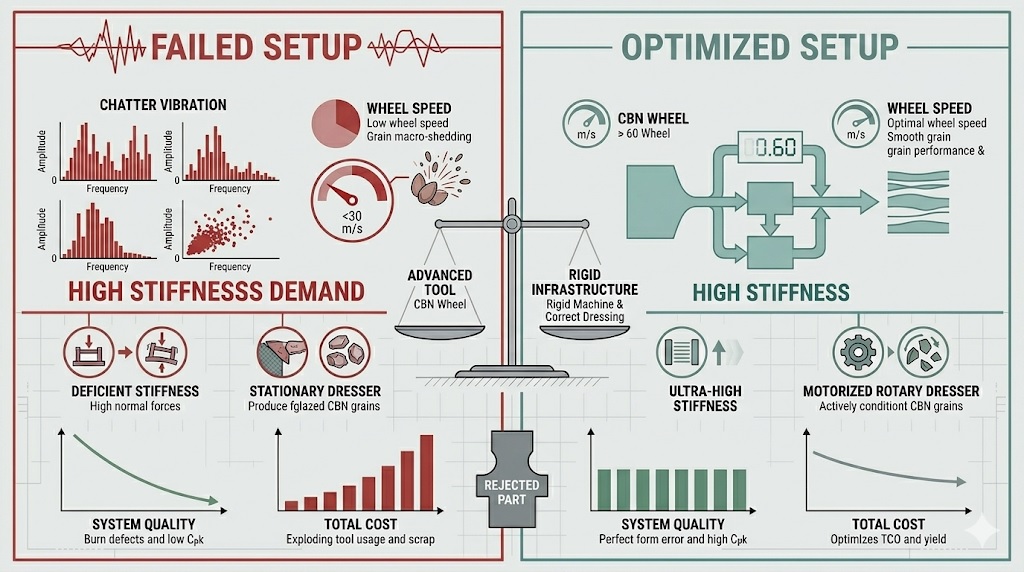
2. Failure Mechanism 1: Deficient Machine Stiffness and the Destructive Chatter Loop
The primary structural reason a CBN conversion fails on the shop floor relates directly to the machine tool’s structural deflection limits. Because CBN grains exhibit extreme hardness and low friability, they do not shear material under light pressures. Cutting with a superabrasive wheel demands a high normal grinding force compared to conventional soft wheels. When an advanced CBN wheel is mounted onto an older or lighter machine tool, the system’s Anatomy cannot support this mechanical load, causing structural bending and destroying Quality Stability.
The Rigidity Threshold: Spindle Deflection under Elevated Normal Forces
During material removal, the contact zone between the CBN grain and the hardened steel face acts as a rigid interface. If the machine’s static and dynamic stiffness (Kmachine) is insufficient, the intense normal force pushes the wheel spindle away from the work axis. This non-yielding Behavior of the superabrasive grain causes micro-deflections throughout the machine body, including the guideways and tailstock. This mechanical flexing acts as a major Hidden Constraint, preventing the tool from reaching its intended depth and inserting dimensional errors into the component geometry.
The Dynamic Machine Deflection and Force Interaction
Fnormal = Kcontact × δdeflect ⇒ δdeflect = Fnormal / Kmachine
Where Kcontact is the high contact stiffness of CBN grains. When the machine structural rigidity (Kmachine) falls below a critical threshold, δdeflect expands non-linearly, causing severe geometric errors.
The Dynamic Chatter Loop: Accelerated Macro-Shedding Failure
This structural deflection quickly triggers a destructive regenerative chatter loop. As the machine body flexes, it generates harmonic vibrations across the spindle housing. The brittle CBN grains cannot absorb these dynamic impacts. Instead of micro-fracturing cleanly to expose fresh cutting edges, the grains undergo severe macro-shedding, where entire CBN crystals are torn from the bonding layer. This premature stripping of the abrasive face destroys the tool’s Residual Value, scores the workpiece surface with deep chatter marks, and drives the Total Manufacturing Cost to unsustainable levels.
Table 2.1: Operational Process Security Under Varying Machine Stiffness Levels
| Machine Stiffness Class (Kmachine) | Dynamic Force Accommodation | Abrasive Wear Mechanism | Economic Feasibility Status |
|---|---|---|---|
| High-Stiffness CNC Line (> 50 N/μm) | Stable Absorption (Zero Flex) | Controlled Micro-Fracturing | Highly Optimized ROI |
| Standard Legacy Line (20 – 30 N/μm) | Moderate Deflection | Grain Flattening & Glazing | Marginal Utility |
| Low-Rigidity Retrofit (< 15 N/μm) | Severe Spindle Deflection | Rapid Bond Macro-Shedding | Complete Process Capital Drain |
Case Study: The Automotive Input Shaft Cam Grinding Failure
A clear instance of this structural breakdown occurred during a production optimization attempt for an automotive transmission input shaft line. Management authorized a change from standard vitrified Al2O3 wheels to a high-density vitrified CBN wheel on an aging mechanical cam-grinding machine, expecting an immediate drop in cycle times.
Once integrated, however, the machine’s old rolling-element spindle bearings could not support the elevated normal forces required by the CBN wheel. The wheel head shifted by 0.03 mm during initial engagement, generating severe harmonic chatter vibrations. Instead of grinding clean profiles, the high-frequency impacts caused massive macro-shedding of the CBN layer, completely stripping the wheel face within 40 parts. This Deterministic Decision to force a premium tool onto low-rigidity machinery resulted in a 400% increase in tool replacement costs and caused an immediate collapse in the line’s process capability index, delivering zero productivity improvement.
3. Failure Mechanism 2: Deficient Dressing Infrastructure and the Thermal Friction Burn Penalty
Another major cause of CBN process failure is the mistaken assumption that superabrasive wheels can be managed with standard dressing methods. Because CBN grains possess extreme wear resistance, they cannot be dressed using conventional stationary diamond sticks or silicon carbide blocks. Attempting to condition a premium CBN wheel without advanced rotary dressing systems leads directly to grain glazing. This problem undermines Quality Stability and creates intense friction that generates severe thermal defects on the workpiece.
The Dressing Match Challenge: Speed Ratios and Micro-Edge Regeneration
Conditioning a vitrified or metal-bonded CBN wheel requires a precise mechanical process to trim the tough grains and clear out the bonding matrix. This setup demands a synchronized motorized rotary diamond dresser. The process engineering team must carefully manage the dressing speed ratio—the surface velocity of the dresser relative to the grinding wheel. If operators use conventional static conditioning tools, they cannot provide the kinetic energy needed to crack the CBN face cleanly. This failure to generate proper micro-edges prevents the wheel’s natural cutting Mechanism from functioning correctly.
The Rotary Dressing Kinematic Speed Ratio
qdressing = vd / vs
Where vd is the rotary dresser surface speed and vs is the grinding wheel speed. For optimal grain micro-fracturing without flattening, qdressing must be strictly maintained between +0.4 and +0.7 for unidirectional setups.
The Friction Spike Paradox: Glazing Traps and Surface Layer Failure
When a CBN wheel is run without proper conditioning, it quickly undergoes severe grain glazing. Instead of cleanly shearing steel, the unconditioned, blunt CBN faces rub heavily against the workpiece. This friction causes a rapid spike in localized temperatures. Even though CBN has excellent thermal conductivity to draw heat away, the friction from a glazed wheel generates more heat than the coolant can dissipate. This failure leads directly to severe grinding burn, creating soft re-tempering zones and surface micro-cracks that destroy the component’s Residual Value.
Table 3.1: Influence of Conditioning Methods on CBN Surface State
| Dressing Infrastructure Employed | Resulting Grain Topography | Thermal Heat Flux Behavior | Surface Integrity Status |
|---|---|---|---|
| Motorized CNC Rotary Diamond Disc | Sharp Micro-Fractured Protrusions | Low (Clean Chip Extraction) | Defect-Free Matrix |
| Stationary Single-Point Diamond Stick | Flattened, Glazed Grain Faces | High (Intense Rubbing Friction) | Re-tempering Damage |
| Manual Silicon Carbide Dressing Block | Bond Loading (Clogged Wheel Pores) | Extreme (Total Thermal Block) | Severe Visible Burn Scrap |
Industrial Example: High-Speed Gear Flank Burn Epidemic
This type of operational failure occurred in a production facility manufacturing high-speed planetary gear flanks. To eliminate a bottleneck in the gear grinding cell, the department replaced its conventional alumina profile wheels with a premium vitrified CBN form wheel. However, to save on upfront equipment capital, they chose not to invest in a motorized diamond dressing spindle upgrade, relying instead on a stationary diamond cluster blade mounted to the tailstock.
This configuration proved disastrous. Because the stationary diamond blade could not chip the CBN grains cleanly, it dragged across the face and flattened the crystal structures. Within ten production cycles, the glazed CBN wheel experienced a massive friction spike, pushing contact zone temperatures past 700°C. This thermal surge caused widespread grinding burn along the gear pitch diameters, creating a hard, brittle re-hardening martensite layer. A Deterministic Assessment forced the company to reject the entire batch, driving up scrap costs and proving that using premium wheels without the proper dressing infrastructure destroys Economic Feasibility.
4. Failure Mechanism 3: Low Peripheral Wheel Velocity and the Loss of Grain Micro-Fracturing
The final critical error in CBN process selection is running the superabrasive wheel at conventional cutting speeds. Conventional aluminum oxide wheels are commonly run at peripheral speeds between 30 m/s and 45 m/s. Attempting to run a premium CBN wheel within this same low-velocity range alters the cutting Mechanism. Operating below the required speed threshold stops the grain’s natural self-sharpening action, turning a premium tool into an inefficient asset that damages Quality Stability.
The Low-Velocity Trap: Elevated Chip Thickness and Structural Loading
When a grinding wheel turns too slowly relative to the workpiece feedrate, the active time each abrasive grain spends in the material increases. This slow speed forces each individual CBN crystal to plow a much larger chip than it was designed to handle, causing the equivalent chip thickness (heq) to expand. This extra volume exerts massive mechanical forces on the grain’s cutting edge. Instead of chipping away in controlled microscopic fragments, the high load tears the entire CBN grain out of its bonding matrix, causing rapid tool wear and creating a major Hidden Constraint on wheel life.
The Maximum Equivalent Chip Thickness Equation
heq = vw / vs × ae
Where vw is the workpiece feed speed, vs is the peripheral wheel speed, and ae is the radial depth of cut. Keeping vs too low directly expands heq, overloading the superabrasive grains.
The Self-Sharpening Breakdown: Why Low Speeds Shorten Tool Lifespans
This mechanical overloading completely breaks down the wheel’s natural self-sharpening process. For a CBN wheel to maintain a clean, open topography, the grains must fracture under controlled, microscopic loads to expose new sharp facets. When low wheel speeds cause entire grains to strip away early, the wheel face loses its structured cutting surface. This rapid stripping forces frequent process stops for re-dressing, raising tool consumption and destroying the project’s Economic Feasibility.
Table 4.1: Operational Process Outcomes Across Peripheral Wheel Velocities
| Peripheral Wheel Velocity (vs) | Equivalent Chip Thickness (heq) | Dominant Grain Failure Mode | Tool Lifespan Status |
|---|---|---|---|
| Conventional Speed (30 – 45 m/s) | Excessive (Overloaded Range) | Macro-Shedding & Complete Bond Pull-Out | Severe Deficit (Shorter than Al2O3) |
| High-Speed Range (60 – 80 m/s) | Balanced Allocation | Normal Progressive Attrition Wear | Extended Baseline |
| Ultra-High Speed (≥ 120 m/s) | Microscopic (Optimal Range) | Controlled Micro-Fracturing (Self-Sharpening) | Maximum Longevity Value |
Operating CBN wheels without sufficient peripheral speed creates a major barrier to factory efficiency. Attempting a superabrasive upgrade without validating that the machine spindle can support high-speed operation ruins process capability. Overcoming this failure mode requires a thorough Deterministic Assessment of the spindle drive, ensures the machine can maintain high velocities, and aligns the process variables with the rules of advanced abrasive mechanics.
5. Designing the Transition Audit: Strategic Bonding Selection and TCO Assessment
To prevent the severe tool macro-shedding, thermal burns, and cycle losses caused by poor setup choices, engineering teams must deploy a rigid Deterministic Decision framework before changing production tools. Moving away from standard abrasives requires a comprehensive pre-audit of the workshop floor. By matching the bonding architecture to the machine’s structural limits and evaluating investment returns with a total cost model, factories can secure high Quality Stability, avoid capital waste, and unlock the true performance of superabrasive tools.
The Bonding System Selection Strategy: Matching Matrix to Machine Stiffness
A critical phase of the pre-conversion audit is selecting the proper wheel bond matrix. Choosing between vitrified, resin, or electroplated systems is not a simple choice; it is a core process Strategy. For example, vitrified CBN bonds offer excellent dressing flexibility and an open structure for coolant flow, but they require high machine rigidity to handle processing forces. Electroplated wheels provide maximum grain protrusion and require no dressing, but they cannot be reconditioned once worn. Matching these bond profiles to the actual capabilities of machine Anatomy protects tools from early failure.
The Total Cost of Ownership (TCO) Framework for Superabrasives
TCOpart = [ Costwheel + ∑( Costdress ) ] / Nparts + Costhourly × Tcycle + Costscrap × ( 1 – Y )
Where Nparts is total lifespan volume, Tcycle is cycle time, and Y is manufacturing yield. True economic viability is achieved only when high tool life and low cycle times offset the initial purchase premium.
System Integration and Cross-Stage Validation Parameters
Successful process migration requires deep System Integration across several machinery sub-systems. Spindle power consumption, dynamic vibration filtering, dressing unit mechanics, and coolant delivery placement must be evaluated together as part of a single operational window. When a production facility tracks and coordinates these variables before purchasing tools, it protects the line from unexpected bottlenecks and keeps production parameters aligned within a highly stable manufacturing window.
Table 5.1: Pre-Upgrade Technical Audit and Risk Mitigation Parameters
| Audit Checkpoint Category | Minimum Operational Threshold | Failure Mitigation Outcome |
|---|---|---|
| Dynamic Structural Rigidity | Static stiffness ≥ 40 N/μm (Zero axis play) | Eliminates wheel chatter loops |
| Spindle Drive Velocity | Peripheral line speed ≥ 60 m/s (Constant torque) | Enables grain micro-fracturing |
| Dressing Mechanism Drive | Motorized rotary spindle with speed ratio control | Prevents face glazing and thermal burn |
The Total Cost of Ownership Approach: Beyond Tool Purchase Price
Finally, analyzing the financial return of a superabrasive upgrade requires a detailed TCO calculation. Evaluating tool investments solely on the initial purchase price is a major error in process planning. A true economic assessment must account for long-term factors, including reduced dressing downtime, extended wheel life, lower power consumption, and minimized scrap costs. Factoring these systemic gains into a long-term capital model allows engineering teams to prove the financial benefit of the upgrade while protecting the tool’s long-term Residual Value.
6. Conclusion: Beyond Material Properties—Mastering CBN as an Integrated Process Architecture
The systemic failures and structural paradoxes reviewed across these chapters reveal that a Cubic Boron Nitride conversion is not a simple tool upgrade, but a complex engineering challenge. Attempting to deploy this premium superabrasive without sufficient machine stiffness, synchronized rotary dressing, and high peripheral velocities transforms a high-performance tool into an expensive source of friction and scrap. Overcoming the cost-performance inversion requires a fundamental Cultural Shift away from standalone tool selection and toward integrated process planning.
The Systems Engineering Approach to Superabrasive Performance
In a modern precision manufacturing line, high-performance abrasives must be treated as one interconnected element within a complete production system. When process engineering teams eliminate the Hidden Constraints of legacy machinery, they allow the CBN grain’s natural micro-fracturing mechanism to function properly. This systemic alignment enables the manufacturing cell to maintain excellent Quality Stability under aggressive removal rates, protecting expensive machinery components and maximizing factory floor productivity.
The Integrated Superabrasive Capability Index (ISCI)
ISCI = [ Kmachine × vs ] / [ Fnormal × ( 1 + | 1 – qdressing | ) ]
Maximizing process capability requires ensuring that the machine’s rigidity and operational speed scale safely above the high normal forces and conditioning demands of CBN processing.
Securing Long-Term Asset Longevity and Operational Value
Sustaining these productivity improvements over high production volumes requires a structured cross-departmental auditing loop. Machine maintenance schedules, spindle vibration tracking, dressing disc wear logs, and finished part surface integrity metrics must be continually reviewed together. Managing these multi-variable process conditions proactively allows companies to maximize the Residual Value of their grinding assets, protect precision tools from sudden damage, and secure a highly predictable, profitable manufacturing cycle.
Table 6.1: Comprehensive Action Plan for Successful CBN Process Integration
| Strategic Implementation Phase | Actionable Operational Tactic | Target Performance Metric |
|---|---|---|
| Structural Pre-Qualification | Measure active spindle deflection under load; reject legacy machines under 30 N/μm. | Zero wheel chatter defects |
| Kinematic Optimization | Upgrade spindle drives to guarantee line speeds ≥ 60 m/s to control chip thickness. | Stable grain micro-fracturing |
| Infrastructure Alignment | Install motorized rotary diamond dressers and lock speed ratios between +0.4 and +0.7. | Protected tool Residual Value |
The Ultimate Goal: Aligning Advanced Tools with Rigid Systems
Ultimately, successfully implementing CBN is about respecting the rigid rules of machine Anatomy. When process engineers support premium cutting materials with matching machine rigidity and precise conditioning, the abrasive wheel delivers flawless results. This data-driven strategy removes production line bottlenecks, prevents thermal grinding burns, and eliminates late-stage scrap epidemics. Balancing tool choices with complete system capabilities allows manufacturing cells to achieve perfect part dimensions and high production yields, securing an optimized manufacturing lifecycle.
References & Technical Resources
- • Malkin, S., & Guo, C. (2008). Grinding Technology: Theory and Applications of Machining with Abrasives. Industrial Press Inc.
- • Rowe, W. B. (2013). Principles of Modern Grinding Technology. William Andrew Publishing.
- • Marinescu, I. D., et al. (2013). Handbook of Machining with Grinding Wheels. CRC Press.
- • Webster, J., & Tricard, M. (2004). Innovations in Structured Grinding Wheels for Precision Applications. Annals of the CIRP.
Related Technical Reading
To deepen your understanding of how abrasive selection interacts with machine rigidity and cost-performance boundaries, we recommend exploring the following technical modules: