1. The Asymptotic Nature of Precision Economics: Beyond Linear Thinking
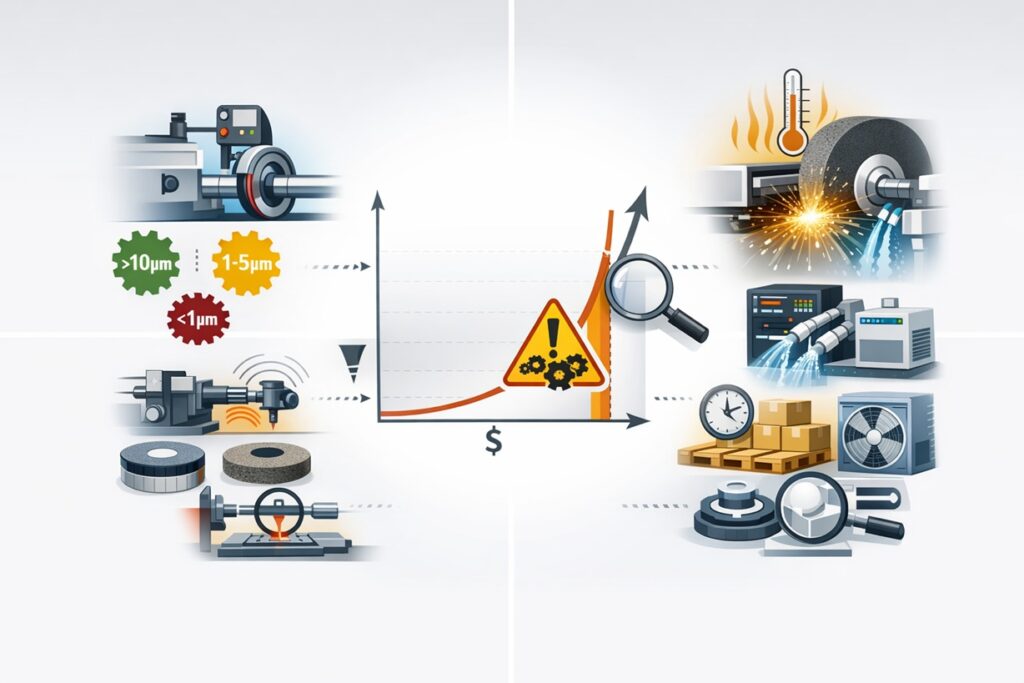
In the landscape of high-precision manufacturing, a pervasive and costly fallacy exists within design departments: the assumption that the relationship between a specified tolerance and its production cost is linear. Engineers often operate under the misconception that tightening a tolerance by half—for instance, shifting from ± 10 μm to ± 5 μm—represents a minor, proportional adjustment in manufacturing effort. However, the fundamental economic mechanism of precision grinding operates on an asymptotic scale. As a dimensional specification approaches the inherent resolution limits of the machine tool, the required effort does not merely increase; it detonates.
The Deterministic vs. Stochastic Mechanism
To understand why costs explode, one must analyze the mechanism of error transition. In the “Deterministic Zone” (typically tolerances > ± 10 μm), the grinding process is governed by macro-level kinematics. Here, the machine tool’s rigidity and basic servomotor resolution are sufficient to maintain a stable Process Capability Index (Cpk). In this zone, cost is primarily driven by material removal rates and standard labor.
However, as we enter the “Stochastic Zone” (tolerances < ± 2 μm), the mechanism of manufacturing changes entirely. At this sub-micron level, infinitesimal variables—such as high-frequency vibration harmonics, sub-degree coolant temperature fluctuations, and even the structural damping of the machine bed—become the dominant influencers of quality. The process is no longer a simple matter of “cutting to size”; it becomes a high-stakes battle against environmental noise. Consequently, the cost of achieving that final 10% of precision often accounts for more than 50% of the total part value.
Mathematical Modeling of the Cost-Tolerance Equilibrium
The mechanism of exponential cost growth can be modeled using an asymptotic function. This allows designers to visualize the “cliff” where value engineering fails and over-specification begins. The total manufacturing cost C as a function of tolerance T is expressed through the following mechanism:
In this model, A represents fixed overhead and material costs, while B and the exponent n (typically between 1.5 and 2.5 for grinding) represent the complexity of the precision mechanism. As T approaches zero, the cost C trends toward infinity. Practically, moving from 5 μm to 1 μm tolerance often multiplies the total cost by more than 500% because it forces the manufacturer to shift from standard CNC operation to an environment-controlled, laboratory-grade process.
2. Thermal Mechanism: The Invisible Destroyer of Sub-Micron Precision
In the pursuit of aggressive cycle times, the most significant physical barrier is not the mechanical limit of the machine, but the thermal mechanism of the grinding process. Unlike cutting processes where the majority of heat is carried away by chips, grinding is an abrasive process where approximately 70% to 80% of the generated energy is conducted directly into the workpiece. This thermal flux creates a dynamic environment where “static” design dimensions become moving targets.
The Mechanism of Linear Thermal Expansion
The fundamental mechanism that compromises precision is the predictable but often unmanaged linear expansion of material. For a standard steel component, a temperature rise of only 1°C can shift a 100mm dimension by more than 1 μm. When a designer specifies a ± 2 μm tolerance, they are effectively demanding that the manufacturing environment and the part itself remain thermally stable within a fraction of a degree.
Where α is the coefficient of thermal expansion (CTE), L0 is the original length, and ΔT is the temperature change. In high-precision grinding, this mechanism necessitates the use of expensive coolant chillers and temperature-controlled facilities. Without these, the “first-part-correct” capability (Cpk) vanishes, as the machine and workpiece drift out of sync during the warm-up cycle.
Specific Grinding Energy and Thermal Damage
As the mechanism of metal removal becomes more aggressive (higher MRR), the Specific Grinding Energy (us) spikes. This energy is dissipated as heat at the grinding zone. If the heat exceeds the threshold of the material’s metallurgical stability, it triggers “grinding burn,” causing tensile residual stresses and micro-cracks.
To mitigate these costs, the design mechanism must account for the “Thermal Window.” By choosing materials with lower CTE or by allowing for slightly wider tolerances on high-CTE materials, the manufacturing cost can be reduced by 30% or more, simply by eliminating the need for laboratory-grade climate control on the shop floor.
3. Vibration and Rigidity Mechanism: The Structural Loop of Precision
While thermal drift affects dimensional accuracy over time, the vibration and rigidity mechanism dictates the instantaneous surface integrity and geometric form of the workpiece. In high-precision grinding, the machine tool must be analyzed as a dynamic system of coupled masses where infinitesimal oscillations become the primary determinant of quality.
Dynamic Stiffness and the Structural Loop
The precision of a grinding process is physically limited by the Dynamic Stiffness (Kd) of the structural loop. This loop includes the spindle, the wheel, the workpiece, and the bed. If the grinding force frequency aligns with the natural frequency of this loop, the system enters a resonance mechanism, leading to visible regenerative chatter marks.
In this mechanism, the damping coefficient (c) is more critical than static stiffness (k) for sub-micron finishes. Without adequate damping, the energy from abrasive grain strikes cannot be dissipated, forcing a reduction in Material Removal Rates (MRR) to maintain stability, which exponentially increases the cost per part.
Ultimately, understanding the vibration and rigidity mechanism allows designers to optimize the “cost-precision window.” By selecting high-damping materials and rigid fixtures, the point at which production costs explode can be deferred, allowing for tighter tolerances without catastrophic financial impact.
4. Abrasive & Wheel Wear Mechanism: The Economic Lifecycle of Precision
In the pursuit of sub-micron tolerances, the grinding wheel is not a constant tool but a dynamic, self-consuming mechanism. The mechanism of wheel wear directly dictates the stability of the Process Capability Index (Cpk). As abrasive grains fracture or dull, the cutting forces shift, leading to dimensional drift that can only be corrected through costly dressing cycles.
The Mechanism of Abrasive Fracture and Attritious Wear
Wheel wear occurs through three primary mechanisms: grain fracture, bond fracture, and attritious wear. Grain fracture is a “self-sharpening” mechanism where the abrasive breaks to reveal new cutting edges. However, if attritious wear—the flattening of the grain tips—becomes dominant, the wheel “glazes,” significantly increasing the specific grinding energy and thermal load on the workpiece.
The G-Ratio defines the economic efficiency of the abrasive mechanism, representing the volume of material removed (Vw) per volume of wheel wear (Vs). For high-precision applications, a low G-ratio implies frequent dressing, which not only consumes the expensive abrasive but also introduces machine downtime, escalating the cost per part as tolerances tighten.
To manage these costs, designers should avoid geometries that force “point contact” grinding, which accelerates the bond fracture mechanism. By allowing for wheel-friendly profiles, the dressing frequency can be halved, directly reducing the non-productive time and extending the life of high-cost super-abrasives like CBN or Diamond.
5. Metrology & Verification Mechanism: The Cost of Absolute Truth
In the world of precision, a tolerance is only as real as the mechanism used to verify it. As specifications move from ± 5 μm to ± 0.5 μm, the metrology mechanism shifts from a simple inspection step to a complex environmental and physical challenge. The cost of verification begins to rival the cost of fabrication itself, as the uncertainty of the measurement system must be an order of magnitude smaller than the part’s tolerance.
The Mechanism of Gage Repeatability and Reproducibility (GR&R)
The fundamental mechanism of quality assurance in sub-micron grinding is the GR&R. At these levels, the contact force of a physical probe can induce elastic deformation of the workpiece—a phenomenon known as the Hertzian Contact Mechanism. This means the act of measuring actually changes the dimension being measured, leading to false rejects or, worse, false accepts.
Where Utotal is the expanded uncertainty, Ucal is the calibration uncertainty, Urep is repeatability, and Uenv is the environmental mechanism (thermal fluctuations in the lab). For a 1 μm tolerance, the measurement system must be stable within 100nm. This necessity forces the use of non-contact mechanisms like laser interferometry or confocal microscopy, which increase equipment capital expenditure by factors of 5x to 10x.
To optimize costs, design engineers should align their tolerance requirements with the available metrology mechanism. Demanding a tolerance that cannot be reliably measured with shop-floor equipment leads to “inspection bottlenecks,” where parts sit in temperature-controlled labs for hours before being cleared for the next operation, dramatically increasing the work-in-progress (WIP) cost.
6. Environmental & Fluid Mechanism: The Life Support of Precision
In the sub-micron regime, the machine tool does not exist in a vacuum; it is part of a larger environmental mechanism. Factors such as ambient temperature fluctuations, humidity, and the hydrodynamic behavior of the coolant are not auxiliary—they are central to the process. The fluid mechanism, in particular, must ensure that the intense heat generated at the grinding zone is not only removed but managed with zero-degree variance.
The Fluid Delivery and Boundary Layer Mechanism
The primary challenge in coolant application is the air-barrier mechanism created by a high-speed rotating wheel. This barrier prevents the fluid from reaching the actual contact zone. To overcome this, the nozzle pressure must be synchronized with the wheel’s peripheral speed to penetrate the boundary layer. If the mechanism of fluid entry is insufficient, the workpiece will undergo “thermal shock,” leading to micro-cracks that are often invisible to the naked eye.
Where Q is the heat removal rate, h is the convection coefficient, and (Tw – Tf) is the temperature gradient between the workpiece and the fluid. For sub-micron precision, the fluid mechanism must maintain Tf within ± 0.1°C of the factory’s reference temperature. A failure to control this mechanism leads to “thermal growth” of the machine spindle, resulting in a Z-axis drift that consumes the entire tolerance budget before the first part is even finished.
To reduce economic waste, design engineers should specify the “Thermal Sensitivity” of a part’s geometry. By understanding that certain materials react more aggressively to the coolant mechanism, they can avoid over-specifying tolerances on parts that will inevitably drift during a standard production run without prohibitive investments in lab-grade environmental control.
7. Conclusion: Strategic Guidelines for Economic Precision
Throughout this report, we have explored how thermal, dynamic, and abrasive mechanisms interact to create the “asymptotic cost curve” of precision. Achieving sub-micron accuracy is not merely a matter of buying better machines; it is an exercise in managing the fundamental laws of physics. The final mechanism of success lies in the synergy between design intent and manufacturing reality.
The Mechanism of the “Tolerance-Cost Threshold”
Every manufacturing system has a “natural precision” limit. When a designer crosses the threshold mechanism into the sub-micron realm, the cost increases are no longer linear. This is because the process moves from a deterministic mechanism (where the machine controls the part) to a stochastic one (where environmental noise and microscopic vibrations dominate the outcome).
As the tolerance (t) approaches zero, the total cost (Ctotal) including fabrication, inspection, and the mechanism of yield loss (scrap) approaches infinity. To avoid this, designers must adopt the following strategic guidelines:
In conclusion, by understanding the mechanisms of heat, vibration, and wear, engineers can design parts that are “born to be manufactured.” High-precision should be treated as a scarce resource—to be used only where functional performance demands it. This balanced approach ensures that the pursuit of sub-micron excellence remains a competitive advantage rather than a financial liability.
References & Technical Resources
Primary Engineering References
- • Malkin, S., & Guo, C. (2008). Grinding Technology: Theory and Applications of Machining with Abrasives. Industrial Press. (Core analysis of the energy partition and thermal mechanism).
- • Rowe, W. B. (2014). Principles of Modern Grinding Technology. William Andrew. (Detailed study on process stability and dynamic rigidity mechanisms).
- • Marinescu, I. D., et al. (2006). Handbook of Machining with Grinding Wheels. CRC Press. (Economic modeling of abrasive wear and dressing mechanisms).
Internal Technical Deep-Dive
For further exploration of the economic and stability principles discussed in this report, please refer to the following internal technical modules:
TECHNICAL PARAMETERS:
Grinding Parameter Selection Guide for High-Precision Components
COST ARCHITECTURE:
Why Grinding Costs Vary So Widely: Hidden Factors Beyond Wheel Price
PROCESS STABILITY:
Grinding Process Stability: Why Stable Processes Reduce Total Manufacturing Cost
QUALITY & YIELD:
Process Capability (Cp, Cpk) in Grinding: Why Surface Integrity Matters for Yield
TOOL LIFE MECHANISM:
Grinding Tool Life Prediction: Why Published Data Often Fails in Production