1. Introduction: The Economic Fragility of “Last-Stage” Machining
In the rigorous hierarchy of high-precision manufacturing, grinding stands as the final arbiter of quality. Positioned at the terminal end of the production value chain, it is the process tasked with correcting dimensional deviations and establishing the final surface integrity of components that have already undergone forging, rough machining, and complex heat treatments. This terminal position creates a unique economic vulnerability: by the time a workpiece reaches the grinding cell, it has already absorbed the vast majority of its production costs. Consequently, any failure during this stage does not merely represent a lost grinding cycle; it signifies the total destruction of the cumulative investment embedded within the part.
The Sunk Cost Trap and Value Accumulation
The “Sunk Cost Trap” is a critical concept for manufacturing engineers to master. In sectors like automotive drivetrain or aerospace turbine production, a component typically incurs 80% to 90% of its total cost before the first abrasive grain ever touches its surface. If poor grinding conditions lead to a quality failure, the financial loss is not limited to the grinding operation itself—it encompasses the raw material, energy, labor, and machine overhead of every preceding stage. This multiplier effect means that process instability in the grinding department can effectively liquidate the profits generated by every upstream operation.
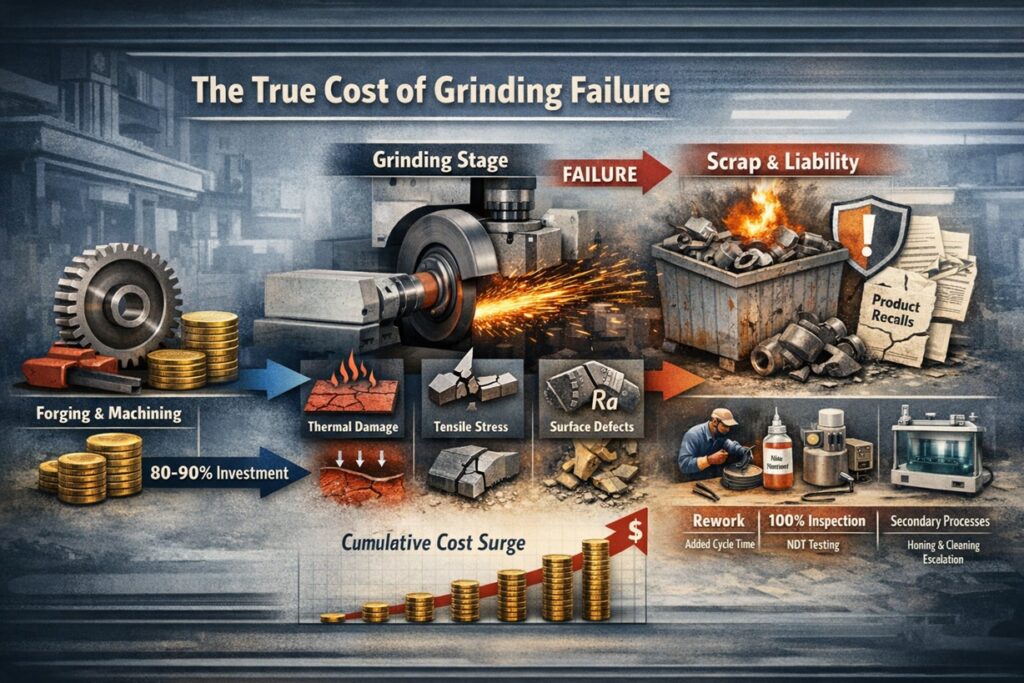
The Value-Added Axiom: “The economic impact of a defect is directly proportional to its proximity to the final assembly. In grinding, because it is the final step, the cost of quality failure is at its absolute peak. Managing grinding conditions is therefore a fundamental strategy for capital preservation.”
Defining Quality Failure: Beyond Visual Defects
In many legacy facilities, “poor conditions” are mistakenly defined only by obvious visual failures such as chatter marks or surface discoloration. However, the most damaging conditions are often latent, residing beneath the surface. These include unstable thermal cycles that lead to tensile residual stress or microscopic cracks that pass initial inspection but cause premature fatigue failure in the field. This necessitates a shift in focus from mere dimensional compliance to the preservation of metallurgical integrity.
The Shift to Energy-Based Cost Optimization
Modern competitive manufacturing utilizes the Taguchi Loss Function to evaluate the economic impact of quality. This model demonstrates that cost increases quadratically as a process deviates from its target value, even if the part remains within the formal tolerance band. Poor grinding conditions push the process toward these limits, necessitating secondary processing steps—such as additional de-magnetization, extra washing, or corrective honing—that were never intended in the original cost model.
Equation 1.1: Taguchi Quality Loss Function as a Driver for Rework Costs
By analyzing the Total Cost of Ownership (TCO), we see that the price of the abrasive tool is often a minor fraction of the total cost-per-part. The true productivity leaks are found in the variability that forces rework. This report will dismantle the traditional view of grinding economics and demonstrate why a deterministic approach to process stability is the only viable path to achieving a sustainable competitive edge.
2. The Mechanism of Surface Integrity Failure
The economic fallout of rework begins at the microscopic interface between the abrasive grain and the workpiece crystal lattice. Surface integrity failure is not a random occurrence but a deterministic result of thermal and mechanical energy exceeding the material’s threshold. In precision grinding, over 80% of the spindle power is converted into heat within the grinding zone. If this energy is not managed through correct parameter selection, it triggers a series of metallurgical alterations that render the part non-compliant, necessitating expensive secondary processing or immediate disposal.
Thermal Flux and Phase Transformation Mechanism
The most prevalent mechanism of quality failure is thermal injury, commonly known as grinding burn. When the flash temperature at the contact arc exceeds the tempering temperature of the steel, the surface undergoes localized softening (re-tempering). If the temperature surpasses the austenitic transformation point (Ac3), followed by rapid quenching by the coolant, a layer of untempered martensite (UTM) forms. This “white layer” is extremely brittle and harbors high levels of internal stress.
Equation 2.1: Maximum Surface Temperature Mechanism in the Grinding Zone
From a rework perspective, thermal damage is catastrophic. Because the phase transformation alters the volumetric properties of the surface, it often induces micro-cracking that extends deep into the substrate. Reworking such a part by simply taking another grinding pass is often futile; the thermal damage may have already compromised the case-depth requirements. Furthermore, identifying this damage requires 100% Non-Destructive Testing (NDT) such as Nital etching, which adds significant labor and chemical disposal costs to the production line.
Residual Stress Transition: Compressive to Tensile
Beyond metallurgical phase changes, the mechanical performance of a ground component is dictated by its residual stress profile. A stable, well-optimized grinding process imparts beneficial compressive residual stress, which inhibits crack propagation and enhances the fatigue life of the part. However, poor grinding conditions—characterized by high friction and dull grains—shift this profile toward tensile residual stress.
The Integrity Axiom: “Tensile stress is an invisible defect that compromises the fatigue life of high-performance drivetrain components. For Tier-1 suppliers, this necessitates secondary operations to restore the surface state. These are classic examples of quality loss that could be eliminated by mastering the initial grinding mechanism.”
Surface Topography and Vibration-Induced Defects
Surface finish (Ra, Rz) and micro-geometry are often compromised by vibration and chatter. This mechanism is typically rooted in a lack of system rigidity or an unbalanced grinding wheel. Chatter marks are not merely aesthetic defects; they represent periodic variations in the material removal rate that affect the aerodynamic or tribological performance of the part.
When chatter occurs, the rework cycle involves a “spark-out” pass or a decrease in the material removal rate (Q’w) to dampen the harmonics. This intervention directly inflates the cycle time and consumes additional machine overhead. Avoiding this requires a deterministic approach to wheel balancing and dressing, ensuring that the topography remains “open” and capable of carrying coolant into the grinding zone to maintain thermal stability.
Understanding these failure mechanisms is the prerequisite for calculating the true cost of quality. By recognizing how thermal and mechanical stresses interact, manufacturers can move away from reactive “salvage” operations and toward a robust, zero-rework production environment.
3. The Hidden Mathematics of Rework Costs
Traditional manufacturing accounting often underestimates the true cost of rework by focusing solely on additional labor hours. In precision grinding, however, the financial impact is non-linear. When poor grinding conditions necessitate a secondary “salvage” pass, the cost is not merely the sum of the extra minutes on the machine; it includes the disruption of the entire production flow and the erosion of the available machine capacity. To quantify this, we must look at the total manufacturing cost through the lens of process stability.
Direct Rework Expenses and Overhead Absorption
The direct cost of rework (Crework) involves the labor rate (Lr), the additional machine overhead (Om), and the incremental abrasive consumption. Because grinding machines are capital-intensive assets, every minute spent on rework is a minute lost for new production. This creates an opportunity cost that is often twice the value of the direct labor involved. If a rework cycle is required for 10% of a batch, the effective machine rate for that batch increases proportionally, drastically reducing the net profit margin.
Equation 3.1: Cumulative Cost Model for Reworked Precision Components
Setup Inefficiency and Lean Disruption
One of the most damaging “hidden” costs is the disruption of lean manufacturing flow. A rework requirement often forces a “break-in” setup, where the current production batch is stopped to accommodate the salvage of defective parts. This necessitates a complete teardown and a new setup, doubling the non-productive time (Tsetup). In high-mix environments, this instability can lead to a domino effect, where every subsequent batch is delayed, incurring late-delivery penalties and damaging customer relationships.
Technical Risk: Case Depth Erosion
There is also a significant technical risk associated with the “Hidden Mathematics” of rework. In parts requiring specific surface hardness, such as induction-hardened gears or shafts, every additional grinding pass removes a portion of the hardened layer. If rework consumes too much of this “case depth,” the part may pass dimensional inspection but fail to meet the functional requirements for wear resistance. This transforms a reworkable part into a total scrap loss—the ultimate quality failure.
The Financial Axiom: “The most expensive part in a factory is not the one made with the most advanced technology; it is the one that has been ground twice. Eliminating rework is the fastest way to increase the Net Hourly Throughput without capital expenditure.”
Ultimately, mastering the economic calculation of these intervals allows manufacturers to identify where the real productivity leaks occur. To mitigate these losses, organizations must move beyond the spindle speed and focus on the cost of variability, which we will explore further in the context of secondary processing escalation.
4. Secondary Processing Escalation: The Domino Effect
The true cost of poor grinding conditions is rarely confined to the grinding cell itself. It functions as a “Domino Effect” that destabilizes the entire downstream manufacturing sequence. When a grinding process operates outside its optimal window, it produces workpieces with surface characteristics that necessitate unplanned secondary operations. These operations—often manual or semi-automated—are high-cost centers that significantly inflate the total lead time and the cost-per-part (Cp).
Extended Honing and Superfinishing Cycles
In the production of high-precision shafts or bearings, grinding is followed by superfinishing or honing to achieve final Ra values below 0.1 µm. However, if the initial grinding finish is compromised by chatter or a high peak-to-valley height (Rz), the superfinishing stage must work harder to remove these deep “valleys.” This necessitates longer cycle times and increased consumption of expensive finishing stones or diamond tapes. A process designed for a 15-second finishing cycle may suddenly require 45 seconds just to “save” a poorly ground surface, effectively creating a bottleneck that reduces the entire plant’s throughput.
Equation 4.1: The Escalation Mechanism of Secondary Processing Time
Metrology Overload and 100% Inspection
When grinding conditions are unstable, “Statistical Process Control (SPC)” loses its validity. Because the process is no longer capable, the Quality Control (QC) department must shift to 100% inspection. This necessitates high-frequency Non-Destructive Testing (NDT) such as Nital Etching or Barkhausen Noise Analysis to detect invisible thermal damage. These inspection methods are labor-intensive, require hazardous chemical management, and create an administrative burden that is never accounted for in the initial grinding quote.
Cleaning and Grit Embedment Issues
A dull or “loaded” grinding wheel does not cut cleanly; it “plows” the material, often embedding microscopic abrasive grit and metal swarf into the workpiece surface. This surface contamination is incredibly difficult to remove and often survives standard cleaning cycles. If these particles migrate into the final assembly—such as a hydraulic valve or an EV motor—they act as abrasive contaminants that cause premature field failure. To prevent this, manufacturers must implement expensive ultra-sonic cleaning or specialized multi-stage degreasing, directly adding to the Cp.
The Secondary Axiom: “Rework is the most visible sign of failure, but the ‘Domino Effect’ of secondary processing is the most expensive. A minute saved in grinding by using aggressive parameters (Q’w) is often surrendered ten-fold in the downstream finishing and cleaning departments.”
By stabilizing the grinding mechanism at its source, we eliminate the need for these reactive secondary operations. The strategic focus must therefore remain on “First-Stage Correctness” to ensure that the production dominoes fall toward profitability rather than loss.
5. Scrap and Liability: The Ultimate Quality Loss
When grinding conditions deviate beyond the “salvageable” threshold, the result is scrap. In the context of “Last-Stage” machining, scrap is the ultimate economic failure. At this point, the workpiece has reached its maximum value-added state, incorporating the costs of raw material, heat treatment, and multiple preceding machining operations. Scrapping a part at this terminal stage means the 100% loss of all prior investments. This is the most direct mechanism of profit erosion in a precision manufacturing facility.
The Non-Recoverable Investment Loss
The financial impact of scrap is not just the cost of the raw material. It is the cumulative loss of “Machine-Hours” and “Energy-Units” that can never be recovered. If a facility has a 5% scrap rate in grinding, it must essentially run the entire factory 5% harder just to break even on its production targets. This hidden tax on productivity reduces the Overall Equipment Effectiveness (OEE) and forces the plant into a reactive mode, where capacity is wasted on replacing lost parts rather than fulfilling new orders.
Equation 5.1: Cumulative Loss Mechanism for Terminal-Stage Scrap
The Liability Risk: Latent Defects in the Field
The most dangerous outcome of poor grinding conditions is the “Latent Defect”—a part that passes all quality checks but contains internal damage like tensile residual stress or micro-cracks. These parts eventually fail in the field under operational fatigue. The resulting product liability costs, including warranty claims, recalls, and brand damage, can be orders of magnitude higher than the original cost of the part. For aerospace or automotive Tier-1 suppliers, a single catastrophic field failure can lead to legal consequences and the permanent loss of major contracts.
The Liability Axiom: “In the era of data-driven quality, a latent defect is a ticking financial time bomb. The cost of preventing a defective part through stable grinding is always lower than the cost of discovering that defect in the hands of the end-user.”
Deterministic Quality as the Only Solution
To mitigate the risk of scrap and liability, the manufacturing philosophy must shift from “Quality by Inspection” to “Quality by Design.” This requires a deterministic understanding of the grinding mechanism—ensuring that parameters are selected not for speed, but for absolute metallurgical safety. By stabilizing the thermal and mechanical energy partition, the probability of latent defects is minimized, securing the financial future of the production line.
The conclusion of this report will synthesize these findings into a strategic roadmap for achieving a zero-defect, zero-rework grinding environment that maximizes the profitability of the entire facility.
6. Conclusion: Achieving a Zero-Rework Strategic Equilibrium
The comprehensive analysis of the grinding process reveals that the traditional obsession with cycle time (Tc) reduction is an incomplete, and often dangerous, strategy for modern manufacturing. True manufacturing excellence is achieved through a Strategic Equilibrium—a state where the mechanism of process stability and the efficiency of the cutting cycle are perfectly synchronized. As demonstrated throughout this report, the most significant productivity gains are realized not through the velocity of the spindle, but through the deterministic elimination of variability and non-productive rework intervals (Irework).
The Holistic Productivity Mechanism
To sustain this equilibrium, organizations must shift their focus toward Net Salable Yield (Ynet). By mastering the mechanisms of geometric integration, thermal stabilization, and energy partition, manufacturers can absorb the complexities of high-precision production without the traditional cost penalties of scrap and secondary processing. The integration of real-time monitoring and automated compensation further reinforces this stability, transforming the grinding cell from a variable-dependent “art” into a science-based profit center.
The Final Axiom: “The ultimate grinding process is one that achieves industrial-grade stability, rendering subsequent micro-adjustments and re-passes unnecessary. In the future of high-precision manufacturing, agility is the new speed, and stability is the new efficiency.”
Summary of Strategic Pillars
The path to achieving this zero-rework environment rests on three fundamental pillars:
In conclusion, the optimization of grinding operations is a multi-dimensional engineering challenge that directly impacts the bottom line. By respecting the physical limits of the material and prioritizing the mechanism of process integrity, the grinding stage becomes a reliable, high-yield engine of value creation. Manufacturers who implement these deterministic strategies will not only survive the transition toward increasingly tighter tolerances but will lead the market through superior quality and resilient economic performance.
References & Technical Resources
Primary Engineering References
- • Malkin, S., & Guo, C. (2008). Grinding Technology: Theory and Applications of Machining with Abrasives. Industrial Press.
- • Rowe, W. B. (2014). Principles of Modern Grinding Technology. William Andrew. (Thermal mechanisms and stability focus).
- • Marinescu, I. D., et al. (2006). Handbook of Machining with Grinding Wheels. CRC Press. (Economic modeling of consumables and waste).
- • Taguchi, G. (1986). Introduction to Quality Engineering. Asian Productivity Organization. (Quality loss function analysis).
Internal Technical Deep-Dive
For further exploration of the environmental and economic principles discussed in this report, please refer to the following internal technical modules:
LOSS ANALYSIS:
Thermal Damage vs Scrap Cost: Quantifying the Real Cost of Grinding Burn
QUALITY & YIELD:
Process Capability (Cp, Cpk) in Grinding: Why Surface Integrity Matters for Yield
PROCESS STABILITY:
Grinding Process Stability: Why Stable Processes Reduce Total Manufacturing Cost
TOLERANCE IMPACT:
Precision Grinding Tolerances: When Tighter Specs Multiply Costs