1. Introduction: The False Efficiency of the “Fast” Cycle
In high-precision manufacturing, particularly within the abrasive machining domain, a pervasive logical fallacy exists among engineers: equating the reduction of visible Cycle Time with overall productivity gains. Technical departments often dedicate disproportionate engineering hours to maximizing the Metal Removal Rate (MRR), aiming to shave off marginal seconds from the spark-out or rapid-feed phases. However, this narrow optimization often ignores the critical mechanism of loss within the Overall Equipment Effectiveness (OEE) framework—the dominant impact of Setup Time on actual throughput.
When a process is hyper-optimized for cycle speed without a corresponding improvement in changeover agility, manufacturers fall into a state of “False Efficiency.” Regardless of how fast the active grinding phase performs, any failure to control the micro-scale physical errors during the setup phase inevitably leads to first-part scrap and prolonged, reactive adjustment periods. These non-productive time leaks frequently negate the marginal gains achieved through cycle speed. Consequently, the true mechanism of productivity improvement lies not in the velocity of the cut, but in how deterministically the system absorbs the downtime associated with batch transitions.
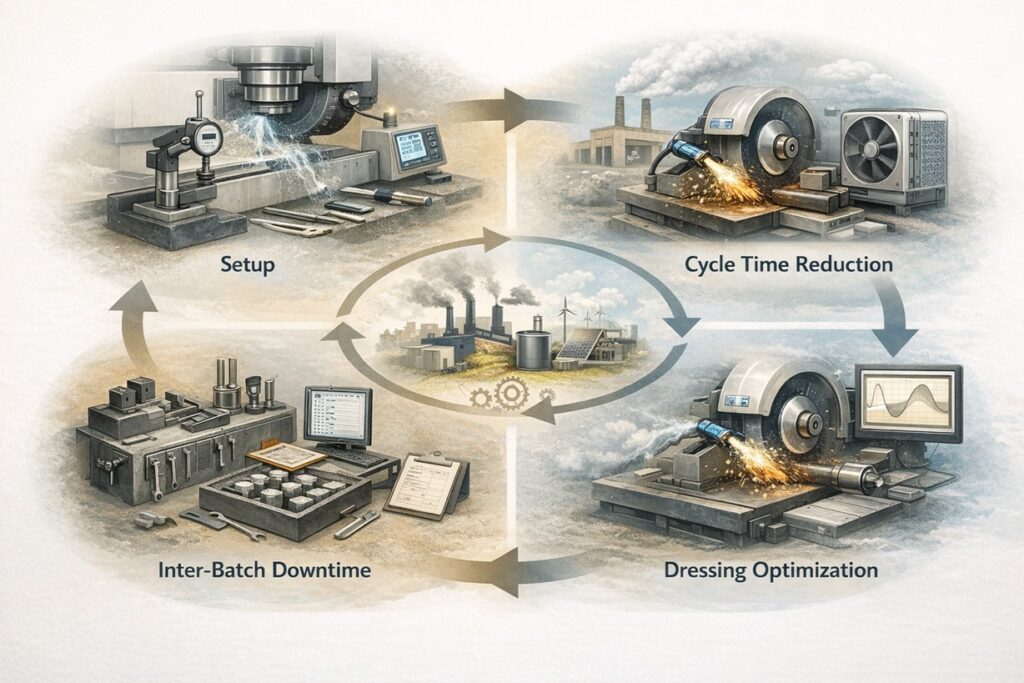
The OEE Mechanism and Setup Sensitivity
Within the mechanism that dictates OEE, setup time is not merely a waiting period; it is the fundamental baseline that determines process stability. As manufacturing shifts toward High-Mix Low-Volume (HMLV) production, the sensitivity of the total manufacturing cost to Tsetup increases exponentially. If aggressive cycle targets complicate the setup or necessitate frequent mid-batch recalibrations, the resulting instability compromises the economic viability of the entire operation.
The Productivity Axiom: “True productivity is defined not by the speed of machining, but by the net volume of salable parts produced per unit of time (Net Yield). The moment incremental gains in cycle speed are surrendered to setup instability, the process loses its competitive edge.”
This engineering deep-dive explores the complex correlation between setup precision and cycle efficiency from both physical and economic perspectives. Having defined the structure of the “False Efficiency” trap in this introductory chapter, the subsequent sections will analyze the mechanism of setup-induced variability and provide concrete engineering solutions, including SMED strategies and automated compensation systems, to achieve a sustainable strategic equilibrium.
2. The Mechanism of Setup-Induced Variability
In a deterministic grinding process, the transition from a non-productive state to an active cutting state is governed by the precision of the initial configuration. Setup-Induced Variability refers to the stochastic deviations introduced during mechanical alignment and parameter input. The primary mechanism of this variability is rooted in the Geometric Integration of the machine-tool-workpiece system, where even sub-micron misalignments can lead to significant process instability.
Geometric Integration and Structural Loop Errors
The precision of a setup is limited by the cumulative tolerances within the machine’s structural loop. Any error in Workhead Centering or fixture repeatability forces the grinding wheel to “correct” these deviations during the initial passes. This correction phase increases the Specific Grinding Energy, causing non-uniform wheel wear and compromising the Process Capability (Cpk) from the very first part. The total variability is a result of the following mechanism:
Equation 2.1: Correlation Mechanism between Setup Precision and Total Process Variance
Thermal Expansion and Calibration Drift
A critical but often overlooked mechanism in setup variability is the Thermal Expansion Coefficient of the machine components. If the initial calibration is performed before the spindle and machine bed reach thermal equilibrium, a Calibration Drift will manifest as the batch progresses. This necessitates reactive “Micro-Setups” or mid-batch offsets, which are essentially hidden downtime leaks that compromise the intended cycle efficiency.
Ultimately, mastering the mechanism of these initial alignments allows manufacturers to shift from a “trial-and-error” setup to a deterministic flow. By stabilizing the setup, we not only reduce Tsetup but also eliminate the reactive adjustments that plague aggressive cycle time targets.
3. Cycle Time Reduction: The Law of Diminishing Returns
In the aggressive pursuit of higher throughput, the most common strategy is the systematic reduction of Active Cycle Time. However, the abrasive machining process is governed by the laws of thermodynamics, where increasing the feed rate (vf) beyond a critical threshold triggers a non-linear rise in thermal flux. This leads to the “Law of Diminishing Returns,” where marginal gains in cycle speed are negated by the exponential increase in quality-related costs and wheel degradation.
Specific Grinding Energy and the Thermal Damage Mechanism
The primary mechanism behind process failure during cycle time reduction is the spike in Specific Grinding Energy (us). As the Metal Removal Rate (MRR) is pushed higher, the energy required to remove a unit volume of material increases due to heightened plowing and rubbing interactions. When the heat evacuation capacity of the coolant is exceeded, the resulting thermal flux causes “Grinding Burn,” leading to tensile residual stresses and subsurface cracks that compromise the integrity of the part.
The Trade-off Between Intensity and Stability
Pushing the cycle time to its physical limit alters the mechanism of wheel wear from steady-state attrition to rapid bond fracture. This necessitates more frequent dressing compensation, which shortens the total life of the grinding wheel and increases the frequency of “Internal Setup” interventions. Paradoxically, the machine may be running faster, but it produces fewer salable parts over its operational window due to the surge in Tadj and scrap rates.
To transcend the diminishing returns of speed, manufacturers must transition from Time-Based Optimization to Energy-Based Optimization. By understanding the mechanism of energy partition, cycles can be designed to stay within the metallurgical safe zone, ensuring that the reduction in cycle time does not trigger an uncontrollable spike in total manufacturing costs.
4. The Hidden Gap: Inter-Batch Downtime and Economic Impact
The true cost of manufacturing is rarely found within the active grinding cycle; instead, it resides in the “Hidden Gap” between batches. Inter-Batch Downtime represents the cumulative period where capital-intensive equipment remains idle during changeovers. The primary mechanism of this loss is the lack of synchronization between the setup process and the production schedule, which causes fixed cost absorption to stall, driving up the total cost per part (Cp).
The Batch-Setup Sensitivity Mechanism
In modern production, batch sizes (N) are decreasing to minimize inventory carrying costs. However, as N drops, the sensitivity of the total manufacturing cost to Setup Time (Ts) increases exponentially. This economic mechanism dictates that a 50% reduction in cycle time may have a negligible impact on the bottom line if the setup gap remains static. The relationship between production volume and cost efficiency is defined by the following economic model:
Equation 4.1: Batch-Dependent Manufacturing Cost Modeling Mechanism
Fixed Cost Absorption and Opportunity Loss
The “Hidden Gap” triggers a mechanism of opportunity loss. When a machine is idle for a 4-hour setup to save 10 seconds per part on a 100-piece batch, the economic logic fails. Every minute of Ts is a minute where the machine’s depreciation and energy overhead are paid for without generating Net Salable Yield. This gap is the silent killer of profitability in high-precision grinding cells, especially when Tadj (adjustment time) further inflates the changeover period due to setup instability.
Ultimately, mastering the economic mechanism of these intervals allows manufacturers to identify where the real productivity leaks occur. To mitigate these losses, organizations must look beyond the spindle speed and focus on the time lost between the last good part of Batch A and the first good part of Batch B. This necessitates a shift toward rapid changeover strategies, which will be explored in the following section.
5. Rapid Changeover (SMED) in Grinding Operations
To eliminate the “Hidden Gap” identified in the previous chapter, manufacturers must re-engineer the changeover process using Single Minute Exchange of Die (SMED) principles. In grinding, the mechanism of SMED is unique because it must account for sub-micron centering and dressing stability. The core strategy involves decoupling the Internal Setup (tasks that require the machine to be stopped) from the External Setup (tasks that can be performed while the machine is still running).
The Internal-to-External Conversion Mechanism
The most effective way to reduce Ts is to move tasks such as wheel mounting, fixture cleaning, and program verification outside the production window. By utilizing Offline Pre-setting Gauges, the geometric offsets can be measured and digitized before the batch transition occurs. This mechanism ensures that the machine only stops for the final physical swap, minimizing the non-productive interval and allowing the spindle to return to an active state within minutes rather than hours.
Strategy: Converting to External Setup
The mechanism of rapid setup relies on ensuring that the “Internal Setup” is strictly reserved for physical component exchanges. All cognitive tasks—searching for tools, verifying dimensions, and loading programs—must be externalized. By treating the changeover as a “surgical strike,” the variance in Ts is minimized, leading to a highly predictable and deterministic manufacturing flow.
High-Precision Quick-Change Hardware
The physical mechanism of rapid setup relies on Kinematic Coupling and standardized zero-point clamping systems. These technologies allow for the repeatable positioning of fixtures and wheels with micron-level accuracy without manual dialing. When combined with Automatic Tool Measurement (ATM), the need for the traditional “Trial-and-Error” first-part adjustment (Tadj) is virtually eliminated. This technological integration transforms the grinding cell into an agile unit capable of handling diverse batches without the typical setup penalty.
By mastering these SMED mechanisms, organizations effectively decouple batch size from unit cost. This agility allows for the profitable production of custom, high-precision components without the traditional constraints of long changeover times. The next critical step is ensuring that this setup quality translates directly into the active cycle through optimized dressing operations.
6. Dressing Optimization: The Link Between Setup and Quality
Even the most precise mechanical setup is rendered ineffective if the interface between the grinding wheel and the workpiece is compromised. Dressing Optimization is the critical mechanism that bridges the gap between the static setup and the dynamic cutting process. It restores the wheel’s topography and ensures that the Cutting Edge Density is perfectly synchronized with the required surface finish and material removal rate.
The Overlap Ratio and Surface Integrity Mechanism
The primary control variable in the dressing mechanism is the Overlap Ratio (Ud). This ratio defines how many times a single point on the wheel width is contacted by the dresser, directly influencing the “sharpness” of the wheel. An improper overlap ratio leads to either wheel glazing (high thermal risk) or excessive dressing (shortened wheel life), both of which trigger the non-productive downtime of Tadj.
Equation 6.1: The Mechanism of Dressing Overlap Ratio and Wheel Topography
Dresser Wear and Initial Stabilization
Another vital mechanism in setup precision is the wear state of the diamond dresser. As the dresser tip flattens, the effective width (bd) changes, causing an unintended shift in the overlap ratio. High-performance grinding requires Acoustic Emission (AE) Sensors to detect the exact “touch-off” point, eliminating “Air Dressing” and ensuring the dressing depth is controlled to sub-micron levels, preserving the wheel’s life and the process’s stability.
Optimizing the dressing mechanism completes the transformation of the grinding process into a deterministic system. With a stable setup, rapid changeover, and a perfectly dressed wheel, manufacturers can finally achieve the strategic equilibrium between setup time and cycle time, ensuring that quality is built into the process from the very first part of the batch.
7. Strategic ROI: Investing in Automated Setup Technology
As the complexity of grinding operations increases, the limitations of manual configuration become a primary bottleneck. Investing in Automated Setup Technology—such as In-process Gauging and Automatic Tool Measurement (ATM)—is not merely a technical upgrade but a strategic financial decision. The economic mechanism of this investment relies on the drastic reduction of Tadj (adjustment time), ensuring that the machine reaches a “First-Part-Correct” state without the traditional trial-and-error waste.
The ROI and Payback Period Mechanism
The justification for automation resides in the Net Present Value (NPV) of the recovered productive hours. By automating the touch-off and compensation cycles, the mechanism of cost recovery is accelerated through higher fixed-cost absorption. The financial viability is typically modeled by calculating the Payback Period (PBP), where the initial capital expenditure (CapEx) is offset by the cumulative reduction in labor costs and scrap-related losses:
Equation 7.1: Mechanism for Calculating Return on Investment in Setup Automation
Beyond Labor Savings: The Capacity Mechanism
While labor reduction is a visible metric, the more potent mechanism of ROI is the creation of Hidden Capacity. Automating the setup allows a single operator to manage multiple cells, and more importantly, it enables the machine to run high-precision batches during unmanned shifts. This shift from reactive manual labor to proactive automated oversight transforms the grinding cell into a deterministic profit center, where the payback is realized not just in minutes saved, but in the reliability of the entire production value chain.
In summary, the mechanism of strategic ROI in setup technology hinges on eliminating the variability that human intervention inherently introduces. By securing the setup through automation, manufacturers can confidently scale their throughput without a linear increase in overhead, setting the stage for the transition from “Artisan-based” to “Data-driven” manufacturing.
8. Human Factor vs. Deterministic Manufacturing
Historically, grinding has been viewed as an “Art”—a process where the quality of the setup and the efficiency of the cycle depend heavily on the intuition and experience of a master craftsman. However, this reliance on the human factor introduces an uncontrollable mechanism of variability into the production line. To achieve true scalability, manufacturers must transition toward Deterministic Manufacturing, where the process is governed by data, physics-based models, and standardized digital protocols.
The Digital Manual and Cpk Stabilization
The primary mechanism for eliminating human-induced variance is the implementation of Standardized Digital Setup Manuals. By digitizing every variable—from clamping torque to dresser depth—the “Tribal Knowledge” of the operator is replaced by a repeatable science. This shift ensures that Process Capability (Cpk) remains consistent across different shifts and different operators, effectively decoupling the quality of the output from the seniority of the workforce.
Key Advantage: Science-Based Standardization
The mechanism of deterministic manufacturing relies on the “Copy-Exactly” philosophy. When a setup is defined by objective data rather than subjective feel, the time spent on “tweaking” or manual adjustments (Tadj) is reduced to near-zero. This allows for a predictable and robust production flow that can be replicated across global manufacturing sites without loss of precision.
Closing the Skill Gap with Data
By leveraging Machine Learning (ML) and real-time feedback loops, the system itself can assist less experienced operators in achieving expert-level results. This mechanism of augmented intelligence ensures that even in an environment with high labor turnover, the core grinding competence remains within the organization’s digital infrastructure. The focus shifts from training operators how to “feel” the wheel to training them how to interpret and act on deterministic process data.
As we move away from artisan-based methods, the need for continuous oversight becomes paramount. This leads us to the critical role of real-time monitoring in capturing and eliminating any remaining productivity leaks within the grinding cell.
9. Real-Time Monitoring: Capturing the Productivity Leaks
The final frontier in eliminating the “False Efficiency” of a cycle is the deployment of Real-Time Monitoring systems. While a setup may appear efficient on paper, the physical mechanism of production often hides “ghost” downtime—micro-intervals where the spindle is idling or “cutting air.” By integrating power, vibration, and acoustic emission (AE) sensors, manufacturers can visualize the true state of the grinding cell and capture the leaks that erode the Net Salable Yield.
Sensor Fusion and Idle Time Detection
The mechanism of digital monitoring relies on Sensor Fusion. Acoustic Emission sensors, for instance, detect the exact micro-second the wheel contacts the workpiece or dresser, allowing for the total elimination of “Air Grinding” during the approach phase. Concurrently, power monitoring captures the energy signature of the setup-to-cycle transition, identifying whether an operator is spending excessive time on manual adjustments or if the machine is waiting for material handling.
Closing the Loop: Data to Decision
Ultimately, monitoring serves as the feedback mechanism for the entire manufacturing strategy. It provides the empirical data required to validate the ROI of automation and the effectiveness of SMED implementations. When the “Hidden Gap” is visualized through real-time dashboards, it ceases to be an abstract engineering problem and becomes a manageable operational metric, allowing for continuous improvement in both setup agility and cycle efficiency.
By capturing these leaks, we can now look at a holistic application. The following case study will demonstrate how balancing these mechanisms yields tangible benefits in a high-mix, low-volume production environment.
10. Case Study: Balancing Setup and Cycle for Maximum Yield
To validate the integrated impact of the mechanisms discussed, we analyzed a high-precision aerospace component cell operating in a High-Mix Low-Volume (HMLV) environment. In this scenario, the average batch size (N) was reduced from 50 to 10 pieces to meet JIT requirements. Traditionally, such a shift would result in a massive spike in unit costs due to the disproportionate weight of Tsetup. However, by prioritizing setup agility over marginal cycle time reduction, the facility achieved a superior strategic equilibrium.
Economic Impact of the 50% Setup Reduction
The primary mechanism for cost containment was the implementation of standardized zero-point clamping and offline tool pre-setting. By reducing the Inter-Batch Downtime by 50%, the “Hidden Gap” was bridged without compromising the surface integrity of the parts. The following data highlights the shift in economic performance when setup precision is prioritized over aggressive cycle speed:
Sustainability and Carbon Reduction Mechanism
An unexpected but significant mechanism of improvement was the reduction in the facility’s carbon footprint. By ensuring First-Part-Correct capability, the energy and material waste associated with scrap and re-grinding were nearly eliminated. Furthermore, a stable setup allowed for more efficient coolant delivery and lower power consumption per salable unit. This case study confirms that the most sustainable process is also the most profitable: one that maximizes Net Yield by stabilizing the initial setup.
The results demonstrate that in HMLV production, focusing on the mechanism of setup efficiency provides a far higher ROI than marginal cycle time reductions. By embracing this balanced philosophy, the facility not only lowered its unit cost but also increased its overall resilience to market fluctuations.
11. Conclusion: Achieving Equilibrium in High-Precision Grinding
The comprehensive analysis of the grinding process reveals that the traditional obsession with cycle time reduction is an incomplete strategy for modern manufacturing. True manufacturing excellence is achieved through a Strategic Equilibrium—a state where the mechanism of setup precision and the efficiency of the cutting cycle are perfectly synchronized. As demonstrated throughout this report, the most significant productivity gains are realized not through the velocity of the spindle, but through the deterministic elimination of variability and non-productive intervals.
The Holistic Productivity Mechanism
To sustain this equilibrium, organizations must shift their focus toward Net Salable Yield. By mastering the mechanisms of geometric integration, thermal stabilization, and rapid changeover (SMED), manufacturers can absorb the complexities of high-mix production without the traditional cost penalties. The integration of real-time monitoring and automated compensation further reinforces this stability, transforming the grinding cell from a variable-dependent “art” into a science-based profit center.
The Final Axiom: “The ultimate setup is one that achieves industrial-grade stability, rendering subsequent micro-adjustments unnecessary. In the future of high-precision manufacturing, agility is the new speed, and stability is the new efficiency.”
Summary of Strategic Pillars
The path to achieving this equilibrium rests on three pillars: Physical Robustness (stabilizing the setup), Economic Agility (reducing the hidden gap), and Deterministic Oversight (leveraging data over intuition). Manufacturers who implement these mechanisms will not only survive the transition toward increasingly smaller batch sizes but will lead the market through superior quality and resilient economic performance.
In conclusion, the optimization of grinding operations is a multi-dimensional engineering challenge. By respecting the physical limits of the material and prioritizing the mechanism of the changeover, the grinding process becomes a reliable, high-yield engine of value creation.
References & Technical Resources
Primary Engineering References
- • Malkin, S., & Guo, C. (2008). Grinding Technology: Theory and Applications of Machining with Abrasives. Industrial Press. (Core analysis of the energy partition mechanism).
- • Rowe, W. B. (2014). Principles of Modern Grinding Technology. William Andrew. (Detailed study on process stability and thermal mechanisms).
- • Shingo, S. (1985). A Revolution in Manufacturing: The SMED System. Productivity Press. (The foundational mechanism for rapid setup and changeover).
- • Marinescu, I. D., et al. (2006). Handbook of Machining with Grinding Wheels. CRC Press. (Economic modeling of consumables and setup-related waste handling).
Internal Technical Deep-Dive
For further exploration of the economic and stability principles discussed in this report, please refer to the following internal technical modules:
COST ARCHITECTURE:
Why Grinding Costs Vary So Widely: Hidden Factors Beyond Wheel Price
PROCESS STABILITY:
Grinding Process Stability: Why Stable Processes Reduce Total Manufacturing Cost
STRATEGIC ROI:
Grinding Automation ROI: When Does Automation Actually Pay Off?
QUALITY & YIELD:
Process Capability (Cp, Cpk) in Grinding: Why Surface Integrity Matters for Yield
PRODUCTION STRATEGY:
Batch Size Effects in Grinding: How Volume Changes Cost Efficiency