1. The Raw Data Illusion: Why Grinding Force Signaling Lies
In modern automated manufacturing, real-time process monitoring relies heavily on force sensors to guard surface integrity. However, production engineers frequently fall into the trap of the Static Fallacy—the unquestioned assumption that raw data streaming from a dynamometer or spindle drive represents the true mechanical interaction at the cutting point. In reality, grinding force data is a highly complex composite signal. What appears on the monitor as a steady, predictable cutting force is often a distorted waveform masked by external system variables, creating a dangerous operational illusion.
The Signal-to-Noise Conundrum: Identifying the True Cutting Force
The fundamental challenge of data interpretation lies in separating the real chip-formation force from surrounding system noise. A raw force signal captures everything simultaneously: the structural vibrations of the machine frame, the hydrodynamic resistance of the high-pressure fluid, and the inertial shifts of the axis acceleration. When an engineer overlooks this Hidden Constraint, they cannot accurately determine if a sudden spike in force indicates structural tool wear or merely a momentary fluctuation in coolant delivery pressure. Without decoupling these forces, true process control remains impossible.
The Composite Grinding Force Signal Equation
Fmeasured = Fcutting + Fcompliance + Fhydrodynamic + Finertia
Where Fmeasured is the raw sensor output, Fcutting is the actual force shaping the material, Fcompliance represents structural deflection losses, Fhydrodynamic is fluid pressure resistance, and Finertia accounts for dynamic machine acceleration noise.
The Anatomy of Distortion: Three Pillars of Data Deception
To build a reliable monitoring system, engineers must understand the physical infrastructure—the Anatomy—of signal distortion. Mechanical compliance inside the machine spindle causes force signals to lag behind actual cutting events. Simultaneously, high-speed fluid dynamics introduce hydro-mechanical forces that register on sensors before the grinding wheel even touches the metal workpiece. Finally, thermal expansions within the machine tool housing alter the baseline calibration mid-cycle, turning an otherwise stable process into an unpredictable Scrap Trigger.
Table 1.1: Signal Components vs. Real Physical States
| Signal Phenomenon | Typical Sensor Manifestation | Actual Machine Floor Reality | Process Security Status |
|---|---|---|---|
| Uncompensated Force Peak | Abrupt, linear force climb on monitor | Hydrodynamic fluid accumulation & wheel glazing | Misleading Wear Alarm |
| Attenuated Steady Signal | Artificially flat, low-force profile | Structural deflection absorbing real contact pressure | Hidden Out-of-Tolerance Risk |
Avoiding severe geometric errors and unexpected surface burning requires a strict Deterministic Assessment of raw data structures. Operators cannot treat digital monitor readings as absolute truths; they must actively filter out structural and environmental noise. Isolate and remove these misleading signal layers to ensure reliable Quality Stability, accurate tool life tracking, and highly predictable cycles across precision production lines.
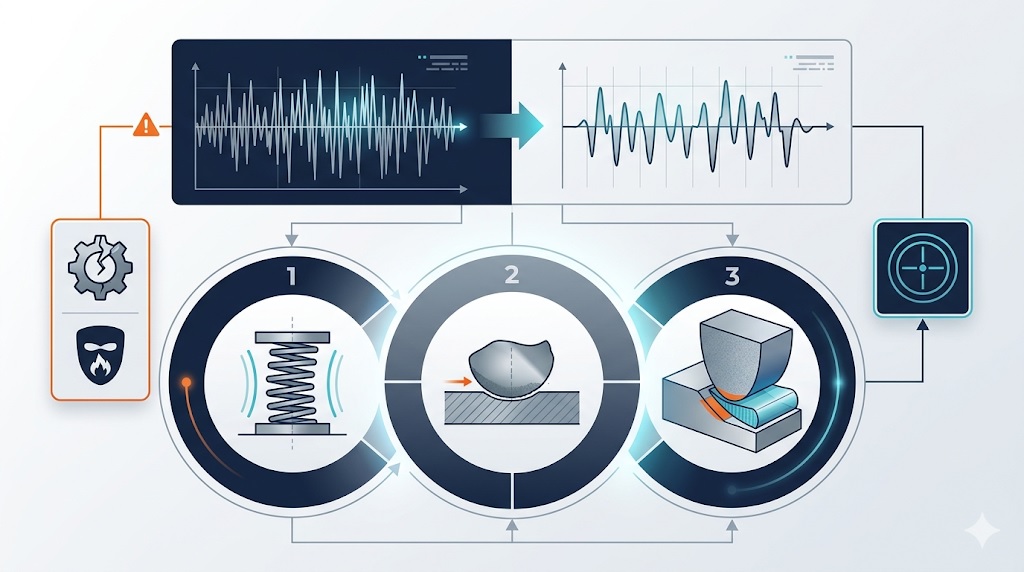
2. Dynamic Distortion: The Machine Stiffness Trap and Structural Compliance
The second layer of data deception occurs within the structural domain of the machine tool. A common misstep among manufacturing analysts is treating the grinding system as a perfectly rigid mechanism. In reality, every component—from the heavy cast-iron bed to the high-speed spindle bearings—possesses a finite structural compliance. This material flexibility introduces a severe Hidden Constraint: when cutting forces increase, the machine structure flexes like a heavy spring, causing a major discrepancy between intended machine movements and actual wheel contact.
The Compliant Spring Effect: Signal Attenuation and Structural Time Lags
When the machine axis commands a specific depth of cut (ae), the actual depth achieved at the tool-material interface is significantly lower during the initial phase of the cycle. This phenomenon, known as the Compliant Spring Effect, forces the machine frame to absorb a portion of the mechanical energy as elastic deformation. Consequently, the force sensor registers an artificially low, gradual climb rather than the immediate step-change occurring in the program. This signal attenuation hides the true aggressive nature of the cut, acting as a silent Scrap Trigger that leads to unexpected dimensional errors once the structure suddenly springs back.
The Elastic Deflection and Actual Cut Equation
ae_actual = ae_programmed – ( Fnormal / Ksystem )
Where ae_actual is the real depth of cut, ae_programmed is the commanded axis position, Fnormal is the perpendicular grinding force, and Ksystem is the static stiffness coefficient of the machine tool assembly.
Regenerative Deflection: How Machine Flex Distorts Real-Time Diagnostics
As grinding continues, this structural deflection creates a continuous feedback loop known as Regenerative Deflection. When a worn or glazed wheel face hits a harder section of the workpiece alloy, the system deflects upward, reducing the instantaneous material removal rate. The force signal on the operator’s monitor drops, falsely suggesting a stable, low-load condition. However, as the machine axis continues its linear advance, this stored elastic energy is suddenly released, forcing the wheel back into the material and causing rapid geometric wave errors and a total loss of component Residual Value.
Table 2.1: Structural Stiffness States and Force Data Deviations
| Machine Component Rigidity | Elastic Energy Storage State | Impact on Real-Time Force Curves | Process Security Status |
|---|---|---|---|
| Ultra-High Rigidity Frame (Ideal) | Near-Zero Deflection Storage | Instantaneous, accurate step-response | High Quality Stability |
| High Compliance Assembly (Deflective) | Severe Mechanical Spring Loading | Attenuated slopes followed by sudden surge spikes | High Sub-Surface Damage Risk |
Compensating for these structural errors requires running a precise Deterministic Assessment of the machine tool’s system compliance matrix. Production planners must actively measure the Ksystem baseline and integrate real-time software compensation algorithms that dynamically adjust axis positioning based on incoming normal forces. Accounting for this structural spring effect allows engineering teams to unmask the true forces, eliminate hidden dimensional drift, and protect long-term Quality Stability across high-precision manufacturing lots.
3. Kinematic Overlap: Abrasive Wear, Glazing, and the Rubbing vs. Plowing Shift
The third major cause of data misinterpretation lies within the microscopic tool-material interaction zone. In a perfectly optimized abrasive process, the individual grit particles remain sharp, executing clean shearing cuts that convert mechanical energy directly into discarded metal chips. However, as the wheel ages, it undergoes a complex Hidden Constraint. The gradual flattening of the abrasive grain tips changes the fundamental material removal mechanism, breaking the direct, linear correlation between measured force and actual cutting depth.
The Glazing Deception: How Friction Mimics False Metal Removal
When a grinding wheel faces severe Glazing, the microscopic abrasive tips lose their cutting edges and flatten into smooth, highly reflective surfaces. Instead of cleanly cutting the alloy, these dull grains slide across the workpiece surface, shifting the process from an efficient cutting mode into high-friction rubbing and plowing phases. On the operator’s control panel, the total force monitor registers a major, alarming spike. However, this increase is not a sign of aggressive metal removal; it is entirely a Glazing Deception caused by frictional heat and localized material displacement. Trusting this raw data blindly leads to a premature Scrap Trigger, forcing unnecessary wheel-dressing cycles and a major loss of tool Residual Value.
The Tri-Phasic Grinding Force Partitioning Equation
Ftotal = Fcutting + Fplowing + Frubbing
Where Ftotal is the aggregate force captured by the dynamometer. As wheel topography degrades, Fcutting shrinks while Fplowing and Frubbing expand non-linearly, inflating data without increasing actual chip volume.
Table 3.1: Microstructural Micro-Topography Shifting and Force Envelopes
| Abrasive State Profile | Dominant Chip Formation Mode | Force-to-Removal Ratio Behavior | Process Security Status |
|---|---|---|---|
| Sharp / Open Structure | Primary Shearing & Micro-Cutting | Highly proportional (True Data Link) | High Quality Stability |
| Dull / Glazed Structure | Severe Sliding, Plowing & Rubbing | Disproportional (Frictional Distortion) | High Thermal Burn Risk |
Unmasking these distorted grinding signals requires a strict Deterministic Assessment of the force ratio (μ = Ftangential / Fnormal). When a wheel operates efficiently in cutting mode, this ratio remains relatively high and stable. When glazing or severe loading occurs, the normal force sky-rockets out of proportion to the tangential force, causing the ratio to drop sharply. Monitoring this structural ratio shift allows engineers to look past misleading raw totals, pinpoint exact wheel wear states, and preserve total Quality Stability across long production runs.
4. Fluid Dynamic Intervention: Hydrodynamic Pressure and Jet Impingement
The fourth major cause of force signal distortion comes from the fluid delivery system. In precision grinding, high-velocity coolant jets are directed into the contact zone to sweep away thermal energy and flush out evacuated chips. However, this fluid delivery introduces a severe Hidden Constraint. The fluid stream hits the high-speed grinding wheel and the workpiece, generating major hydro-mechanical forces that register on the machine’s load sensors long before any real metal-to-metal contact occurs.
The Coolant Cushion: How Fluid Pressure Builds Virtual Force Ghosts
As the grinding wheel closes the gap toward the workpiece surface, the trapped coolant is squeezed through a rapidly tightening channel. This restriction creates a high-pressure Coolant Cushion, generating an upward lifting force known as hydrodynamic buoyancy. On the operator’s digital display, the sensors record a sudden, progressive force climb. This signal is a Virtual Force Ghost—a purely fluid-driven pressure reading that mimics actual mechanical cutting. Trusting this uncalibrated baseline triggers a premature Scrap Trigger, tricking adaptive control software into slowing down axis feeds before the tool even touches the workpiece, heavily reducing cycle efficiency and lowering asset Residual Value.
The Hydrodynamic Wedge Pressure Equation
Fhydrodynamic = ( 6 × η × vs × b × lc2 ) / hmin2
Where Fhydrodynamic is the virtual force ghost, η is fluid dynamic viscosity, vs is the wheel speed, b is the width of cut, lc is contact length, and hmin is the instantaneous fluid film thickness between wheel and part.
Aerodynamic Shield Interruption: High-Speed Wheel Rotation Interference
This fluid distortion amplifies significantly as wheel velocities scale upward. High-speed rotation drives a dense, fast-moving aerodynamic air barrier around the wheel face. Piercing this air shield requires boosting fluid nozzle pressures to extreme levels. The resulting high-energy fluid jet creates an intensive Jet Impingement Force on the sensor bed. If this fluid force is not actively filtered out, any minor variation in coolant flow rate or nozzle alignment will look exactly like a sudden change in material resistance, distorting the process baseline.
Table 4.1: Fluid Velocity Regimes and Sensor Zero-Point Drift
| Coolant Flow Condition | Hydrodynamic Wedge Build-Up | Zero-Point Calibration Drift | Process Security Status |
|---|---|---|---|
| Low Pressure / Standard Flush | Minimal (Fluid escapes easily) | Negligible (Sensor baseline stays stable) | High Quality Stability |
| High Pressure / Targeted Jet Injection | Severe (Fluid wedge compresses intensely) | High Drift (Registers up to 50N of virtual load) | High Signal Distortion Risk |
Isolating real cutting feedback from fluid noise requires conducting a strict Deterministic Assessment of the fluid delivery baseline. Machine operators must implement a non-contact tare routine, recording the fluid impingement force when the coolant is fully active but the wheel is clear of the workpiece. Subtracting this dynamic fluid profile from the real-time data allows production lines to eliminate virtual force ghosts, read true mechanical contact clearly, and protect Quality Stability across precision cycles.
5. Quantitative Signal Decoupling Framework: Filtering the Noise
To extract actionable intelligence from misleading raw data, production floors must transition from direct monitor readings to a structured, algorithmic filtering method. Because raw data combines mechanical cutting, machine deformation, and fluid pressure, analyzing uncorrected values inevitably leads to false alarms. Implementing a systematic signal decoupling framework allows process engineers to isolate true cutting mechanics, clearing away Hidden Constraints to reveal the actual state of the tool and workpiece interface.
The Specific Energy Baseline: Transitioning from Raw Force to Normalized Efficiency
The core step in signal decoupling involves converting raw forces into a normalized metric known as Specific Grinding Energy (ec). While raw force totals shift with changes in part width or contact length, specific energy remains tied directly to the material removal rate. This conversion allows engineers to calculate exactly how much power is required to remove a cubic millimeter of metal. Any sudden spike in specific energy—independent of fluid volume shifts—serves as an authentic indicator of wheel dulling, helping avoid a late-stage Scrap Trigger and protecting the workpiece’s ultimate Residual Value.
The Specific Grinding Energy Normalization Equation
ec = ( Ft × vs ) / ( vw × ae × b )
Where ec is the specific grinding energy, Ft is the decoupled tangential cutting force, vs is the wheel speed, vw is the workpiece feed speed, ae is the real depth of cut, and b is the grinding width.
Table 5.1: Diagnostic Matrix: Raw Signal Patterns vs. Decoupled Physical Reality
| Observed Raw Signal Pattern | Decoupled Primary Root Cause | True Physical State on the Floor | Corrective Action Tactic |
|---|---|---|---|
| Sudden force spike before tool contact | Hydrodynamic wedge compression | Virtual force ghost from coolant injection | Apply dynamic fluid tare routine |
| Artificially flat, suppressed force curve | High machine frame compliance | Structural spring deformation storing energy | Integrate axis-feed position compensation |
| Gradual force climb with dropping Ft/Fn ratio | Micro-topography abrasive wear | Wheel glazing inducing severe rubbing/plowing | Initiate controlled wheel dressing cycle |
Executing this diagnostic decoupling framework requires a continuous, Deterministic Assessment of overlapping sensor variables. By separating machine flex losses and coolant wedge pressures from the raw feedback loop, engineers can map the process with absolute clarity. This precision tracking ensures that tool change alarms are based entirely on real physical wear, maximizing wheel life and ensuring total Quality Stability across high-volume production operations.
6. Conclusion: Deterministic Data Interpretation and Quality Stability
The structural lags, micro-topography shifts, and hydrodynamic force ghosts analyzed throughout this study demonstrate that raw grinding force data cannot be treated as a direct reflection of manufacturing reality. Relying on uncorrected sensor signals inevitably compromises process control, leading to premature tool replacement or undetected thermal damage. Overcoming these diagnostic errors requires a major Cultural Shift toward an integrated, multi-variable signal decoupling framework.
The Industrial Paradigm: Synthesizing Machine Kinematics with Sensory Feedback
Achieving true precision in high-volume grinding cells requires looking past simple digital monitor thresholds. When engineering teams replace raw force monitoring with normalized specific energy data, they clear away the Hidden Constraints that cause unexpected geometric drift. This analytical approach guarantees that variations in coolant pressure or machine flex are automatically filtered out, allowing operators to track actual wheel glazing and cutting mechanics with total precision.
The Data Integrity Index (DII)
DII = Fcutting / ( Fcompliance + Fhydrodynamic + Finertia )
To maintain continuous production security, the signal integrity index must be kept as high as possible through rigorous filtering. When non-cutting factors dominate the raw feedback loop, the index falls, triggering a data anomaly alarm that prevents an expensive Scrap Trigger.
Maximizing High-Value Asset Performance and Eliminating Defect Epidemics
Sustaining these diagnostic improvements requires establishing a rigorous pre-qualification checklist for sensor systems. Machine stiffness metrics, coolant nozzle geometries, spindle acceleration profiles, and wheel bond properties must be systematically mapped and calibrated before executing a high-volume manufacturing run. Managing these underlying variables allows engineering groups to preserve the Residual Value of advanced CNC grinding centers, eliminate subsurface metallurgical burn defects, and maintain an exceptionally lean, stable production envelope.
Table 6.1: Strategic Action Plan for Grinding Force Data Optimization
| Implementation Phase | Actionable Calibration Tactic | Target Monitoring Metric |
|---|---|---|
| Structural Compensation | Map the Ksystem compliance matrix to dynamically correct programmed axis feed positions. | Zero dimensional tolerance creep |
| Hydrodynamic Filtering | Execute a non-contact fluid tare cycle to isolate and subtract virtual force ghosts. | Accurate initial contact tracking |
| Topography Tracking | Monitor the Ft/Fn force ratio alongside specific energy to identify the onset of wheel glazing. | Optimized wheel dressing intervals |
The Ultimate Goal: Aligning Digital Analytics with Machine Anatomy
Successful grinding monitor integration is about respecting the rigid physical rules of mechanical Anatomy. When process planners separate environmental noise from actual cutting energy, the data turns from a misleading illusion into a powerful diagnostic tool. This information-backed control loop eliminates late-stage scrap epidemics, prevents severe structural distortion, and optimizes production throughput. Aligning digital analytics with the physical realities of the machine floor allows manufacturing lines to secure flawless surface integrity and high output yields, cementing an optimized process chain.
References & Technical Resources
- • Malkin, S., & Guo, C. (2008). Grinding Technology: Theory and Applications of Machining with Abrasives. Industrial Press, 2nd Edition.
- • Inasaki, I. (1995). Sensor Monitoring for Grinding Processes. CIRP Annals, 44(2), 543-557.
- • Tonshoff, H. K., & Friemuth, T. (2000). In-Process Monitoring of Grinding Forces and Structural Deflections. International Journal of Machine Tools and Manufacture, 40(9), 1285-1301.
- • Rowe, W. B. (2013). Principles of Modern Grinding Technology. William Andrew, Chapter 8: Process Control and Dynamics.
Related Technical Reading
To further optimize your high-output operations and prevent costly sub-surface material integrity failures, we highly recommend exploring the following interconnected modules from our master technical directory: