1. Introduction: The Final Interface
In the rigorous world of ultra-precision manufacturing, we often equate perfection with Form. We spend thousands of hours grinding and polishing to reach a λ/100 wavefront accuracy, believing that the physical shape is the final destination. However, this is a dangerous misconception. Polishing defines the shape of the mirror, but it does not define what the mirror does. The moment light first touches the surface, the optical system ceases to be a mechanical object and becomes a physical filter. The true functional birth of a telescope mirror occurs only at the Final Interface—the thin-film coating.
The Transition from Form to Function
Thin-film coating is the ultimate “Gatekeeper” of optical energy. A raw glass-ceramic substrate, no matter how perfectly figured, reflects only about 4% of incident light. For an observatory peering into the deep infrared to capture photons from the first dawn of the universe, this 4% is effectively zero. To bridge this gap, we must apply an Atomic Architecture—a layer of metal and dielectric material so thin it is measured in atoms, yet so powerful it can elevate reflectivity to 99.5%. This process is not a “finish”; it is a transformation of the material’s fundamental relationship with the electromagnetic spectrum.
The High-Stakes Paradox
There is a profound paradox in the coating of giant optics. We take a multi-ton mirror, crafted over years, and place it in a vacuum chamber where it is subjected to a “rain” of evaporated metal. This 100-nanometer layer is the only part of the instrument that actually “touches” the universe. Yet, this final layer also harbors the potential to destroy the years of work that preceded it. The internal Residual Stress of the thin film can exert enough force to warp the entire meter-class substrate, turning a perfect asphere into a failed geometry.
Understanding coating, therefore, requires a shift in perspective. It is not an isolated vacuum process; it is the climax of a Continuous Process Chain that began with the first grind. To master the alchemy of light, the engineer must understand how the mechanical truth of the substrate interacts with the atomic reality of the film. This white paper will explore that intersection—where material science, optical physics, and nanometric manufacturing meet to create the most precise interfaces ever built by human hands.
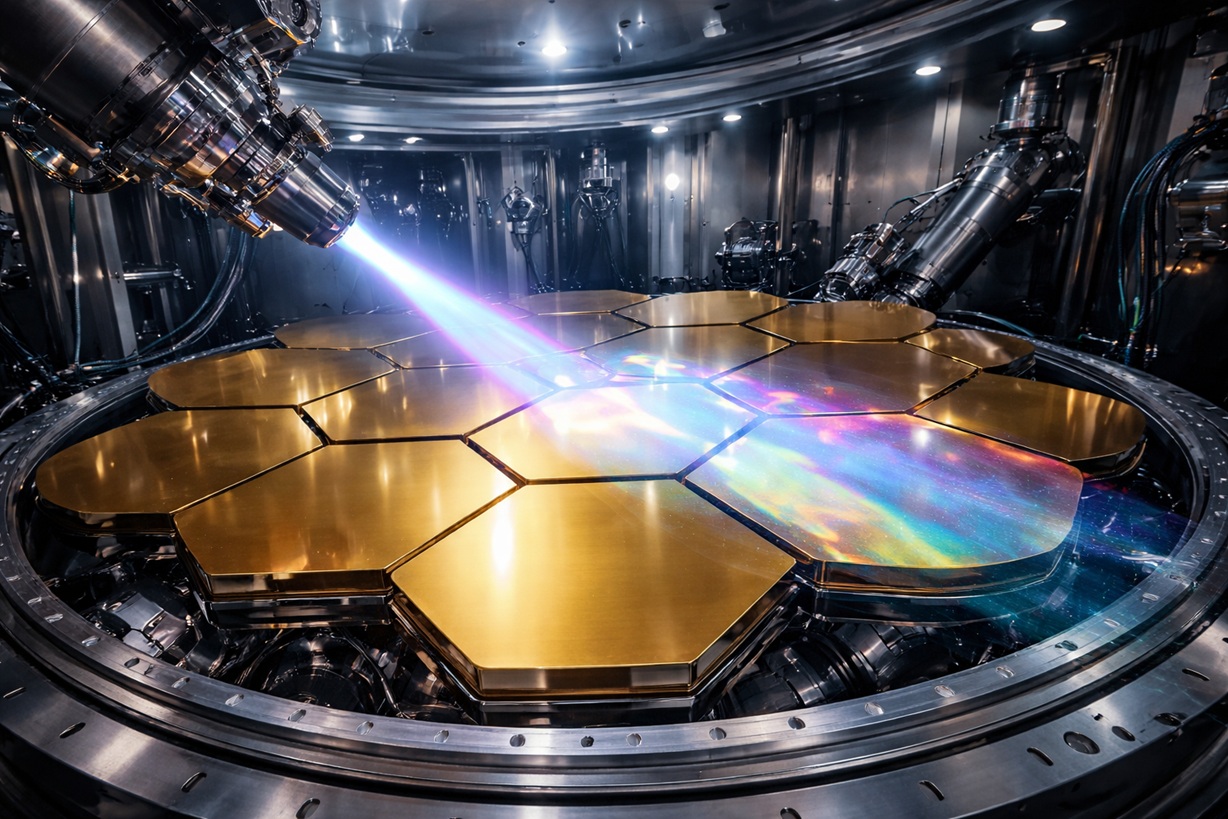
The Interface Axiom: “If polishing is the soul of the mirror, coating is its skin. We do not just apply a layer; we engineer a physical boundary between the glass and the stars. Any failure in this nanometric skin renders the ton-scale body blind.”
Scope note.
This paper treats optical coating as a single continuous system: optical constants (atomic physics) → vacuum deposition (scale engineering) → uniformity and protection (systems control) → stress (shape risk) → metrology (verification loop).
2. The Physics of Reflection: Optical Constants and Atomic Reality
To understand how a nanometric layer of metal can redefine a telescope’s performance, we must look beyond the macroscopic concept of “shininess.” Reflection is a quantum interaction between incident photons and the sea of electrons within the coating material. At this atomic level, every material is defined by its Complex Refractive Index.
Complex Refractive Index
ñ = n − i k
- n: real refractive index (phase velocity of light)
- k: extinction coefficient (absorption and attenuation)
- i: imaginary unit, representing phase quadrature
The Role of the Extinction Coefficient (k)
For a metal to be a high-performance reflector, it must possess a high k value and a relatively low n value in the target wavelength. Metals like Gold (Au) and Silver (Ag) exhibit an extraordinary density of “free electrons.” When an electromagnetic wave hits these surfaces, the electrons oscillate in response, creating a secondary wave that cancels the transmitted light and reradiates it as a reflection. In the infrared (IR) spectrum, Gold’s k value climbs rapidly, leading to the 99% reflectivity required by the James Webb Space Telescope. However, this same atomic reality makes Gold a poor reflector for Ultraviolet (UV) light, where its n and k values shift, causing the metal to absorb high-energy photons rather than reflecting them.
Wavefront Phase Shift and Polarization
Reflection is not an instantaneous “bounce.” As the light wave interacts with the coating, it undergoes a Phase Shift. According to the Fresnel Equations, this shift is dependent on the angle of incidence and the polarization state (s and p components). On a massive aspheric mirror, the angle of incidence varies significantly from the center to the edge. If the coating’s thickness or its optical constants are not perfectly uniform, the phase shift will vary across the aperture, effectively distorting the wavefront that the polishing team spent months perfecting. This is why we do not just measure “Reflectivity (%)”; we must measure the Complex Phase Map of the coated surface.
The Lithium Fluoride (LiF) Challenge
While metals provide the “bulk” reflection, high-energy observatories (FUV/EUV) often require specialized dielectric materials like Lithium Fluoride (LiF). LiF has the widest bandgap of any known material, allowing it to remain transparent deep into the ultraviolet. However, LiF is hygroscopic and possesses a crystalline structure that is prone to internal stress. Integrating LiF with an Aluminum base layer requires an understanding of Atomic Lattice Matching. If the dielectric atoms do not sit comfortably on the metal atoms, the resulting film will harbor “Micro-voids,” which scatter light and lower the Signal-to-Noise Ratio (SNR) of the entire telescope.
The Atomic Axiom: “Reflection is not a mechanical bounce; it is a quantum conversation. If the n and k values of your skin do not match the frequency of the universe, your ton-scale instrument will remain in the dark.”
3. PVD at Scale: The Giant Vacuum Chamber
Translating the quantum equations of Chapter 2 into a physical layer requires an environment where matter can be manipulated without the interference of the atmosphere. This is the domain of Physical Vapor Deposition (PVD). When we scale this process for an 8-meter telescope mirror, the vacuum chamber ceases to be a laboratory instrument and becomes a monumental piece of industrial architecture. These chambers, often three stories tall and made of high-grade stainless steel, must maintain a pressure of less than 10-7 Torr—a regime where the density of air is a billion times lower than at sea level.
The Tyranny of the Mean Free Path
In a standard environment, an evaporated gold atom cannot travel more than a few nanometers before colliding with a nitrogen or oxygen molecule. To coat a giant mirror, the evaporated atoms must travel several meters from the source to the substrate in a perfectly straight line. This requires maximizing the Mean Free Path (MFP). If the vacuum is insufficient, the metal atoms will undergo “Gas Phase Scattering,” arriving at the mirror surface with random energies and trajectories. The result is a porous, “milky” film that lacks the structural density required for high reflectivity and environmental survival.
Thermal Evaporation vs. Magnetron Sputtering
For large-scale observatories, there are two primary methods of “liberating” the coating atoms. Thermal Evaporation uses high-current tungsten filaments or electron beams to melt the source metal until it boils into a vapor. This method is “gentle” and produces high-purity films, but it can be difficult to control for complex alloys. Magnetron Sputtering, on the other hand, uses a plasma of Argon ions to physically knock atoms off a target. Sputtering produces much more energetic atoms that “slam” into the substrate, creating a denser, more adhesive film. However, the heat generated by sputtering can be a significant risk for the Thermal Inertia of a ton-scale Zerodur mirror.
Cryogenic Pumping and Outgassing
The biggest enemy inside the chamber is not the air, but the Outgassing of the mirror itself. Large glass-ceramic substrates and the mechanical structures holding them harbor microscopic amounts of water vapor and hydrocarbons. As the chamber reaches high vacuum, these molecules “boil” off the surface, contaminating the coating. To counter this, giant Cryogenic Pumps (operating at 10 Kelvin) act as “molecular sponges,” freezing and trapping residual gases before they can reach the optical surface. The cleanliness of the vacuum is not just about the pressure gauge; it is about the chemical purity of the atomic rain.
The Vacuum Axiom: “In the chamber, the absence of matter is the presence of control. We do not just build a vacuum; we build a sanctuary for atoms to travel unhindered until they find their place in the optical lattice.”
4. The Battle for Uniformity: Shadow Masks and Planetary Motion
Achieving λ/100 precision in polishing is a waste of effort if the coating process adds 20 nanometers of uneven thickness across the aperture. In a vacuum chamber, the evaporation source acts as a point source, following the Cosine-Theta Law of deposition. This means that a flat, stationary substrate would naturally be thicker in the center (closest to the source) and thinner at the edges. For a deep aspheric or parabolic mirror, this geometric disparity is even more extreme. In the world of giant optics, we do not leave uniformity to chance; we solve it through Dynamic Geometry.
Planetary Rotation: Spatial Averaging
The primary tool for uniformity is Planetary Rotation. The mirror is mounted on a massive carousel that rotates the substrate (rotation) while the entire carousel itself rotates around the chamber’s central axis (revolution). This “double-rotation” ensures that every radial zone of the mirror spends an equal amount of time at various distances and angles from the evaporation sources. This spatial averaging effectively “smooths out” the variations in the flux of metal atoms, transforming a chaotic spray into a controlled, uniform rain.
The Shadow Mask: Mathematical Throttling
Even with planetary motion, the inherent geometry of a large chamber often results in a slight radial thickness gradient. To counteract this, engineers employ Shadow Masks (or “Uniformity Shields”). These are stationary, mathematically shaped metal plates positioned between the source and the rotating mirror. By “shadowing” certain areas of the mirror’s path, the mask physically throttles the deposition rate at specific radii. Designing these masks is a high-order calculus problem; we must model the 3D vapor distribution of the source and the 4D path of the mirror to create a mask that results in a perfectly flat Deposition Profile.
Real-Time Monitoring: The Quartz Crystal Microbalance (QCM)
We do not guess when the coating has reached the target thickness. Inside the chamber, near the mirror, sits a Quartz Crystal Microbalance (QCM). As the metal deposits onto the quartz crystal, its vibration frequency shifts with the added mass. By calibrating this frequency shift against the “Tooling Factor” (the ratio of material on the sensor vs. the mirror), we can stop the deposition at the exact nanometer required. For multi-layer coatings, where five or six different materials are stacked, the QCM acts as the conductor of an atomic orchestra, ensuring each layer’s Optical Thickness (n × d) matches the design.
The Uniformity Axiom: “In a giant vacuum chamber, the shortest path is the enemy of precision. By forcing the mirror to travel in complex circles and hiding it behind mathematical shields, we create the perfect uniformity that nature’s point sources deny us.”
5. Protection and Survival: The Dielectric Shield
A high-purity metallic film is a delicate atomic structure. Metals like Aluminum and Silver are highly reactive; without protection, their reflectivity begins to decay the moment the vacuum chamber is repressed. Aluminum forms an absorbing oxide layer, while Silver tarnishes even in trace amounts of sulfur. In the harsh environment of LEO (Low Earth Orbit) or the Lagrange points, the mirror faces an even greater threat: Atomic Oxygen (AO) and high-energy ionizing radiation. To ensure a 20-year mission lifespan, we must wrap our reflective metal in a Dielectric Shield.
The Overcoating Strategy: MgF2 and SiO2
The most common protective layers for telescope optics are Magnesium Fluoride (MgF2) and Silicon Dioxide (SiO2). These are dielectric materials—non-conductive and transparent at the target wavelengths. By evaporating a layer of MgF2 (typically λ/4 thick) directly onto the fresh aluminum, we seal the metal from the atmosphere. This prevents the formation of the lossy Al2O3 oxide. However, the application must be instantaneous; even a few seconds of delay can allow a mono-layer of oxygen to contaminate the interface, permanently lowering the mirror’s throughput in the Deep Ultraviolet (DUV).
Enhancing Performance through Interference
The dielectric shield is not just a passive raincoat; it is an optical component. By precisely controlling the thickness of the dielectric layer, we can exploit Thin-Film Interference. If the layer is exactly one-quarter of the target wavelength (λ/4), the reflected waves from the air-dielectric interface and the dielectric-metal interface will interfere constructively. This allows a “Protected Silver” coating to actually exceed the reflectivity of raw silver at a specific frequency, while simultaneously providing the chemical stability required for ground-based transport and assembly.
The Adhesion Layer: The Molecular Glue
A major failure mode in space optics is Delamination—the peeling of the coating due to thermal cycling (swinging from -150°C to +100°C). Glass and metal have different coefficients of thermal expansion (CTE). To prevent the coating from “flaking” off, we must first deposit an Adhesion Layer (often Chromium or Titanium). This layer, only a few atoms thick, acts as a molecular bridge, bonding chemically to the oxygen in the glass substrate and the metallic lattice of the reflector. Without this “glue,” the most perfect reflective film will crack and peel under the thermal stress of the first orbital sunrise.
The Survival Axiom: “In the vacuum of space, reflectivity is a fleeting gift. To preserve the nanometric truth of the mirror, we must armor it in a dielectric shield that is transparent to light but impenetrable to the corrosive breath of the cosmos.”
6. The Hidden Enemy: Thin-Film Stress and Surface Warp
To the uninitiated, it seems physically impossible that a coating only 100 nanometers thick could alter the shape of a rigid glass mirror several decimeters thick. However, in the world of λ/100 optics, this is a devastating reality. Every thin film is born with Intrinsic Stress. As atoms deposit onto the substrate, they are rarely in their lowest energy state; they are “frozen” in a state of tension or compression. This microscopic tug-of-war across the vast surface area of a 2-meter mirror generates a macroscopic bending moment that can warp the entire optical figure.
Quantifying the Distortion: Stoney’s Equation
The relationship between film stress and substrate curvature is defined by Stoney’s Equation. It dictates that the change in curvature (κ) is directly proportional to the film stress (σ) and the film thickness (tf), but inversely proportional to the square of the substrate thickness (ts). While a thick mirror blank offers significant resistance, the extreme precision required for modern observatories means that even a shift of 10 nanometers in the “Power” or “Spherical Aberration” terms of the surface can render the telescope blurry.
Tensile vs. Compressive Stress
Film stress manifests in two forms: Tensile and Compressive.
- Tensile Stress: The film wants to shrink, pulling the edges of the mirror toward the center and creating a “concave” warp.
- Compressive Stress: The film wants to expand, pushing outward and causing a “convex” or “doming” effect.
In multi-layer coatings, such as a JWST-style stack (Cr + Au + dielectric), each layer may have a different stress sign. If not carefully balanced, these stresses accumulate—leading not only to surface warping but also to micro-cracking or delamination as the film tears itself away from the glass to relieve stored energy.
The Paradox of Pre-compensation
The most sophisticated solution to this problem is Pre-compensation. Instead of trying to eliminate stress (which is often physically impossible), engineers deliberately polish the mirror into the “wrong” shape. By using Finite Element Analysis (FEA), we calculate exactly how much the coating will warp the mirror. If we know the coating will pull the mirror 15 nm toward a concave shape, we polish the raw glass to be 15 nm “too convex.” The coating process then acts as the final “forming” step, pulling the glass into the perfect, intended aspheric figure. This is the ultimate convergence of the grinding shop and the vacuum lab.
The Stress Axiom: “The mirror is never truly finished until it is coated. A master optician does not polish to a static target; they polish to a ‘predicted error’ that only becomes truth once the atomic tension of the coating is applied.”
7. Metrology of the Invisible: Verifying the Nano-Layer
Once the vacuum chamber is repressed and the giant mirror is revealed, a critical question remains: Is the coating what we think it is? Unlike the surface figure, which we can verify with interferometry, the internal health of a multi-layer coating—its density, adhesion, and exact stoichiometry—is invisible to the naked eye. In large-scale optics, we cannot risk contact-based testing on the primary substrate. Instead, we employ a sophisticated regime of Indirect Metrology to verify the nanometric integrity of the film.
The Proxy Truth: Witness Samples
The most vital tool in coating verification is the Witness Sample. These are small (typically 25mm to 50mm) coupons of the same material as the mirror, placed at strategic locations around the carousel during deposition. These samples act as “proxies” for the mirror. Because they are expendable, they can be subjected to destructive testing that the primary mirror cannot endure—such as Cross-sectional SEM (Scanning Electron Microscopy) to measure layer thickness or Tape-Pull Testing to verify the strength of the adhesion layer.
Spectroscopic Ellipsometry: The Phase Hunter
To measure the thickness and refractive index without touching the surface, we use Spectroscopic Ellipsometry. This technique relies on the change in the Polarization State of light upon reflection. By measuring how the “p” and “s” polarization components shift relative to each other across a broad spectrum, we can mathematically reconstruct the entire thin-film stack. This allows engineers to detect if a layer is even 1 nanometer off-target or if the dielectric overcoat has begun to oxidize prematurely. It is the definitive method for validating the n and k constants established in Chapter 2.
Reflectance Mapping and Scatterometry
For a giant observatory, a single-point measurement is insufficient. We must perform Reflectance Mapping across the entire multi-meter aperture using portable spectrophotometers. Furthermore, we analyze the BRDF (Bidirectional Reflectance Distribution Function)—a measure of how much light is “scattered” rather than reflected. If the IBF process (Chapter 4) or the coating deposition created microscopic roughness, it will show up as a “haze” in the scatterometry data. High scatter levels are the primary cause of contrast loss in exoplanet imaging, making this “Invisible Metrology” the ultimate arbiter of a telescope’s scientific value.

The Verification Axiom: “We cannot touch the mirror to prove it is perfect, so we must learn to read the story of its photons. Metrology is the bridge that allows us to see the atomic structure through the language of polarization and scatter.”
8. Conclusion: Beyond Reflectance
The journey from a raw, ton-scale glass casting to a nanometrically coated observatory mirror is a testament to the convergence of disparate engineering disciplines. We have seen that a mirror is not merely a piece of glass, but a Dynamic Physical System. Its performance is the result of a delicate truce between the mechanical forces of grinding, the mathematical rigor of interferometry, and the atomic alchemy of thin-film deposition. Coating is the climax of this narrative—the point where we stop shaping the material and start tuning the light.
The Future: Adaptive and Active Coatings
As we look toward the next generation of observatories—such as the Habitable Worlds Observatory (HWO) or the Extremely Large Telescopes (ELTs)—the boundaries of coating technology are being pushed even further. We are entering the era of Active Coatings, where the thin-film stack might integrate conductive layers to prevent “Static Surface Charge” or specialized coatings that can be “refreshed” in-situ through robotic docking. The dream is to move beyond passive reflection toward a “Smart Skin” that can actively manage thermal loads and filter stray light at the molecular level.
The Engineer’s Final Responsibility
For the precision engineer, the lesson of this white paper is one of Contextual Integrity. You cannot polish an asphere without respecting the stress of the coating; you cannot design a coating without respecting the chemistry of the substrate. The “Moat of Extreme Precision” mentioned in our previous series is built upon this integrated understanding. By mastering the Final Interface, we ensure that the thousands of hours spent on the grinding spindle are not lost to a few nanometers of atomic disorder.
The Final Signature:
“A coating is not a paint; it is a mathematical structure of atoms.
It is the only part of the instrument that stares directly into the history of the stars.
In the vacuum of space, we do not just reflect light—we protect the truth of the universe.”
References & Internal Technical Resources
Primary Engineering References
- • Macleod, H. A. (2017). Thin-Film Optical Filters. CRC Press. (The global standard for thin-film design).
- • Stoney, G. G. (1909). The Tension of Metallic Films Deposited by Electrolysis. Proceedings of the Royal Society. (The foundation of stress-warp analysis).
- • Boller, A., et al. (2021). Gold Coating Process for the James Webb Space Telescope Primary Mirror Segments. Journal of Astronomical Telescopes.
- • Heavens, O. S. (1955). Optical Properties of Thin Solid Films. Butterworths Scientific Publications.
Internal Technical Deep-Dive
To bridge the gap between atomic thin-films and the mechanical precision of the substrate, explore these core modules: