1. Introduction: The Evolution of Automotive Quality Standards
The automotive industry is undergoing a paradigm shift, driven by the rapid transition to Electric Vehicles (EVs) and the demand for autonomous driving technologies. In this new era, the quality standards for precision components have transcended simple dimensional accuracy. Today, Surface Integrity—the physical and chemical state of the finished surface and its underlying layers—is the decisive factor in system reliability. For EV drivetrains, where the internal combustion engine’s noise is absent, the micro-geometry and metallurgical state of ground components like gears and bearings directly dictate the vehicle’s NVH (Noise, Vibration, and Harshness) profile and long-term durability.
From Dimensional Tolerance to Functional Performance
Historically, automotive quality control focused on macroscopic metrics: diameter, runout, and average roughness (Ra). However, high-performance EV reduction gears operate at speeds exceeding 15,000 RPM, placing unprecedented stress on the tooth flanks. Under these conditions, a part that meets all dimensional tolerances can still fail prematurely if the grinding process induced “invisible” damage. This shift in focus necessitates a deeper understanding of how the grinding energy affects the Subsurface Zone, where fatigue cracks often initiate.
The Zero-Defect Imperative in Global Supply Chains
As automotive Tier-1 suppliers integrate more complex materials and heat treatment processes, the risk of “Grinding Burn” and unfavorable residual stress becomes a critical bottleneck. The industry’s move toward Zero-Defect Manufacturing (ZDM) means that surface integrity issues are no longer just maintenance concerns; they are high-stakes liabilities. Precision grinding, once viewed as a simple finishing operation, is now recognized as a thermo-mechanical process that can either enhance the fatigue life of a component through compressive stress or destroy it through re-tempering and micro-cracking.
To master automotive quality in this context, engineers must look beneath the surface. This requires analyzing the complex interactions between abrasive grains and hardened steel, where energy partitioning dictates the final metallurgical state of the component.
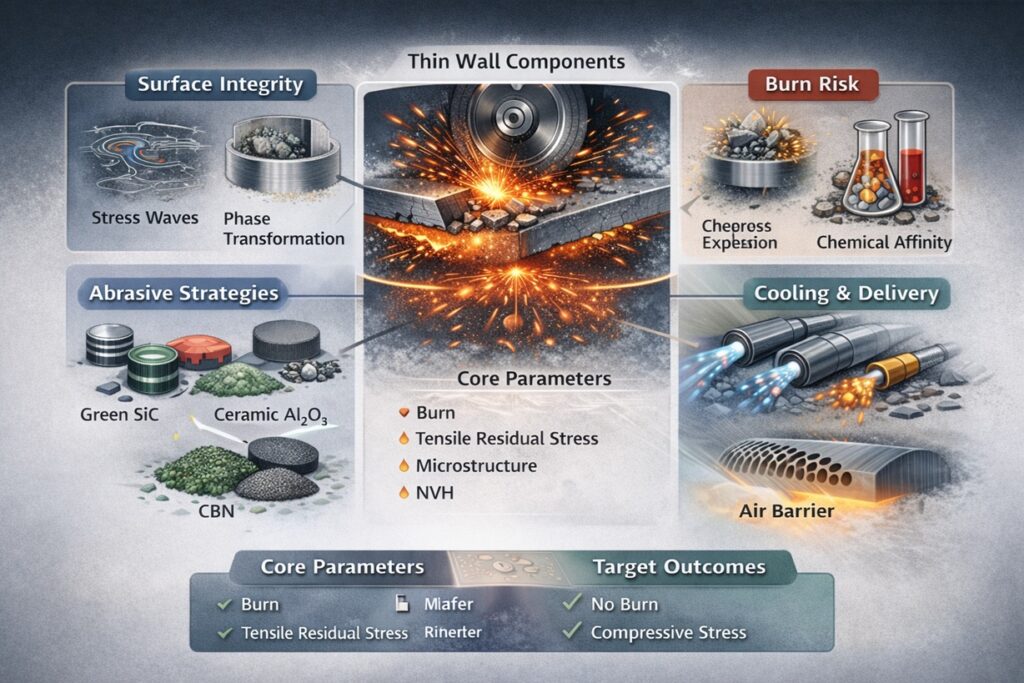
2. The Physics of Surface Integrity in High-Volume Production
In the mass production of automotive components—such as crankshafts, camshafts, and transmission gears—the grinding process is the final arbiter of quality. Unlike turning or milling, grinding is characterized by an extremely high specific energy consumption. Most of this energy is converted into heat at the grinding zone. When producing thousands of parts per shift, maintaining the stability of the thermo-mechanical interactions is the greatest challenge to surface integrity.
Energy Partitioning and the Subsurface Zone
In automotive hardened steels (typically Case-Hardened or Induction-Hardened), the surface integrity is defined by how the heat is partitioned. The heat flux entering the workpiece creates a temperature gradient that can exceed the material’s tempering temperature. This results in a multi-layered altered zone:
- The White Layer: A hard, brittle layer of untempered martensite formed by rapid heating above the Ac3 temperature followed by immediate quenching.
- The Over-tempered Zone (Dark Layer): A region where the hardness drops below the bulk specification due to excessive thermal exposure, leading to softened “soft spots.”
- Residual Stress Profile: The transition from compressive stress (desirable for fatigue resistance) to tensile stress (dangerous for crack initiation).
The Influence of Wheel Attrition on Mass Quality
In high-volume lines, the grinding wheel does not stay sharp. Attritious wear dulls the abrasive grains, increasing the contact area between the grit and the steel. This shift from “sharp cutting” to “blunt rubbing” increases the energy partition to the workpiece (Rw). For automotive engineers, this means that surface integrity often degrades progressively throughout the dressing interval. A part ground at the beginning of a cycle may have compressive stress, while the 500th part may harbor tensile stresses or even microscopic cracks due to increased friction.
On the shop floor, this drift is often noticed indirectly—through higher spindle load, dressing alarms, or a gradual rise in scrap rates rather than a single obvious failure.
Thermo-Mechanical Coupling
Surface integrity is the result of thermo-mechanical coupling. While mechanical deformation (plastic flow) tends to induce compressive stress, the thermal gradient induces tensile stress. In automotive components subjected to millions of load cycles, the net residual stress must remain compressive. Failure to control the thermal aspect of the grinding process leads to a “tensile spike” at the surface, which is the primary cause of sudden shaft breakage or gear tooth failure in high-torque EV applications.
3. Grinding Burn: The Invisible Enemy of Transmission Gears
In the automotive powertrain sector, Grinding Burn is often difficult to spot on the shop floor. It can pass visual inspection and later show up as unexpected field issues if left unchecked. For transmission gears and driveshafts, which are subjected to intense contact pressures and cyclic loading, even a minor thermal injury can reduce the fatigue limit by up to 50%. As automotive designs push toward higher power densities, particularly in Electric Vehicle (EV) reducers, the tolerance for these thermal defects has reached near-zero.
In practice, burn-related issues rarely appear as a single event but accumulate quietly until a durability problem shows up downstream.
The Chemistry and Physics of Burn
Grinding burn occurs when the local temperature at the grinding zone exceeds the metallurgical tempering temperature of the hardened steel (typically around 180°C to 250°C for case-hardened parts). This thermal surge leads to re-tempering, where the hardness of the gear tooth flank drops significantly. If the temperature exceeds the Ac1 or Ac3 points, re-hardening occurs, creating a brittle “white layer” that is prone to spalling and pitting under operational loads.
Detection Technologies: From Acid Etch to Barkhausen Noise
Traditional quality control relied on Nital Etching, a destructive or semi-destructive chemical process where burnt areas appear as dark (over-tempered) or light (re-hardened) spots. However, modern automotive “Industry 4.0” lines are shifting toward 100% non-destructive testing (NDT).
Barkhausen Noise Analysis (BNA) has emerged as the industry standard. BNA measures the inductive noise produced by the movement of magnetic domain walls (Bloch walls). Because the magnetic properties of steel are highly sensitive to stress and microstructure, BNA can detect subsurface thermal damage that visual inspection would miss entirely.
Root Causes in Automotive Production
Identifying burn is only the first step; preventing it requires addressing the root causes. In mass production, these typically include:
- Wheel Glazing: When the abrasive grains dull and become smooth, increasing friction without material removal.
- Coolant Starvation: The “Air Barrier” around the high-speed wheel preventing fluid from entering the contact zone.
- Inconsistent Dressing: Variations in diamond dresser wear that result in a “closed” wheel topography.
4. Dimensional Precision vs. Surface Quality in EV Components
The rise of Electric Vehicles (EVs) has introduced a new set of grinding challenges that differ significantly from those of traditional Internal Combustion Engine (ICE) manufacturing. EV drivetrains demand higher rotational speeds and higher torque density, which translates to a need for extreme dimensional precision paired with flawless surface integrity. However, these two goals often conflict in a high-volume production environment.
The Challenge of Thin-Walled and Hollow Components
To reduce weight and improve efficiency, EV manufacturers increasingly utilize thin-walled gears and hollow shafts. These components are highly susceptible to elastic deformation and thermal expansion during the grinding process. When the grinding force is applied, the part may deflect, resulting in errors in roundness and cylindricity. Furthermore, the heat generated can cause the part to expand during the cut; once it cools, the final dimensions may fall outside the required micron-level tolerances.
This is why process settings that work well for solid shafts often fail when applied unchanged to hollow or weight-optimized EV components.
NVH: The New Quality Benchmark
In an EV, the absence of engine noise makes the “whine” of the reduction gear set much more noticeable. This noise is primarily driven by Transmission Error (TE), which is a direct result of the gear tooth micro-geometry. Achieving the required Lead and Profile accuracy while maintaining a specific surface finish (often Rz < 2.0 μm) is critical. If an engineer prioritizes dimensional speed, they risk inducing thermal damage that alters the surface topography and increases gear noise.
Balancing Throughput and Integrity
To solve this, automotive lines are adopting multi-stage grinding cycles. The “Roughing” stage focuses on rapid material removal and dimensional shaping, while the “Finishing” or “Spark-out” stages use lower feed rates and specialized dressing patterns to restore surface integrity and induce compressive residual stress. This dual-purpose approach ensures that the part is both geometrically perfect and metallurgically sound.
5. Abrasive Selection for Automotive Hardened Steels
In the automotive industry, where hardened alloys such as SCM420H or SNCM439 are standard for powertrain components, the choice of abrasive is the primary lever for controlling both cost-per-part and surface quality. The abrasive must be capable of penetrating high-hardness surfaces (typically 58-62 HRC) without generating excessive frictional heat that leads to the “invisible” damage discussed in previous sections.
Micro-Crystalline Alumina: The Versatile Workhorse
Traditional fused alumina has largely been replaced in automotive lines by Ceramic Micro-Crystalline Alumina. These grains are engineered with a sub-micron crystal structure that allows for “micro-fracturing.” Unlike standard grit that dulls and creates heat-inducing friction, ceramic grains break away at a microscopic level to constantly reveal new, sharp cutting edges. This self-sharpening characteristic is vital for maintaining a Cool Cut during high-speed production of camshafts and crankshafts.
The CBN Revolution in EV Gear Grinding
For the high-precision gears found in Electric Vehicle (EV) reducers, Cubic Boron Nitride (CBN) is increasingly becoming the mandatory choice. CBN’s hardness is second only to diamond, but more importantly, its Thermal Conductivity is significantly higher than that of ceramic grains. In high-volume gear grinding, a vitrified CBN wheel can hold its form for thousands of parts, drastically reducing the “Thermal Drift” that occurs as conventional wheels wear down.
Dressing Strategy: The Final Quality Control
The selection of the abrasive is incomplete without a controlled Dressing Strategy. In automotive production, the dresser determines the “openness” of the wheel topography. For gear flanks requiring low noise, a “fine” dressing lead is used to reduce Ra. However, if the dressing is too fine, the wheel becomes “closed,” the chip clearance is lost, and the risk of Grinding Burn increases exponentially. Quality managers must balance the dressing frequency to ensure the abrasive grains are sharp enough to induce compressive residual stress.
6. Coolant Strategy: Managing Thermal Gradients
In the high-speed grinding of automotive components, the metalworking fluid (coolant) serves two critical functions: Lubrication to reduce the generation of heat and Cooling to remove the heat that is inevitably produced. For mass-produced hardened steel parts, the effectiveness of the coolant delivery system is often the difference between a part with high compressive residual stress and one destined for failure due to thermal re-tempering.
Lubricity vs. Convective Cooling
The choice between Neat Oil and Soluble Emulsions is a strategic one in automotive manufacturing. Neat oils provide superior lubricity, reducing the coefficient of friction at the grit-workpiece interface and thus generating less heat. This is why oil is often preferred for high-precision EV gear grinding where surface integrity is paramount. However, water-based emulsions have a higher specific heat capacity, making them more effective at “bulk cooling” to prevent dimensional drift in large components like crankshafts.
Hydrodynamic Barriers and Jet Coherency
A common failure in automotive quality control is the assumption that more coolant volume equals better cooling. At peripheral wheel speeds typical of automotive lines (60–120 m/s), a Hydrodynamic Air Barrier forms around the wheel. If the coolant jet is turbulent or low-pressure, it will be deflected by this air envelope, leaving the contact zone functionally dry. Achieving a Coherent Jet—where the fluid velocity is matched to the wheel speed—is mandatory to ensure the lubricant actually reaches the “heat trap” where the metal is being sheared.
Many cooling issues traced back during audits turn out to be delivery problems rather than fluid chemistry itself.
Filtration and Surface Finish (Ra)
In automotive precision grinding, the coolant also acts as a transport medium for swarf. If the Filtration System is inadequate (e.g., > 10 μm particles remaining), the recirculated metal chips will cause “comet tails” or scratches on the finished surface. For EV components requiring mirror-like finishes to minimize friction losses, filtration levels of 1–5 μm are now standard. Maintaining fluid purity is not just about cleanliness; it is a critical variable in achieving the “Zero-Defect” surface integrity required for high-speed drivetrains.
7. Metrology: From Ra to Functional Surface Parameters
As automotive components evolve to meet the high-torque, high-frequency demands of Electric Vehicles (EVs), traditional metrology focused on Average Roughness (Ra) has become insufficient. While Ra provides a general idea of surface finish, it fails to describe the functional behavior of a surface—such as its lubricant retention, wear resistance, and noise generation characteristics. Modern automotive quality control now demands a 3D characterization of surface topography.
The Limitations of 2D Roughness
Two surfaces can have identical Ra values but drastically different functional performances. For instance, a surface with sharp “peaks” will experience rapid initial wear and high friction, whereas a surface with deep “valleys” (but smooth plateaus) will retain oil better and exhibit superior fatigue life. In EV gear sets, relying solely on Ra can lead to “ghost” quality issues where parts pass inspection but fail in the field due to micro-pitting or excessive vibration.
The challenge is not measuring more parameters, but deciding which ones actually correlate with noise, wear, and field performance.
Functional Parameters: Skewness (Rsk) and Kurtosis (Rku)
To ensure “Zero-Defect” quality, automotive engineers are increasingly adopting Skewness (Rsk) and Kurtosis (Rku). A negative skewness indicates a “plateau-like” surface with deep valleys—ideal for engine cylinders and high-speed bearings because it provides excellent lubrication reservoirs while maximizing the load-bearing area. Kurtosis, on the other hand, describes the “sharpness” of the profile. By controlling these parameters, manufacturers can optimize the Running-in behavior of drivetrain components.
Advanced 3D Areal Metrology (S-parameters)
The gold standard for modern automotive metrology is ISO 25178, which defines areal (S-parameters) rather than profile (R-parameters). Using 3D optical profilometers or white-light interferometers, engineers can map the entire surface of a gear tooth. This allows for the detection of Lay Directionality—the orientation of grinding marks. In automotive transmissions, aligning the grinding lay perpendicular to the direction of sliding can significantly reduce NVH (Noise, Vibration, and Harshness) levels.
8. Conclusion: Zero-Defect Manufacturing Strategy
Achieving Zero-Defect Manufacturing (ZDM) in the precision grinding of automotive components is no longer a luxury—it is a functional necessity driven by the electrification of the powertrain. As we have explored, surface integrity is the bridge between a part that simply “fits” and a part that “lasts.” The move toward higher power densities and quieter cabins in the EV era has rendered traditional, macro-focused quality metrics obsolete.
The Synthesis of Integrity and Intelligence
The future of automotive quality lies in the integration of process monitoring and metallurgical science. By shifting from periodic quality audits to 100% in-line monitoring—using technologies like Barkhausen Noise Analysis and real-time acoustic emission sensors—manufacturers can detect the onset of thermal damage before it results in a scrap part. This data-driven approach allows for dynamic adjustments in dressing frequency and feed rates, effectively “closing the loop” on surface integrity.
Strategic Pillars for Zero-Defect Automotive Grinding:
- • Thermal Stewardship: Treating heat not as a byproduct, but as the master variable that dictates fatigue life and NVH performance.
- • Functional Metrology: Implementing Rsk, Rku, and 3D areal parameters to predict real-world wear and lubrication behavior.
- • Predictive Maintenance: Leveraging sensor data to ensure wheel sharpness and coolant coherency remain within the “Green Zone” of compressive stress.
Final Technical Perspective
In the global automotive supply chain, the cost of a single field failure can outweigh the savings of thousands of optimized grinding cycles. Therefore, the ultimate goal of precision grinding is to induce a state of mechanical permanence. By mastering the interaction between advanced abrasives, coherent cooling, and functional metrology, automotive engineers can deliver components that define the next generation of vehicular performance: silent, efficient, and virtually indestructible.
References & Internal Technical Resources
Primary Automotive Engineering Standards
- • ISO 18436-1: Condition monitoring and diagnostics of machines. (Standards for in-line sensor integration in automotive production).
- • DIN 3960/3962: Concepts and parameters for cylindrical gears. (The benchmark for EV transmission precision and lead/profile tolerances).
- • Karpuschewski, B., et al. (2000). Grinding Burn Monitoring on Gears using Barkhausen Noise. CIRP Annals. (Foundation for non-destructive testing in high-volume lines).
- • Brinksmeier, E. (1991). Process and Workpiece Related Causes of Layer Alterations in Grinding. (Detailed analysis of the White Layer and Over-tempering physics).
Curated Roadmap Insights: Automotive Quality Path
To further optimize your production line for EV-grade surface integrity, explore these critical technical reports from our series:
Note: All technical specifications listed are intended for Tier-1 automotive manufacturing environments. Local metallurgical variations in steel batches (cleanliness, inclusions) can influence the surface integrity response and should be validated through X-ray Diffraction (XRD) during initial process qualification.