1. Introduction: Moving Beyond Dimensional Compliance
In the hierarchy of manufacturing processes, grinding is often the final arbiter of quality. It is the process entrusted with achieving sub-micron tolerances and mirror-like finishes. However, a dangerous misconception persists on many shop floors: the idea that if a part is dimensionally correct, the process is “capable.” In reality, grinding possesses a unique Quality Paradox. A component can pass every dimensional inspection with a high Cpk, yet fail catastrophically in service due to invisible metallurgical damage. True Process Capability in grinding must therefore extend beyond the micrometer and into the realm of Surface Integrity.
The “Silent Killer” of Yield: Subsurface Damage
Yield is traditionally calculated as the ratio of acceptable parts to total parts produced. In most machining operations, “unacceptable” means a part is physically too large or too small. In grinding, the most significant threat to yield is Thermal Debt. When a process is not thermally stable, the high temperatures in the contact zone can cause “Grinding Burn,” leading to re-tempering or the formation of brittle untempered martensite (white layer).
These defects are often undetectable by standard 1D or 2D gauging. They represent a Latent Failure Risk that can decimate yield during final NDT (Non-Destructive Testing) or, even worse, during the component’s operational life. A process with a high dimensional Cpk but a low thermal stability margin is not a capable process; it is a liability.
Integrating Statistics with Physics
To achieve a robust yield, process engineers must treat Surface Integrity as a hard specification—equal in importance to diameter or length. This requires a shift in how we interpret statistical indices:
- Cp (Potential): Represents the machine’s ability to maintain a tight distribution under ideal thermal conditions.
- Cpk (Performance): Measures how well the process stays “centered” despite wheel wear, dresser decay, and spindle growth.
If the standard deviation (σ) of the process is driven by erratic thermal spikes rather than predictable mechanical wear, the Cpk will fluctuate wildly, leading to Yield Volatility. Mastering the “Why” behind these fluctuations is the only path to a zero-defect production environment.
The Quality Axiom: “In high-stakes grinding, a part is not finished when it meets the blueprint’s dimensions; it is finished when it meets the material’s metallurgical requirements. High yield is the natural byproduct of a process that is designed to stay within the thermal limits of the steel.”
2. Statistical Foundations: Cp vs. Cpk in the Abrasive Context
Statistical Process Control (SPC) provides the mathematical language to describe manufacturing stability. However, applying these metrics to grinding requires an understanding of the Abrasive Life Cycle. Unlike turning or milling, where tool geometry remains relatively static until failure, a grinding wheel is a “self-sharpening” tool that constantly changes its diameter and topography. This inherent instability makes the calculation of Cp and Cpk a dynamic challenge, as the standard deviation (σ) and the mean (μ) are under constant pressure from mechanical and thermal drift.
Decoding Cp: The Potential of the Machine Architecture
Cp (Process Capability) measures the “Potential” of the system—the width of the process spread relative to the tolerance width, assuming the process is perfectly centered. It is calculated as:
In grinding, σ (Standard Deviation) is primarily driven by System Rigidity and Vibration. If a machine bed lacks damping or the spindle bearings have excessive runout, the “scatter” of the dimensions will be wide, resulting in a low Cp. To achieve a high Cp (typically > 1.66), the mechanical foundation must be rock-solid, ensuring that the only variations remaining are the predictable ones, such as grain wear.
Decoding Cpk: The Reality of Geometric and Thermal Drift
While Cp tells you what the machine could do, Cpk (Process Capability Index) tells you what it is doing. It accounts for the centering of the process mean (μ). In grinding, μ is a moving target due to Wheel Wear. As the wheel diameter (ds) decreases, the process mean naturally drifts toward one of the tolerance limits.
If a process has a high Cp but a low Cpk, it indicates a Centering Problem. In grinding, this is usually caused by inadequate Compensation Logic. If the dresser does not accurately update the CNC with the new wheel diameter, or if the spindle grows due to thermal expansion, the mean (μ) will shift, narrowing the “Safety Margin” and increasing the risk of producing out-of-tolerance parts.
The “Sawtooth” Stability Pattern
Grinding stability often follows a Sawtooth Pattern. The process mean starts near the center, drifts as the wheel wears (increasing the variance), and is “snapped” back to center by a dressing cycle. The key to high yield is ensuring that the “peaks” of this sawtooth never cross the Control Limits. High-yield manufacturers achieve this by:
- Deterministic Dressing: Scheduling dressing based on the precise volume of material removed (Q’w) rather than time.
- Thermal Stabilization: Running the machine until it reaches steady-state equilibrium before measuring for Cpk studies.
The Statistical Axiom: “A high Cp is a gift from the machine builder, but a high Cpk is a reward for the engineer’s vigilance. In grinding, you cannot have one without managing the physical drift of the other.”
3. The Surface Integrity Lever: The Invisible Specification
The most significant pitfall in assessing Cpk is the exclusive reliance on measurable dimensions as the sole data points for stability. In high-performance sectors such as aerospace or Electric Vehicle (EV) drivetrains, the primary enemy is not dimensional deviation but the compromise of Surface Integrity. This refers to metallurgical changes that are often invisible to the naked eye or standard gauging, yet act as the ultimate arbiter of component longevity. For a process to be truly capable, it must satisfy the “Invisible Specification”—ensuring the part is not only the right size but also possesses the correct metallurgical DNA to survive its service life.
Thermal Damage: The Genesis of Soft Spots and Grinding Burn
When the temperature in the grinding zone (Tmax) exceeds the material’s Critical Tempering Temperature, a localized softening occurs, known as Grinding Burn. This excessive heat over-tempers the hardened martensitic structure, creating “soft spots” that are highly susceptible to mechanical wear and premature pitting.
If your Process Capability study only tracks diameters, it will miss these thermal events entirely. A part can be perfectly centered within its 6σ dimensional band while suffering from subsurface softening that will lead to catastrophic field failure. To protect yield, the process must be designed to stay within a Thermal Window that prevents these phase transformations.
Residual Stress Profile: Compression vs. Tension
Another pillar of surface integrity is the Residual Stress Profile. An ideal grinding process induces Compressive Residual Stress on the surface, which effectively “squeezes” the material together, inhibiting the initiation and propagation of cracks. However, when the process generates excessive heat, the surface attempts to expand while the cooler core remains rigid. Upon cooling, this results in Tensile Residual Stress.
Tensile stress is an invisible defect that pre-loads the part for failure. It can reduce fatigue life by over 50%. Therefore, maximizing yield requires more than just hitting a size; it requires managing the Specific Grinding Energy (us) to ensure that the mechanical deformation (which creates compression) outweighs the thermal expansion (which creates tension).
White Layer Formation: The Brittle Menace
In extreme cases of thermal instability, rapid heating followed by immediate quenching (by the coolant) creates a re-hardened layer known as White Layer (Untempered Martensite). This layer appears white under Nital etching and is characterized by extreme hardness but catastrophic brittleness.
The presence of White Layer acts as a “Yield Killer.” Once detected during Non-Destructive Testing (NDT) or etching inspections, the entire batch must typically be scrapped. This highlights the volatility of a process that lacks thermal control: your dimensional Cpk might suggest a 99.9% yield, but your metallurgical integrity could be forcing a 50% scrap rate.
The Integrity Axiom: “Surface integrity is the ‘soul’ of the component. While dimensions tell you if the part will fit, integrity tells you if it will survive. To maximize yield, the process must be mastered at the atomic level, not just the micron level.”
4. Wheel Wear and Geometric Drift: The Enemy of Cpk
Statistical Process Control (SPC) assumes a stable environment, yet the fundamental nature of grinding is one of continuous tool decay. As the grinding wheel engages the workpiece, it loses mass through bond fracture and grain attrition. This Wheel Wear is the primary driver of Geometric Drift—the gradual shift of the process mean (μ) away from the nominal target. If this drift is not precisely countered by compensation logic, the process window narrows, causing the Cpk to collapse and leading to a direct hit on production yield.
The G-Ratio Connection to Stability
The mechanical stability of your Cpk is inextricably linked to the G-Ratio (the ratio of material removed to wheel wear). A wheel with a low G-ratio wears rapidly, causing part dimensions to drift—growing in OD grinding or shrinking in ID grinding—within a single batch.
For high-yield manufacturing, a high G-ratio (typically achieved through Superabrasives like CBN) is essential. It minimizes the “slope” of the dimensional drift, allowing more parts to be ground between dressing cycles while keeping the process mean (μ) centered within the 6σ band. Without this stability, the process is forced into a “reactive” mode where operators must constantly apply offsets, which inadvertently increases the process variance (σ) and lowers the Cp.
Corner Radius Decay and Profile Tolerance
Geometric drift is not limited to simple diameters; it is most destructive in Profile Grinding. The sharp corners of a grinding wheel are the first to break down, a phenomenon known as “Corner Breakdown.” As the radius on the wheel edge increases, the part profile deviates from the blueprint.
In industries like aerospace or medical implants, profile tolerances are measured in microns. When the wheel profile “rounds off,” the Cpk of the profile drops significantly faster than the Cpk of the diameter. Maintaining yield in these scenarios requires Frequency-Based Profile Dressing, where the wheel is reshaped before the profile error exceeds a predetermined threshold of the tolerance limit.
Dressing Compensation and Error Stacking
To restore wheel geometry, we use a dresser. However, the dresser itself is a mechanical system subject to wear and thermal expansion. If the dresser does not communicate the exact new wheel diameter to the CNC controller, Compensation Errors occur.
These errors are “stacked”—they accumulate over multiple cycles. If the dresser over-compensates or under-compensates by even 1 or 2 microns per cycle, the process mean will eventually drift outside the Upper/Lower Control Limits (UCL/LCL). This non-deterministic drift is the leading cause of “ghost rejects”—parts that were expected to be perfect based on previous offsets but are found out of spec during final inspection.
The Mechanical Insight: “In grinding, the tool is a variable, not a constant. To maintain a high Cpk, you must transition from reactive offsets to deterministic compensation based on real-time abrasive decay models.”
5. The Thermal Stabilization Strategy for Higher Yield
Statistical stability in grinding is not merely a product of mechanical precision; it is a product of Thermal Equilibrium. A process that produces a perfect part at 10:00 AM might produce a scrap part at 2:00 PM if the thermal state of the machine and the wheel has drifted. To achieve a Cpk that satisfies high-yield requirements, engineers must implement strategies that stabilize the Heat Flux entering the workpiece. This transition from static grinding cycles to “Thermal-Aware” processing is the hallmark of modern, high-yield manufacturing.
Constant Heat Flux via Variable Feed Rates
As discussed in previous chapters, the wheel diameter (ds) decreases over time, which shrinks the contact length (lc) and alters the Equivalent Diameter (de). In a static cycle where the feed rate (vw) is constant, this geometric drift causes the specific grinding energy (us) and the resulting heat flux to increase. This leads to a wider Standard Deviation (σ) in surface integrity.
The stabilization strategy involves utilizing Diameter-Adaptive Feed Rates. By gradually reducing vw as the wheel wears, the system maintains a constant chip thickness (hcu) and a stable maximum temperature (Tmax). This “Variable Cycle” ensures that every part in a 1,000-piece batch experiences the exact same thermal history, effectively narrowing the distribution curve and centering the Cpk.
Hydrodynamic Optimization of Coolant Delivery
The second pillar of thermal stabilization is the Coherence of the Coolant Jet. In many low-yield processes, the coolant nozzle is fixed, and the pressure is inconsistent. As the wheel speed or diameter changes, the jet may fail to break the “air knife” boundary layer, leading to erratic cooling and sudden “spikes” in the standard deviation of surface hardness.
To protect yield, the coolant delivery must be deterministic. This requires matching the jet velocity (vj) to the wheel peripheral speed (vs). When vj = vs, the fluid is carried efficiently into the contact arc, maintaining Hydrodynamic Lubrication. This stability prevents the “Film Boiling” threshold from being crossed unexpectedly, ensuring that tensile residual stresses are never introduced into the part.
Machine Warm-up and Volumetric Error Control
A significant portion of yield loss occurs during the first hour of a shift—the “Warm-up Phase.” During this time, the spindle and machine bed expand thermally, causing a drift in the Volumetric Accuracy. A process that appears centered in a Cpk study conducted at steady-state will produce out-of-tolerance parts during the cold start.
Strategic stabilization involves Active Thermal Compensation. Modern CNCs use temperature sensors on the spindle housing and machine frame to calculate the expected expansion and apply real-time offsets to the Z and X axes. By automating this “Thermal Handshake,” the manufacturer eliminates the “early-shift scrap” phenomenon, pushing the overall yield closer to the theoretical maximum.
The Thermal Strategy: “High yield is not achieved by hoping the process stays cool; it is achieved by designing a cycle where heat is a constant, predictable variable. If you control the thermodynamics, the statistics of quality will naturally follow.”
6. Advanced Monitoring: Real-time Cpk Prediction
Traditional quality control is reactive; by the time a part is measured on a CMM (Coordinate Measuring Machine) and found to be out of spec, the process has already generated scrap. In high-value grinding, this delay is unacceptable. To maximize yield, the industry is shifting toward Real-time Cpk Prediction. By utilizing advanced sensor arrays and digital signatures, we can monitor the “Pulse” of the grinding zone, detecting the minute fluctuations in vibration and power that signal a breakdown in process stability before a single defect is produced.
Acoustic Emission (AE): The Early Warning System
Acoustic Emission (AE) sensors detect high-frequency stress waves (typically 50 kHz to 1 MHz) generated by the interaction between the abrasive grains and the workpiece. Unlike standard vibration sensors, AE can distinguish between the clean “hiss” of efficient cutting and the erratic “crackle” of Thermal Shock or grain dulling.
As the wheel dulls and the process mean (μ) begins to drift due to increased forces, the AE signature changes. By mapping these signatures against known good parts, the CNC can calculate a “Predictive Cpk.” If the AE signal suggests that the standard deviation is beginning to swell, the machine can autonomously trigger an unscheduled dressing cycle, effectively “resetting” the process capability before the tolerance limit is breached.
Spindle Power Monitoring and Metallurgical Correlation
One of the most reliable indicators of process capability is Spindle Power Consumption. There is a direct mathematical correlation between the power drawn by the motor and the Specific Grinding Energy (us) entering the part.
A stable process displays a consistent power “envelope.” When the power spikes beyond a predefined threshold, it indicates a loss of sharpness or a failure in coolant delivery—both of which drive Tmax higher. Modern monitoring software uses these power signatures to predict Residual Stress states. If the energy partition exceeds the “compressive-to-tensile” transition point, the system flags the part as a metallurgical reject, even if its dimensions remain perfect. This real-time filtering ensures that only high-integrity parts reach the final assembly, protecting the overall factory yield.
Digital Twins and Multi-Physics Forecasting
The pinnacle of advanced monitoring is the integration of Digital Twins. By feeding real-time data from the machine (vibration, power, temperature) into a multi-physics model, the system can simulate the future state of the wheel. This allows for Proactive Capability Management. Instead of asking “Is the process capable now?”, the Digital Twin asks “Will the process still be capable 50 parts from now?”. This foresight allows for strategic maintenance and dressing intervals that are optimized for maximum abrasive utilization without risking a yield collapse.
The Predictive Insight: “In high-precision grinding, the sensor is the new gauge. By monitoring the energy of the cut in real-time, we transition from measuring what went wrong to predicting what will stay right, ensuring a Cpk that is built on data, not hope.”
7. ROI of High Capability: The “Zero-Defect” Financial Model
In many manufacturing environments, high Process Capability (Cpk) is viewed as an added cost—a luxury of over-engineering. However, in high-precision grinding, the opposite is true: a low Cpk is the most expensive operational failure a factory can endure. The financial impact of a “near-miss” process extends far beyond the immediate scrap bin; it encompasses the Cost of Non-Conformance (CONC), which includes lost machine time, energy waste, and the potential for catastrophic warranty claims. To maximize yield, the financial model must shift toward a “Zero-Defect” philosophy where stability is recognized as the primary engine of profit.
The Economics of Late-Stage Rejection
Grinding is typically the final or near-final operation in the manufacturing value chain. By the time a part reaches the grinding machine, it has already accumulated significant costs from raw material, forging, heat treatment, and soft machining.
If a part is scrapped due to poor process capability (such as a Cpk < 1.0), you aren’t just losing the cost of the grinding operation; you are losing the entire value accumulated in all previous steps. In aerospace or medical implant manufacturing, a single scrapped component can represent thousands of dollars in “sunk cost.” High capability ensures that this accumulated value is protected, effectively lowering the Total Cost per Part even if the grinding cycle itself is slower or uses more expensive superabrasives.
Yield vs. Throughput: The Profitability Threshold
There is a common management trap: pushing for higher Throughput at the expense of Cpk. Increasing the material removal rate (MRR’) may shorten the cycle time, but if it pushes the process standard deviation (σ) higher, the resulting scrap rate will quickly erase the gains.
A process with a 90% yield and a 30-second cycle is often less profitable than a process with a 99.9% yield and a 45-second cycle. This is because the “Good Part” must subsidize the cost of the “Scrap Part.” In high-value grinding, a high Cpk is the only way to decouple profit from volume, allowing for high-margin, zero-defect production that satisfies the most demanding quality standards.
Eliminating “Quality Debt” and Warranty Risk
The most dangerous financial risk is Quality Debt—parts that are sold but contain subsurface defects like tensile residual stress. These parts pass initial inspection but fail early in the field. The ROI of high capability includes the avoidance of Product Recalls and Warranty Claims.
By investing in thermal stabilization and real-time monitoring to achieve a Cpk > 1.66, a manufacturer effectively buys an “insurance policy” on their brand reputation. In the long run, the trust gained from consistently delivering high-integrity parts is the most valuable asset in the company’s financial portfolio.
The Financial Axiom: “Process capability is not a cost center; it is a profit protector. In the world of high-value grinding, the cheapest part is not the one ground the fastest—it is the one ground with the highest Cpk, ensuring it never has to be ground a second time.”
8. Conclusion: Quality as a Design Variable
Achieving superior Process Capability (Cp, Cpk) in grinding is not a matter of chance; it is the result of treating quality as a primary design variable rather than a post-process inspection result. Throughout this analysis, we have demonstrated that yield in precision manufacturing is protected at the intersection of Kinematics, Thermodynamics, and Statistics. To maintain high-yield production, manufacturers must move beyond simple dimensional compliance and master the invisible metallurgical parameters that define the true capability of the grinding process.
The Unified Stability Framework
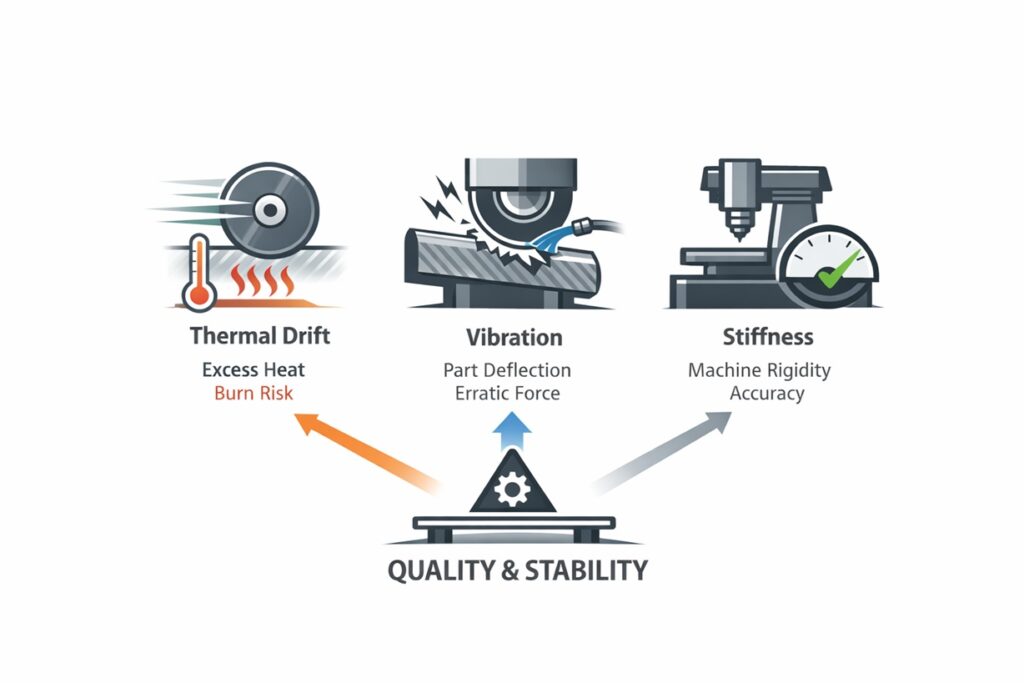
A high-yield grinding strategy relies on a three-tiered approach to stability:
- Mechanical Integrity (The Foundation): Achieving high Cp through machine rigidity, damping, and deterministic dressing cycles that manage wheel wear and geometric drift.
- Thermal Equilibrium (The Controller): Narrowing the standard deviation (σ) by implementing diameter-adaptive feed rates and coherent coolant delivery to maintain a constant heat flux.
- Proactive Monitoring (The Safeguard): Using real-time sensors (AE, Spindle Power) to predict Cpk shifts and intercept “latent defects” like tensile stress before they enter the supply chain.
The Roadmap to Zero-Defect Manufacturing
As the industry shifts toward Industry 4.0 and autonomous production, the role of the process engineer is evolving from a problem-solver to a “Stability Architect.” The future of grinding lies in self-correcting systems where Digital Twins forecast the decay of process capability and adjust parameters in milliseconds to stay perfectly centered within the tolerance window. In this high-stakes environment, Cpk becomes the ultimate KPI—a single number that validates the harmony between machine physics and financial profitability.
The Final Proclamation: “In the precision grinding industry, quality is not something you inspect into a part; it is something you design into the process. A capable process is one that acknowledges the volatility of physics and manages it with the rigidity of statistics. True yield is the victory of stability over drift.”
References & Internal Technical Resources
Primary Engineering References
- • Montgomery, D. C. (2019). Introduction to Statistical Quality Control. Wiley. (Focus: Implementation of Cp/Cpk in High-Precision Manufacturing).
- • Malkin, S., & Guo, C. (2008). Grinding Technology: Theory and Applications of Machining with Abrasives. Industrial Press. (Focus: Thermal Damage and Surface Integrity).
- • Rowe, W. B. (2014). Principles of Modern Grinding Technology. Academic Press. (Focus: Process Stability and Thermal Management).
Internal Deep-Dive Series: Quality & Yield Optimization
To technically implement the statistical stability and metallurgical protection strategies detailed in this report, please refer to the following core modules: