1. Introduction: The Geometric Foundation of Grinding Economics
In the field of precision grinding, the selection of Wheel Diameter (ds) is often treated as a secondary constraint dictated by the machine’s physical envelope. However, a rigorous analysis of Process Design reveals that the wheel’s geometry—and the resulting Contact Length (lc)—is the primary driver of both thermal integrity and operational profitability. Every millimeter of the contact arc represents a zone where mechanical energy is converted into heat, where coolant must penetrate against centrifugal resistance, and where individual abrasive grains must survive high-pressure engagement. Failing to optimize these geometric foundations leads to a cascade of Hidden Costs, ranging from thermal damage (grinding burn) to premature wheel disposal.
The Design Paradigm: Beyond “Bigger is Better”
There is a common industrial misconception that a larger wheel is universally superior due to its increased abrasive volume and longer life between changes. While a larger ds does reduce the frequency of Capital Expenditure (CAPEX) on new wheels, it simultaneously increases the contact length (lc) for a given depth of cut (ae). This expanded contact zone can become a thermal trap, significantly increasing the risk of Tensile Residual Stress and surface cracks.
Strategic process design requires balancing the economic benefits of wheel longevity against the physical risks of thermal accumulation. A process that is “stable” with a new 500 mm wheel may become highly “unstable” or even unviable as the wheel wears down to its minimum stub diameter, where the changing curvature alters the Equivalent Diameter (de) and the chip thickness (hcu).
The Economics of the Contact Arc
The financial performance of a grinding cell is intrinsically tied to the Material Removal Rate (MRR’). However, the limit of MRR’ is not determined by the spindle power, but by the Burn Threshold of the contact arc. If the contact length (lc) is too long, the heat flux density exceeds the cooling capacity of the fluid, resulting in scrapped parts.
Understanding how ds influences lc allows engineers to design for Predictable Performance. The “Cumulative Loss” of an unoptimized design manifests in three primary economic areas:
- Yield Volatility: Increased scrap rates at the end of the wheel’s life-cycle due to changing geometric heat distribution.
- Throughput Bottlenecks: Being forced to run at lower feed rates (vf) to accommodate the thermal risks of an oversized contact length.
- Consumable Overhead: Excessive dressing costs incurred in an attempt to maintain wheel “sharpness” to compensate for poor geometric design.
Summary of Strategic Intent
The goal of this series is to transform wheel selection from a logistical task into a Geometric Optimization Strategy. By mastering the relationship between diameter and contact length, manufacturers can ensure that the grinding process remains within a “Sweet Spot” of maximum productivity and minimum thermal risk throughout the entire life of the tool.
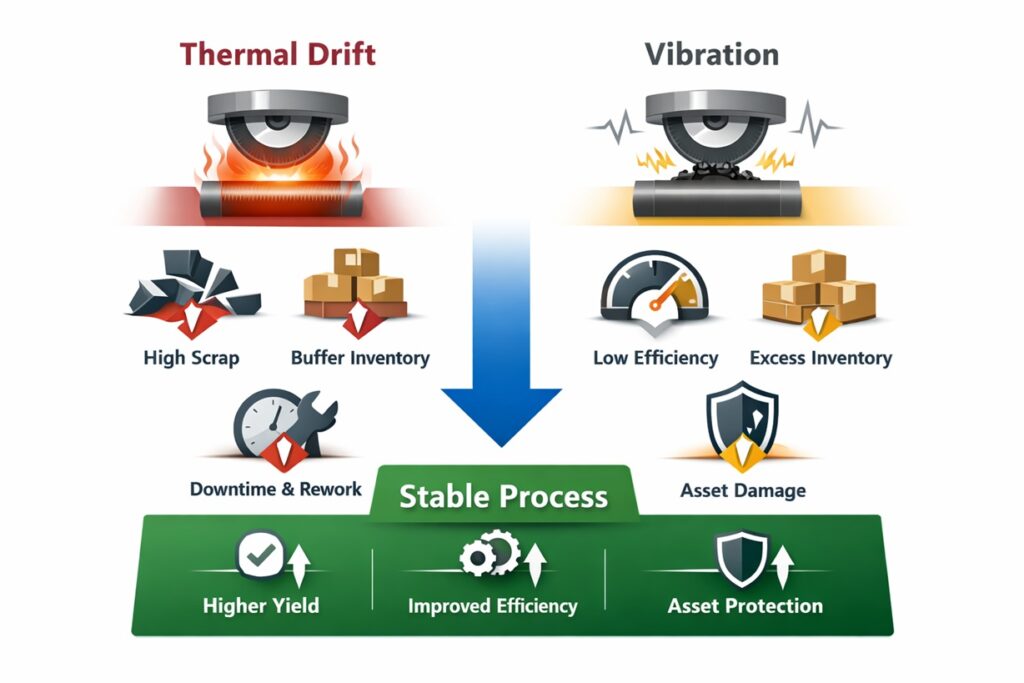
The Designer’s Axiom: “In grinding, geometry dictates thermodynamics, and thermodynamics dictates profit. A wheel is not just a tool; it is a moving heat engine whose efficiency is defined by its contact arc.”
2. The Physics of Contact: Geometry of the Arc (lc)
To engineer a grinding process for maximum efficiency, one must first master the mathematical relationship between the tool and the workpiece. In grinding, unlike single-point turning, the “cutting edge” is a distributed contact zone known as the Geometric Contact Length (lg). This arc is the primary site of energy exchange. As the Wheel Diameter (ds) decreases due to wear and dressing, the curvature of this arc changes, fundamentally altering the mechanics of the cut. Understanding this shift is not merely an academic exercise; it is a prerequisite for stabilizing Total Manufacturing Costs.
Defining the Contact Arc and Equivalent Diameter (de)
The theoretical length of the contact zone in surface grinding is defined by the square root of the product of the depth of cut and the wheel diameter. However, to account for various grinding configurations (Internal, External, and Surface), engineers utilize the Equivalent Diameter (de). This allows for a unified calculation of the geometric contact length (lg):
In External Cylindrical Grinding, de is calculated based on both the wheel diameter (ds) and the workpiece diameter (dw):
As ds decreases, de also decreases, which in turn reduces the contact length lg. While a shorter contact length might seem beneficial for reducing heat, it dramatically increases the mechanical load on each individual abrasive grain.
The Mechanics of Chip Thickness (hcu) Control
The most critical physical consequence of changing the wheel diameter is its impact on the Maximum Undeformed Chip Thickness (hcu). This parameter determines whether an abrasive grain will cut, plow, or simply rub against the material. The relationship is governed by the following proportionality:
When the wheel diameter (ds) shrinks, de drops. For a constant feed rate (vw) and wheel speed (vs), this reduction in de causes the hcu to increase. In other words, as the wheel gets smaller, each grain is forced to take a deeper, more aggressive bite into the steel. This leads to:
- Higher Specific Grinding Forces: Increased pressure on the bond system, leading to accelerated grain pull-out.
- Roughness Shift: A natural increase in Surface Roughness (Ra) as the wheel wears down, often requiring an adjustment in dressing frequency.
- Vibration Sensitivity: A thinner contact zone provides less “damping” at the interface, making the process more susceptible to regenerative chatter.
Geometric Stability vs. Economic Flux
The “Physics of Contact” teaches us that a grinding process is never truly in a steady state if the wheel diameter is changing. From a Process Design perspective, this means the OPEX (Operational Expenditure) of a wheel is non-linear. The initial 10% of a wheel’s diameter might provide perfect surface integrity, while the final 10% (the “stub” phase) might struggle to stay within Cpk limits due to the high hcu and reduced lg.
The Engineer’s Insight: “You cannot control the cost of your parts if you do not control the geometry of your arc. As ds shrinks, your process window shrinks with it. Smart design accounts for the ‘Stub Wheel’ condition before the first part is ever ground.”
3. Thermal Dynamics: How Contact Length Drives Heat (Tmax)
The primary constraint on productivity in any precision grinding operation is not the power of the spindle motor, but the Thermal Integrity of the workpiece. In the contact zone, nearly 90-95% of the mechanical energy expended is converted directly into heat. The Geometric Contact Length (lc) determines how this massive energy influx is distributed across the surface of the part. As we alter the wheel diameter or depth of cut, we are essentially reconfiguring the “Heat Engine” of the process. Understanding the Thermal Dynamics of this interface is critical to preventing the “Hidden OPEX” of metallurgical damage and scrap.
Heat Flux Distribution and the Contact Time Window
When the contact length (lc) increases—either due to a larger wheel diameter (ds) or a deeper cut (ae)—the time that any single point on the workpiece remains under the “Heat Flux” increases. This is the Contact Time (τ), and it is a fundamental driver of surface temperature. While a longer lc spreads the total energy over a wider area, it also creates a sustained thermal load that penetrates deeper into the material.
The maximum surface temperature (Tmax) can be modeled using the Jaeger Moving Heat Source theory:
where qw is the heat flux entering the workpiece, k is thermal conductivity, ρ is density, and Cp is specific heat. Crucially, notice that Tmax increases with the square root of lc. This means that a process design utilizing a very large wheel or a massive depth of cut is inherently pushing the material closer to its Critical Burn Threshold (Tcrit), even if the total power remains constant.
Peclet Number (Pe) and Fluid Cooling Resistance
The contact length also dictates the Cooling Efficiency. In grinding, the coolant must penetrate the boundary layer of air surrounding the rotating wheel and enter the tiny gaps between the abrasive grains. As lc becomes longer, the fluid must travel a greater distance through a high-pressure, high-temperature narrow channel. This increases the likelihood of Film Boiling, where the coolant vaporizes before it can reach the center of the contact arc.
To analyze this, we use the Peclet Number (Pe), which relates the rate of advection (heat carried by the moving workpiece) to the rate of diffusion (heat conducted into the bulk material):
where α is the thermal diffusivity. A high Pe—often caused by a long contact length—indicates that the heat is being generated faster than it can be dissipated or cooled. This leads to a steep thermal gradient, resulting in Tensile Residual Stress on the surface and compressive stress underneath, a primary cause of subsurface micro-cracks and premature component failure.
The “Burn Threshold” Economics
From a Process Design perspective, every manufacturing facility has a “Safety Margin” relative to the burn threshold. If the contact length is unmanaged, this margin shrinks to nearly zero. The financial impact is realized in the form of Batch Scrapping: a minor fluctuation in wheel sharpness or material hardness will instantly push Tmax above Tcrit, resulting in martensitic re-tempering (burn).
The Thermal Axiom: “In grinding, length is heat. Every extra millimeter of contact is another millisecond for the heat to penetrate the surface. Mastering the geometry of lc is the only way to safeguard your parts against the invisible damage of residual stress.”
4. Impact of Wheel Wear: The Shrinking Diameter Problem
A grinding wheel is a consumable that evolves throughout its life cycle. As the Wheel Diameter (ds) decreases from its “New” state to its “Stub” (End-of-life) state, the fundamental kinematics of the process drift. This Geometric Drift is one of the most significant sources of process instability in high-volume production. If the process design does not account for this shrinking diameter, the manufacturer faces a decline in quality and an increase in unit cost as the wheel ages. Managing this transition requires a deep understanding of how velocity, force, and surface integrity are coupled to the diameter of the abrasive tool.
The Constant Surface Speed (vs) Challenge
To maintain a consistent material removal mechanism, the Wheel Peripheral Speed (vs) must remain constant. As ds decreases, the spindle rotational speed (ns) must increase proportionally:
While modern CNC controllers can handle this calculation, the physical implications are significant. At the end of a wheel’s life, the spindle may be running at its Maximum RPM Limit, yet it may still fail to reach the target vs if the diameter has shrunk too far. A drop in vs leads to an immediate increase in the Maximum Undeformed Chip Thickness (hcu), which results in higher grinding forces and a rapid deterioration of the G-Ratio. Economically, this means the wheel wears even faster in its final stages, creating a “Death Spiral” of consumable cost.
Geometric Drift: Surface Roughness (Ra) and Stress
As discussed in Chapter 2, a smaller ds leads to a smaller Equivalent Diameter (de). This geometric change alters the Surface Topography. With a smaller diameter, the abrasive grains penetrate deeper into the workpiece (higher hcu), which inherently increases the Surface Roughness (Ra).
Moreover, the shorter contact length (lc) of a worn wheel reduces the “Burnishing Effect” or the spark-out efficiency. In precision components where Compressive Residual Stress is required for fatigue life, a shrinking wheel can unintentionally shift the stress profile toward the Tensile regime. This shift is often invisible during dimensional inspection but manifests as premature field failure, representing a massive Warranty Liability for the manufacturer.
The Compensation Trap: Dressing and OPEX
To combat the loss of quality as ds decreases, operators often increase the frequency or depth of Dressing Cycles. While this restores wheel sharpness, it accelerates the consumption of the tool.
- Consumable Inflation: Dressing away more abrasive than necessary to compensate for poor geometric design increases the tooling cost per part by 15-25%.
- Non-Productive Time: More frequent dressing leads to lower Spindle Utilization and higher labor burden.
Strategic process design must include Diameter-Adaptive Grinding Cycles. By gradually reducing the workpiece feed rate (vw) as the wheel gets smaller, the hcu can be kept constant, stabilizing the forces and surface quality throughout the entire life of the wheel.
The Life-cycle Insight: “A grinding wheel is not a static tool; it is a decaying geometry. If your CNC code is the same for a new wheel and a worn wheel, you are leaving money on the table through wasted abrasive and inconsistent quality.”
5. Grinding Cost Analysis: CAPEX vs. OPEX of Wheel Size
In process design, the selection of the initial Wheel Diameter (ds) is a critical financial decision that balances Capital Expenditure (CAPEX) against long-term Operational Expenditure (OPEX). While larger wheels command a higher upfront purchase price, they offer a disproportionately lower cost-per-part over their entire life cycle. However, the economic reality is more complex than a simple “volume-to-price” ratio. The true cost of wheel size must account for the stability of the process, the risk of thermal damage as the wheel wears, and the logistics of inventory management.
The Economics of Initial Diameter Selection
A larger initial diameter provides a larger “Abrasive Reservoir,” which directly extends the time between wheel changes. This reduces Non-Productive Time—the labor and machine idle time associated with wheel replacement and subsequent re-calibration.
For example, a 610 mm wheel may cost 40% more than a 450 mm wheel, but it provides nearly 85% more usable abrasive volume. When factoring in the Burden Rate of the machine (often exceeding $200/hour), the reduction in setup frequency alone can yield an Internal Rate of Return (IRR) of over 30% on the higher CAPEX. Furthermore, a larger wheel maintains its geometric stability longer, providing a consistent Contact Length (lc) and Equivalent Diameter (de) for a greater portion of its service life.
The Scrap Risk of “Stub” Wheels
The most dangerous period for OPEX is the final 15% of the wheel’s diameter, often called the “Stub” phase. As we explored in previous chapters, the shrinking ds leads to an increased Maximum Undeformed Chip Thickness (hcu) and higher specific forces.
If a manufacturer pushes a wheel to its absolute minimum diameter without adjusting the Material Removal Rate (MRR’), the probability of Grinding Burn increases exponentially. Scrapping even a single high-value component (such as a turbine blade or a crankshaft) in the final stage of production can wipe out all the savings gained by extending the wheel’s life. The Risk-Adjusted Cost of using a worn wheel often exceeds the cost of simply replacing it earlier.
Inventory Economics and Logistics
Beyond the machine tool, wheel diameter influences Inventory Carrying Costs. Standardizing on a single, larger wheel size across multiple machines can simplify the supply chain and increase Inventory Turnover. Conversely, managing multiple custom diameters for different “Stub” conditions creates logistical friction and increases the risk of stock-outs.
The Financial Axiom: “In precision manufacturing, you do not save money by buying the cheapest wheel; you save money by buying the most abrasive life that can be used within a stable thermal window. A large wheel is a hedge against the high cost of setup and scrap.”
6. Optimizing the “Sweet Spot” in Process Design
The ultimate objective of grinding process design is to identify and maintain the “Sweet Spot”—the precise intersection where Material Removal Rate (MRR’) is maximized while Surface Integrity remains compromised by zero thermal damage. This optimization requires a multidimensional approach that balances the wheel diameter (ds), depth of cut (ae), and feed rate (vw). In this chapter, we explore how to manipulate the Contact Length (lc) as a strategic tool to suppress heat generation and how advanced concepts like HEDG redefine the boundaries of what is possible in precision manufacturing.
The Balancing Act: MRR’ vs. Contact Stress
To increase productivity, engineers often increase the depth of cut (ae). As established, this increases the contact length (lc), which spreads the mechanical load but traps more heat. To find the sweet spot, one must calculate the Specific Grinding Energy (us). As lc increases, us typically decreases because the individual chip thickness (hcu) becomes smaller, shifting the energy from “plowing” to “cutting” efficiency.
However, there is a thermal limit. The key to optimization is to utilize a High-Speed Grinding strategy where the wheel speed (vs) is increased alongside the feed rate (vw). This keeps the contact time short, preventing the heat from penetrating the surface. This “Short Pulse” energy delivery ensures that even with a larger wheel diameter, the thermal debt remains manageable.
High-Efficiency Deep Grinding (HEDG) Dynamics
HEDG (High-Efficiency Deep Grinding) represents a paradigm shift in process design. It utilizes extremely high vw and vs combined with a large ae. This results in an exceptionally long contact length (lc), which would normally cause catastrophic burn.
The secret to HEDG’s success lies in the Energy Partition (e). Because the workpiece is moving so fast, most of the heat is carried away by the chips rather than being conducted into the part. From a geometric standpoint, HEDG requires a highly rigid spindle and a wheel with large diameter (ds) to provide the necessary mechanical stability. This allows the process to achieve MRR’ levels that compete with milling, while maintaining grinding tolerances—a high-ROI strategy for high-volume automotive and aerospace components.
Nozzle Geometry Synergy with lc
No process optimization is complete without considering Coolant Delivery. The coolant nozzle must be designed to match the specific Contact Arc. As ds changes, the “throat” of the contact zone shifts.
- Hydrodynamic Pressure: The nozzle must deliver fluid at a velocity (vj) that matches the wheel speed (vs) to break the air barrier.
- Angular Optimization: As lc lengthens, the nozzle angle must be adjusted to ensure the fluid is directed into the leading edge of the arc, preventing Film Boiling at the center of the cut.
The Optimizer’s Perspective: “The ‘Sweet Spot’ is a moving target. To hit it consistently, you must understand that as your tool geometry changes, your entire thermodynamic strategy must follow suit. Success in grinding is about maintaining the balance between mechanical force and thermal dissipation.”
7. Real-world Case Study: Solving the “End-of-Life” Burn
One of the most persistent challenges in high-precision automotive manufacturing is the “End-of-Life Burn” phenomenon. This occurs when a grinding process that has been stable for 80% of a wheel’s life suddenly begins producing parts with thermal damage as the wheel approaches its minimum diameter. This case study analyzes a Tier-1 crankshaft manufacturer that was losing over $150,000 annually due to this specific issue and demonstrates how a Geometric Redesign of the grinding cycle transformed their profitability.
The Problem: Geometric Instability in the Stub Phase
The facility used large 600 mm vitrified CBN wheels to grind hardened steel journals. The initial process design was static: the feed rate (vw) and wheel speed (vs) were fixed regardless of the Wheel Diameter (ds). As the wheel wore down to 510 mm, the following physical shifts occurred:
- Contact Length (lc) Reduction: The arc of contact shrank by nearly 12%, reducing the time for individual grains to dissipate heat.
- Chip Thickness (hcu) Spike: Because the equivalent diameter (de) decreased, the undelformed chip thickness increased by 18%, causing specific grinding forces to rise sharply.
- Vibration Sensitivity: The smaller wheel lacked the mass and damping of the new wheel, leading to micro-chatter that exacerbated thermal spikes.
The Solution: Implementing a Diameter-Adaptive Variable Cycle
Instead of simply replacing the wheel earlier (which would have increased Tooling OPEX), the engineering team implemented a Diameter-Adaptive Variable Cycle. This algorithm, integrated into the CNC controller, adjusted the workhead speed and feed rate based on the real-time ds value provided by the dresser compensation logic.
The primary adjustment was to gradually reduce the feed rate (vw) as the wheel diameter decreased. By keeping the chip thickness (hcu) constant across the entire life of the wheel, the team effectively stabilized the grinding forces and the heat flux density. Additionally, they optimized the coolant nozzle pressure to ensure the jet velocity (vj) remained perfectly matched to the increasing spindle RPM required to maintain a constant vs.
Financial ROI and Results
The results were immediate and measurable. The scrap rate for “End-of-Life” parts dropped from 4.5% to zero. By utilizing the full abrasive layer of the wheel without the risk of burn, the facility realized the following financial gains:
The Case Axiom: “The most expensive wheel is the one you throw away with 20% of its life remaining. By understanding the physics of the shrinking diameter, you can transform the riskiest phase of your process into a zone of predictable profit.”
8. Conclusion: Designing for Predictable Performance
The technical exploration conducted throughout this report confirms a fundamental axiom of precision manufacturing: Wheel Diameter (ds) and Contact Length (lc) are not merely physical dimensions, but the primary architects of a grinding process’s economic and thermal destiny. From the initial CAPEX decision regarding wheel size to the micro-adjustments required during the “Stub” phase, every aspect of the process is governed by the laws of contact geometry. By mastering these variables, manufacturers can move beyond reactive “firefighting” and build a production environment defined by Predictable Performance and superior cost leadership.
The Convergence of Geometry, Heat, and Profit
As we have analyzed, the contact arc acts as the “Heat Engine” of the grinding process. A process designed with a deep understanding of Equivalent Diameter (de) and Peclet Number (Pe) is a process that operates with a wide safety margin against thermal damage. The strategic transition from static grinding cycles to Diameter-Adaptive Variable Cycles represents the pinnacle of modern process design. It ensures that the Specific Grinding Energy (us) and Surface Integrity remain constant, regardless of whether the wheel is brand new or at the end of its service life.
Strategic Imperatives for Future Process Design
To maintain a competitive edge in an increasingly automated landscape, organizations must adopt three strategic imperatives:
- Robust Geometric Modeling: Utilizing Digital Twins to simulate the entire lifespan of a wheel—from maximum to minimum diameter—before the first physical part is ground.
- Adaptive Kinematic Control: Implementing real-time CNC logic that compensates for the shrinking ds by adjusting feed rates (vw) and dressing intervals.
- Total Cost of Ownership (TCO) Focused Procurement: Moving away from “lowest unit price” abrasive purchasing and toward “lowest cost-per-part” via optimized abrasive volumes and stability windows.
Final Proclamation: The Geometry of Profit
Ultimately, a grinding process is as strong as its weakest geometric link. By designing for the “Stub” condition while maximizing the “New” wheel potential, we create a process that is truly Robust. In the world of high-precision manufacturing, geometry dictates thermodynamics, and thermodynamics dictates profit. A well-designed contact arc is not just an engineering achievement; it is a financial fortress.
The Closing Vision: “Designing a grinding process without considering wheel diameter drift is like building a ship for only the high tide. True engineering excellence lies in ensuring the process sails smoothly even when the tide—your abrasive diameter—is at its lowest.”
References & Internal Technical Resources
Primary Engineering References
- • Malkin, S., & Guo, C. (2008). Grinding Technology: Theory and Applications of Machining with Abrasives. Industrial Press.
- • Rowe, W. B. (2014). Principles of Modern Grinding Technology. Academic Press.
Internal Deep-Dive Series: Integrated Process Optimization
To technically implement the diameter-adaptive strategies and thermal cooling solutions detailed in this report, please refer to the following core modules: