1. Introduction: The Mechanics of Grinding Forces
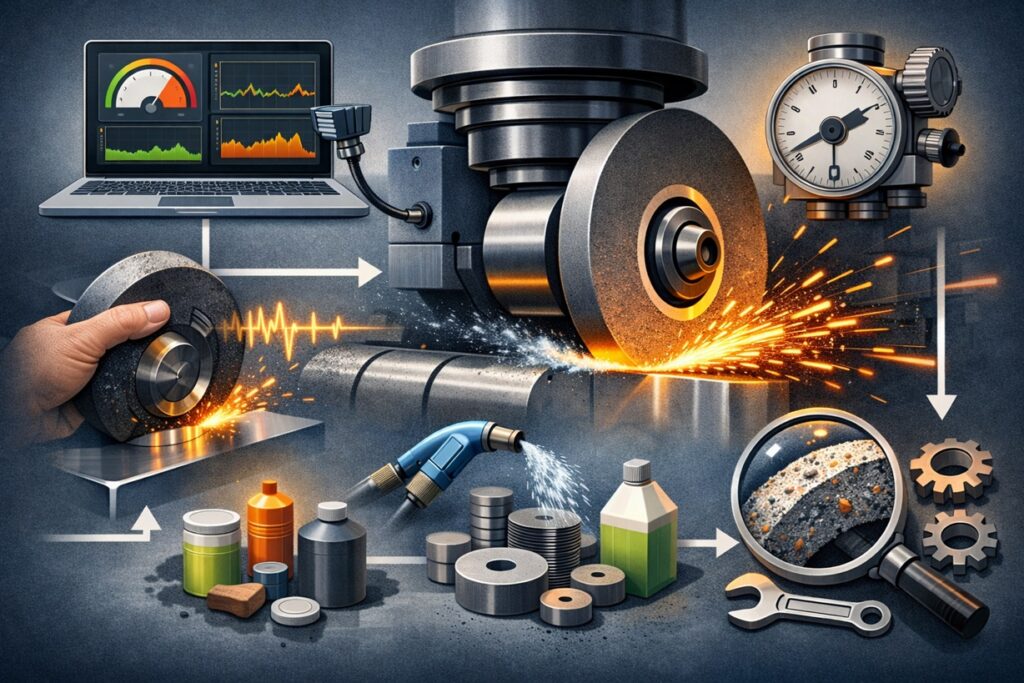
In precision manufacturing, Grinding Forces are the primary drivers of process instability. Unlike single-point cutting tools, a grinding wheel utilizes thousands of randomly oriented abrasive grains, each exerting a localized force on the workpiece. These forces are typically decomposed into two main vectors: the Normal Force (Fn), acting perpendicular to the surface, and the Tangential Force (Ft), acting parallel to the direction of cut.
The Impact of Force on Process Stability
The stability of a grinding process is directly tied to the magnitude of these forces. Excessive Normal Forces lead to elastic deflections in the machine-tool-workpiece system, causing dimensional inaccuracies and “out-of-roundness.” Meanwhile, high Tangential Forces increase the spindle power consumption and generate frictional heat, which can trigger thermal instability (burn). Reducing these forces without lowering the Material Removal Rate (MRR) is the ultimate goal of process optimization.
The Three Stages of Grit Interaction
Total grinding force is the summation of three distinct physical interactions at the microscopic level. Stabilization requires shifting the balance from energy-wasting phases to efficient material removal:
- • Rubbing: The grit slides over the surface without penetration, contributing only to friction and heat.
- • Plowing: The grit displaces material plastically to the sides of the groove without forming a chip, increasing Fn significantly.
- • Cutting: The grit effectively penetrates and removes a chip, which is the most efficient use of energy for a given MRR.
By understanding that grinding force is not a fixed byproduct but a controllable variable, we can begin to apply strategies that decouple the material removal rate from the mechanical load. In the next section, we will analyze the mathematical relationship between force and productivity, identifying the Specific Energy targets needed for a stabilized process.
2. The Relationship Between Force and MRR
To optimize a process, one must quantify the efficiency of material removal. The primary link between productivity and mechanical load is the Specific Grinding Energy (u). This value represents the energy required to remove a unit volume of material (J/mm³). In a deterministic system, as we increase the Material Removal Rate (MRR), the grinding forces will naturally rise, but the rate of that increase depends heavily on how efficiently the grains are cutting.
The Force Partitioning Equation
The total tangential force (Ft) can be mathematically modeled as the sum of cutting, plowing, and rubbing forces. For stabilization, our goal is to minimize the “non-cutting” components of this equation. By reducing the specific energy (u), we can achieve a higher MRR with a lower total force than a non-optimized process.
Force-Productivity Relationship
Ft = ( u × Q′w × b ) / vs
The “Size Effect” in Grinding
A critical phenomenon in force reduction is the Size Effect. As the chip thickness (hcu) decreases, the specific energy (u) increases. This means that very light cuts can paradoxically be less “efficient” in terms of energy per volume than heavier cuts. To reduce forces while maintaining MRR, we must find the “sweet spot” where the chip thickness is large enough to promote efficient cutting but small enough to avoid overwhelming the system stiffness.
The fundamental strategy for force reduction lies in the manipulation of Kinematics. By adjusting the speeds of the wheel and the workpiece, we can change the thickness of the chips being removed. In the next section, we will explore Kinematic Thinning—the primary lever for reducing mechanical load through wheel speed optimization.
3. Strategy 1: Kinematic Thinning (The Speed Factor)
The most potent method for reducing grinding forces while keeping the Material Removal Rate (MRR) constant is to increase the Wheel Peripheral Speed (vs). This technique, known as kinematic thinning, relies on the principle that if you remove the same amount of material over a higher number of abrasive grain passes, each individual grain has to do less work.
Reducing the Maximum Undeformed Chip Thickness (hcu)
Grinding forces are fundamentally determined by the Undeformed Chip Thickness (hcu). When vs is increased while the workpiece feed rate (vw) remains the same, the path length of each grain through the material remains similar, but the volume of the chip it carves out becomes significantly thinner. Thinner chips require lower Normal Forces (Fn) to achieve penetration, leading to a more stable and accurate process.
Simplified Kinematic Chip Thickness Model
hcu ∝ ( vw / vs ) ⋅ √( ae / deq )
Force Reduction Ratios
In practical industrial applications, doubling the wheel speed can often reduce the normal grinding force by 30% to 50% for the same MRR. This reduction significantly lowers Spindle Deflection, which is the primary cause of “taper” and “chatter” in precision components.
While increasing speed is effective, it must be balanced against the thermal limits of the material. As vs increases, the frequency of grain-workpiece friction also increases. To mitigate this, the wheel must be kept in its sharpest possible state. In the next section, we examine Wheel Topography and Sharpness as the second pillar of force reduction.
In practice, speed increases are rarely applied in a single jump. Engineers typically raise wheel speed in controlled increments while monitoring spindle power, part temperature, and acoustic emission levels. This staged approach prevents thermal shock and allows the process window to be expanded safely without introducing burn or unexpected chatter.
4. Strategy 2: Wheel Topography and Sharpness (Dressing DNA)
While kinematics define the theoretical chip size, the Wheel Topography determines the actual efficiency of the cutting process. A “dull” wheel, where the grains have developed large wear flats, increases the Rubbing and Plowing components of the grinding force. To reduce forces while maintaining the Material Removal Rate (MRR), the dressing process must be engineered to create a sharp, open wheel structure.
The Dressing Lead and Active Grain Density
The “sharpness” of a wheel is often quantified by its Active Grain Density (C). By increasing the Dressing Lead (fd)—the lateral distance the dresser moves per wheel revolution—we create a “coarser” topography. This reduces the number of active grains, meaning each remaining grain takes a slightly deeper, more efficient “cutting” stroke rather than a shallow “rubbing” stroke. This paradoxically reduces the total Normal Force (Fn) by minimizing the cumulative friction of blunt grains.
Dressing Overlap Ratio (Ud)
A critical metric for process stability is the Overlap Ratio (Ud), which indicates how many times the dresser passes over the same point on the wheel. For force reduction, an overlap ratio between 2 and 4 is typically targeted. A ratio higher than 8 “crushes” the grains, creating a closed topography that spikes grinding forces and leads to vibration.
Self-Sharpening and Force Stability
A stabilized process utilizes Controlled Bond Fracture. If the wheel bond is too hard, the dulled grains remain in place, causing forces to climb until the machine vibrates. By selecting a slightly “softer” wheel grade, the increased grinding forces at the grain level will naturally trigger Self-Sharpening, where the blunt grains are shed to reveal fresh, sharp edges. This maintains a consistent force profile over the duration of the cycle.
While sharpness handles the cutting efficiency, the friction between the wheel bond and the workpiece remains a major force component. In the next section, we examine Real-Time Force Attenuation via Lubrication to further lower the mechanical load.
5. Strategy 3: Real-Time Force Attenuation via Lubrication
A significant portion of the total grinding force, particularly the Tangential Force (Ft), is consumed by friction rather than actual material removal. By implementing high-performance lubrication, we can reduce the friction coefficient (μ) at the grain-workpiece interface. This leads to a direct reduction in spindle power and prevents the force “creep” that occurs as wheels begin to load with swarf.
Boundary Lubrication and Force Partitioning
In the high-pressure environment of the grinding zone, standard fluid films often break down. We rely on Boundary Lubrication, where extreme pressure (EP) additives—such as sulfur, phosphorus, or chlorine compounds—form a molecular sacrificial layer on the metal surface. This layer prevents “micro-welding” between the swarf and the wheel bond, effectively lowering the Plowing and Rubbing components of the force.
Oil vs. Water: The Friction Trade-off
The choice of fluid chemistry has a deterministic impact on grinding forces. Neat oils provide the lowest friction coefficient, resulting in significantly lower Ft compared to water-based emulsions. However, in high-MRR operations, the superior cooling of water is often required. The stabilization strategy here is to use High-Oil Content Emulsions (10-15% concentration) to bridge the gap between cooling capacity and force reduction.
Hydrodynamic Lift and Normal Force
Interestingly, at very high delivery pressures, the fluid can create a Hydrodynamic Wedge. While this helps in reducing friction, it can also create a small upward force that counters the Normal Force (Fn). This “lift” effect must be accounted for in ultra-precision grinding to avoid unintended size variations, but in standard production, it serves as a valuable cushion that dampens mechanical shocks.
Lubrication manages the friction, but the kinematic timing of the cut also plays a role in how the material responds. In the next section, we look at how Workpiece Velocity can be leveraged to reduce the elastic deformation phase.
A common shop-floor scenario occurs when force gradually rises despite unchanged cutting parameters. Investigation often reveals wheel loading or clogged coolant nozzles rather than an incorrect feed rate. Restoring proper fluid delivery frequently drops spindle power immediately, demonstrating how lubrication effectiveness can outweigh purely mechanical adjustments.
6. Strategy 4: Workpiece Velocity and the Peclet Effect
While increasing wheel speed is a common tactic, adjusting the Workpiece Velocity (vw) offers a different pathway to process stabilization. By increasing the feed rate, we decrease the Contact Time (tc) that any single point on the workpiece spends under the grinding wheel. This manipulation of time and speed is essential for managing the thermal-mechanical load balance.
The Peclet Number (Pe) and Force Localization
In the context of grinding, the Peclet Number represents the ratio of heat convection by the moving workpiece to the heat conduction into the material. At high workpiece speeds, the heat is “outrun” by the material removal process. While higher vw naturally increases the Normal Force (Fn) due to a larger chip thickness, it simultaneously reduces the time for Elastic Deformation and thermal expansion to occur. This leads to a “cleaner” cut with less energy lost to sub-surface plastic flow.
Balancing Force and Thermal Expansion
There is a strategic trade-off: higher workpiece speeds increase mechanical forces but decrease thermal expansion. In precision grinding, thermal expansion of the workpiece into the wheel can create a “feedback loop” where the part gets hotter, expands more, and increases the depth of cut, which in turn spikes the grinding force. By using a higher vw, we break this loop, keeping the part cooler and the Effective Force more predictable.
Managing workpiece velocity ensures the material behaves as a rigid body during the cut. However, even with optimized speeds, every machine system has a limit. In the next section, we look at how to implement these force reduction strategies within the context of Stability Lobe Diagrams to eliminate vibration and chatter.
7. Implementation: The Stability Lobe in Grinding
Even with optimized force reduction strategies, a process can still fail due to Self-Excited Vibration, commonly known as chatter. Chatter occurs when the grinding force frequency aligns with the natural frequency of the machine-tool system. To achieve true process stabilization, we must map our force reduction efforts onto a Stability Lobe Diagram.
The Relationship Between Force and Vibration
Grinding forces act as the “input” to the system’s dynamic response. When the Dynamic Force exceeds the system’s damping capacity, the wheel begins to bounce, creating “waves” on the workpiece surface. By reducing the steady-state grinding force through the strategies previously discussed (speed, sharpness, lubrication), we effectively lower the energy available to excite these vibrations, widening the “Stable Zone” of operation.
Identifying the Stability “Sweet Spots”
A stability lobe diagram plots the depth of cut (ae) against the wheel speed (vs). The “lobes” represent regions of instability. A deterministic approach involves shifting the process into the “valleys” between lobes where higher removal rates are possible without triggering resonance. Force reduction acts as a safety margin: the lower the Specific Energy (u), the higher the “ceiling” of the stable zones.
The Role of System Rigidity
Finally, force reduction must be proportional to System Stiffness (k). If a machine has a low static stiffness, even small forces will cause significant deflection. The goal of stabilization is to ensure that the Force-to-Stiffness Ratio remains within the linear elastic range of the machine, preventing the non-linear behaviors that lead to scrap parts and tool damage.
Stabilizing the process through force management creates a predictable manufacturing environment. In the final section, we conclude with a summary of how to balance these variables for long-term deterministic stability.
8. Conclusion: Achieving Deterministic Stability
Reducing grinding forces while maintaining the Material Removal Rate (MRR) is not a matter of compromise, but of Kinematic and Tribological Engineering. By shifting the energy balance from rubbing and plowing toward efficient cutting, manufacturers can achieve a stabilized process that is immune to the common pitfalls of vibration, geometric drift, and thermal damage.
The Stabilization Roadmap
To implement these findings in a production environment, engineers should follow a hierarchical approach to force reduction:
- 1. Kinematic Optimization: Increase vs to thin the chips (hcu) and lower the mechanical load per grit.
- 2. Topography Engineering: Dress the wheel for “sharpness” to minimize the friction-induced normal force.
- 3. Tribological Control: Use high-oil content fluids or EP additives to attenuate tangential force.
- 4. Dynamic Verification: Map the operating points on a stability lobe diagram to avoid resonance zones.
The Economic Impact of Reduced Forces
A stabilized process with low grinding forces yields significant dividends beyond simple quality metrics. It leads to Longer Tool Life through reduced grain fracture, Lower Energy Consumption per part, and Higher Machine Availability by reducing the frequency of corrective dressing and maintenance. In the competitive landscape of modern manufacturing, this deterministic control is the bridge to high-margin, zero-defect production.
The Force-Quality Axiom
“Precision is the byproduct of minimized deflection; stability is the byproduct of controlled energy.”
References & Further Reading
Technical Publications & Industrial Standards
- • Tönshoff, H. K., Friemuth, T., & Becker, J. C. (2002).
Process Monitoring in Grinding. CIRP Annals – Manufacturing Technology.
(Focus: Grinding force measurement, acoustic emission, and adaptive control strategies). - • Inasaki, I. (1991).
Monitoring and Optimization of Grinding Processes. International Journal of Machine Tools and Manufacture.
(Focus: Relationship between grinding forces, process stability, and chatter suppression). - • Malkin, S., & Guo, C. (2008).
Grinding Technology: Theory and Applications of Machining with Abrasives (2nd ed.). Industrial Press.
(Focus: Grinding mechanics, specific energy, and thermal–mechanical interactions). - • Badger, J. (2013).
The Book of Grinding. Badger Publishing.
(Focus: Practical industrial methods for wheel dressing, sharpness control, and force reduction).
Curated Internal Resources: Process Stabilization Series
To master force reduction and ensure deterministic stability in high-volume production, we recommend the following technical deep-dives:
Industrial Research Institutions
- Machine Tool Laboratory (WZL) at RWTH Aachen: Pioneers in grinding force modeling and dynamic stability lobes.
- The Grinding Institute: Specialized consultancy for wheel sharpness optimization and industrial productivity enhancement.
© 2026 Advanced Machining Intelligence | Strategic Resource for Process Stabilization and Force Optimization