Technical Disclaimer
This document provides technical guidelines for process optimization in abrasive machining. All formulas and physical constants are based on established tribological research. Specific process parameters must be validated through empirical testing on-site to account for machine-specific stiffness and ambient variables.
1. Introduction: Transitioning to Deterministic Process Control
In high-precision grinding, thermal damage is frequently viewed as a sporadic and unpredictable anomaly. However, from an engineering perspective, Grinding Burn is a deterministic outcome resulting from the exhaustion of the system’s thermal dissipation capacity. To transition from a reactive “scrap-and-sort” mentality to a proactive prevention strategy, manufacturers must master the thermodynamic variables that govern the abrasive-workpiece interface.
The Economics of Process Integrity
The prevention of grinding burn is not merely a quality control objective; it is an economic necessity. The Total Machining Cost (TMC) is disproportionately affected by thermal distress through several indirect channels:
The Deterministic Prevention Framework
Effective prevention requires managing the Specific Grinding Energy (u)—the energy required to remove a unit volume of material (J/mm3). Thermal damage occurs when the heat flux entering the workpiece (qw) exceeds the critical threshold that triggers phase transformation. According to the energy partition model, the relationship is defined by:
Critical Heat Flux Condition
qw = Rw × u × Q’w / b
To prevent the temperature spike (Tmax), process adjustments must focus on three primary pillars:
- I. Maximizing Convective Cooling: Ensuring the metalworking fluid (MWF) penetrates the air barrier to act as an effective heat sink.
- II. Reducing Frictional Generation: Maintaining wheel sharpness through precise dressing to minimize the rubbing and ploughing components of specific energy.
- III. Enhancing Lubricity: Utilizing advanced fluid chemistry to provide a stable boundary film, thereby lowering the partition ratio (Rw).
By systematically optimizing these variables, the “burn threshold” is no longer a limit on productivity but a manageable boundary within a deterministic manufacturing environment. This report provides a technical roadmap for these adjustments, starting with the most critical fluid dynamic factor: kinematic synchronization.
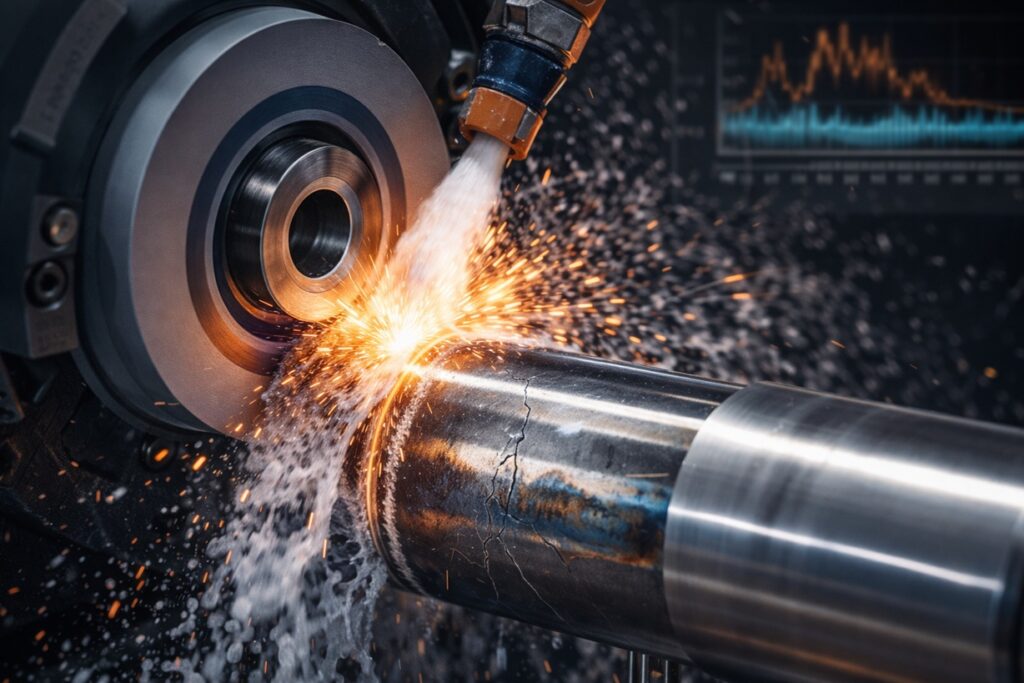
2. Kinematic Optimization: Nozzle Engineering and Jet Dynamics
The primary failure in cooling systems is not a lack of fluid volume, but the failure of the fluid to penetrate the Air Boundary Layer surrounding the high-speed grinding wheel. As established by Malkin and others, a rotating wheel acts as a centrifugal fan, creating a high-pressure air shroud that deflects incoming coolant jets. To overcome this, the delivery system must be engineered for Kinematic Synchronization.
The vj ≅ vs Matching Principle
Effective penetration into the grinding zone requires the Jet Velocity (vj) to match or slightly exceed the Wheel Peripheral Speed (vs). If the jet is too slow, it is “blown away” by the air barrier; if it is too fast, it may induce turbulence and air entrainment. The relationship between pump pressure and jet velocity for water-based fluids is governed by the Bernoulli-derived principle:
Theoretical Jet Velocity Formula
vj = Cv × √(2 × P / ρ)
Nozzle Geometry and Coherency
The structural integrity of the jet is as important as its speed. Standard “fan” or “pipe” nozzles create divergent, turbulent streams that entrain air, reducing the effective Convection Heat Transfer Coefficient (h). To maximize cooling efficiency, Coherent Jet Nozzles should be utilized. These nozzles are designed with internal profiles (such as the Webster curve) that minimize internal turbulence and maintain a laminar stream over a longer distance.
Strategic Nozzle Positioning
To ensure the fluid reaches the Grinding Zone (Contact Length lc), the nozzle must be aimed precisely at the entry wedge. A tangential orientation—rather than a perpendicular one—reduces splash-back and facilitates the “pumping” action of the wheel’s pores. Furthermore, an additional Air Scraper or deflector can be installed upstream of the coolant nozzle to mechanically disrupt the air shroud, further lowering the required pressure to achieve fluid penetration.
By synchronizing the jet velocity with the wheel speed and utilizing coherent delivery geometry, the system can maintain a stable convection regime (Qconv), preventing the premature onset of nucleate boiling. This aerodynamic mastery ensures that the cooling agent is physically present where it is most needed, transitioning the focus to the mechanical state of the wheel itself.
3. Abrasive Management: Dressing for Thermal Efficiency
While fluid dynamics manage heat dissipation, the Mechanical State of the grinding wheel dictates the amount of heat generated. As abrasive grains wear, they develop Wear Flats—flattened areas that increase friction without aiding material removal. Precise dressing is the primary mechanism used to maintain a sharp wheel topography, thereby minimizing the Specific Grinding Energy (u).
The Overlap Ratio (Ud) and Topography Control
In stationary or rotary dressing, the Overlap Ratio (Ud) determines how many times a single point on the wheel is contacted by the dresser. A high overlap ratio produces a “smooth” wheel with high precision but increased burn risk due to a closed topography. Conversely, a lower overlap ratio creates an “open” wheel with higher chip clearance and lower frictional heat.
Overlap Ratio Formula
Ud = (bd × vs) / vfd
Dressing Lead (ad) and Specific Energy Reductions
The Dressing Lead (ad), or the axial distance the dresser moves per wheel revolution, directly influences the number of active cutting edges. By increasing the lead, the number of active grains decreases, which increases the chip thickness per grain (hcu). This shift forces the wheel into the Cutting Phase more efficiently, reducing the energy-wasting Rubbing and Ploughing components.
Dressing Interval and Self-Sharpening Limits
Ideally, a grinding wheel should exhibit Self-Sharpening behavior, where worn grains fracture under load to reveal new sharp edges. However, in many high-precision applications, the dressing interval must be set deterministically based on Spindle Power Thresholds. When power consumption increases by a specific margin (e.g., beyond the steady-state baseline), it indicates that the wear flats have reached a critical area, necessitating a dressing cycle to restore thermal integrity before the burn threshold is breached.
Controlling the wheel’s topography through precise dressing parameters ensures that the mechanical energy input is primarily used for material removal rather than heat generation. This management of the abrasive interface works in tandem with high-pressure cleaning systems to prevent the accumulation of swarf, which otherwise acts as a secondary heat source.
4. Advanced Cleaning: High-Pressure Scrubbing Systems
Even a perfectly dressed wheel can rapidly lose its thermal efficiency through Wheel Loading—the adhesion of metallic chips (swarf) into the wheel’s interstitial pores. This metallic accumulation acts as a heat sink that traps thermal energy against the workpiece and physically blocks the entry of metalworking fluid. To counteract this, a deterministic High-Pressure Scrubbing strategy is required to maintain the wheel’s open topography throughout its service life.
The Mechanics of Pore Decontamination
High-pressure scrubbing nozzles operate by delivering a concentrated stream of fluid at pressures significantly higher than the primary cooling jet. The objective is to apply sufficient Kinetic Impact to dislodge micro-chips before they become mechanically or thermally bonded to the abrasive grains or the bond matrix.
Required Scrubbing Pressure (Ps)
Ps ≥ 0.5 × (Wheel Peripheral Speed vs)2 × ρ / 1000
Cleaning Fluid Detergency and Swarf Evacuation
While pressure provides the mechanical force, the Detergency of the fluid ensures chemical separation. Advanced metalworking fluids utilize surfactants that lower the surface tension and reduce the chemical affinity between the metal chips and the wheel. This prevents the chips from “smearing” across the grain tips—a primary cause of Adhesive Burn.
Synergy with Specific Energy (u)
The implementation of a high-pressure scrubbing system extends the Steady-State Period of the grinding cycle. By preventing the accumulation of conductive metallic particles on the wheel surface, the partition ratio (Rw) remains predictable. Without scrubbing, the “Loaded” wheel creates a localized thermal circuit where heat is reflected back into the workpiece, bypassing the convective cooling capacity of the primary jet.
Maintaining a decontaminated wheel surface ensures that the mechanical adjustments made during dressing are not neutralized by early-stage loading. This cleanliness is a prerequisite for the thermodynamic fluid properties to perform their function, as the fluid must reach a clean grain-workpiece interface to provide effective lubrication and phase-change protection.
5. Thermodynamic Fluid Selection: Boiling Point and Lubricity
While mechanical adjustments reduce heat generation, the Metalworking Fluid (MWF) is the final safeguard against thermal spikes. The effectiveness of a fluid is not merely defined by its cooling capacity (thermal conductivity) but by its ability to prevent the Leidenfrost Effect and maintain a lubrication film under extreme contact pressures.
Lubricity and the Reduction of Energy Partition (Rw)
Lubricity refers to the fluid’s ability to reduce friction in the Rubbing and Ploughing zones. High-lubricity fluids, typically containing esters or extreme-pressure (EP) additives, form a sacrificial molecular layer on the workpiece. This layer reduces the tangential force (Ft), which directly lowers the total energy input and the fraction of heat (Rw) that enters the material.
Managing the Critical Heat Flux (CHF)
The most dangerous phase in grinding is the transition to Film Boiling. When the heat flux exceeds the fluid’s Critical Heat Flux (CHF), a vapor blanket forms at the interface, effectively insulating the workpiece and leading to a rapid temperature surge. Water-based fluids have high cooling capacity but a low boiling point (approx. 100°C), while neat oils provide superior lubricity and a much higher boiling threshold (over 300°C).
Fluid Concentration and Additive Stability
For water-based emulsions, maintaining the correct Concentration (monitored via Refractometer) is critical. A drop in concentration leads to a disproportionate loss in lubricity, which increases the Rw and can trigger a burn even if the flow rate remains constant. Furthermore, the Boiling Incipience temperature can be chemically raised by using specific glycol-based additives that suppress early bubble formation, maintaining the more efficient nucleate boiling regime for longer periods.
By matching the fluid’s thermodynamic profile to the material’s thermal sensitivity (e.g., higher oil content for Inconel or Titanium), the process can operate closer to its theoretical maximum removal rate without breaching the metallurgical integrity limit. This chemical stability provides the necessary environment for real-time monitoring systems to track the process effectively.
6. Real-time Monitoring and Power Signal Analysis
Physical adjustments and fluid selection provide the foundation for burn prevention, but Real-time Monitoring serves as the indispensable feedback loop. Because grinding burn often occurs due to transient changes—such as a sudden loss of wheel sharpness or a momentary drop in coolant pressure—waiting for post-process inspection is a high-risk strategy. Monitoring the Spindle Power Signal provides a direct window into the energy state of the grinding zone.
Spindle Power as a Thermal Proxy
There is a direct linear correlation between the Tangential Grinding Force (Ft) and the spindle power consumption. As established in the Specific Energy (i>u) model, any increase in power for a constant material removal rate (Q′w) signifies an increase in friction (rubbing and ploughing). This energy, not being used for cutting, is converted almost entirely into heat.
Energy-to-Power Relationship
Pnet = u × Qw‘
Establishing Power Thresholds and “Burn Envelopes”
Deterministic control requires the establishment of a Power Baseline for a healthy, sharp wheel. By monitoring the signal in real-time, systems can detect the “Power Ramp”—a gradual increase in energy consumption that precedes metallurgical damage. When the signal crosses a pre-calculated Critical Power Threshold (Pcrit), the CNC controller can trigger an immediate remedial action, such as an emergency dressing cycle or a reduction in feed rate.
Acoustic Emission (AE) Integration
For ultra-precision applications, spindle power may lack the sensitivity to detect micro-burns. In these cases, Acoustic Emission (AE) sensors are utilized. AE sensors detect high-frequency elastic waves generated by the contact between the wheel and the workpiece. A shift in the AE frequency spectrum—specifically an increase in the RMS signal—often indicates the transition from the Cutting phase to the Rubbing phase before the heat has even penetrated the sub-surface.
Integrating power and AE signals creates a robust multi-sensor monitoring framework. This deterministic data allows for the validation of the mechanical and thermodynamic adjustments previously implemented, ensuring the process stays within the “Safe Zone” of the thermal integrity window. Once the process is monitored and controlled, the final step is standardizing the inspection protocols to verify the results.
7. Process Validation: Standardizing Inspection Protocols
Implementing process adjustments is only the first half of a deterministic strategy; the second half is Validation. Because grinding burn can be “invisible”—hidden beneath a superficially perfect surface finish or a thin oxide layer—standardizing inspection protocols is essential to ensure that the metallurgical and mechanical integrity targets are consistently met.
Nital Etching: The Visual Benchmark
Nital Etching remains the industry standard for detecting phase transformations in hardened steels. By applying a dilute solution of nitric acid and alcohol, the inspector can reveal the presence of “White Layer” (untempered martensite) and “Dark Layer” (over-tempered zone). To be effective, the etching protocol must be standardized in terms of immersion time, temperature, and neutralizer application to prevent false positives or excessive surface corrosion.
Non-Destructive Testing (NDT) via Barkhausen Noise
For high-volume production, destructive or chemical-intensive etching is often impractical. Barkhausen Noise Analysis (BNA) provides a non-destructive alternative that measures the “magnetic fingerprints” of the material. Changes in the BNA signal intensity directly correlate with variations in Residual Stress and Micro-hardness. This allows for 100% inspection of critical components, ensuring that every part remains within the compressive stress regime.
Calibration and Statistical Process Control (SPC)
Validation data should be integrated into Statistical Process Control (SPC) charts. By tracking the BNA peak values or the frequency of etching “shadows” over time, engineering teams can observe shifts in process stability. This data-driven approach links the mechanical adjustments (dressing/nozzles) to the final metallurgical output, providing a closed-loop system for continuous improvement.
Standardizing these inspection protocols ensures that the efforts in kinematic optimization and thermodynamic fluid management are not in vain. It provides the final verification required to claim a truly burn-free process, leading to the ultimate conclusion regarding the Return on Investment (ROI) for such technical rigor.
8. Strategic Conclusion: The ROI of Zero-Burn Manufacturing
The journey from reactive firefighting to Deterministic Burn Prevention represents a fundamental shift in manufacturing philosophy. By treating grinding burn as a preventable physical phenomenon rather than an unavoidable operational risk, organizations unlock significant value across the entire production lifecycle. The technical adjustments detailed in this report—from kinematic synchronization to multi-sensor monitoring—form a comprehensive defense-in-depth strategy against thermal degradation.
The Synergy of Integrated Adjustments
No single adjustment operates in isolation. The success of a high-pressure scrubbing system is contingent upon the fluid’s detergency, and the effectiveness of a coherent nozzle is maximized only when the jet velocity is synchronized with the wheel speed. When these variables are aligned, the system achieves Process Robustness, where the distance between the operating temperature and the critical burn threshold is maximized.
Sustainability and Future-Proofing
Beyond immediate cost savings, deterministic grinding supports Manufacturing Sustainability. Reducing scrap directly lowers the carbon footprint per component, and optimizing fluid dynamics reduces energy consumption at the spindle. As materials become more challenging (e.g., aerospace superalloys) and tolerances more stringent, the ability to maintain thermal integrity through scientific process control will distinguish industry leaders from their competitors.
The Final ROI Equation
Technical Rigor + Real-time Feedback = Zero-Burn Predictability
In summary, preventing grinding burn is not about luck; it is about the precise application of tribological and thermodynamic principles. By implementing the practical adjustments outlined in this report—kinematics, topography management, chemistry, and monitoring—manufacturers can achieve a state of process mastery where surface integrity is guaranteed and manufacturing excellence becomes the standard.
Author’s Note from the Shop Floor
In many grinding operations, burn does not first appear in metallurgical reports — it shows up in small operational clues. Operators may notice the power meter drifting slightly higher over several batches, or hear a subtle change in the grinding sound long before inspection reveals any discoloration. The coolant flow still looks “normal,” but chips begin to look darker or more powdery, and dressing intervals quietly become shorter than planned.
These signals are easy to dismiss during a busy shift because production is still running and surface finish numbers may remain within tolerance. However, experienced engineers learn that burn is often preceded by this gradual loss of process margin. A nozzle that moved a few millimeters during maintenance, a filter slowly clogging, or fluid concentration slipping out of range over several days can all shift the thermal balance without triggering an immediate alarm.
Lines that consistently avoid burn are rarely relying on a single advanced technology. Instead, they pay attention to these early operational signs and treat power trends, dressing frequency, and coolant condition as process health indicators. When these everyday variables are kept stable, the sophisticated models described in this report stop being theoretical safeguards and become practical tools that quietly keep surface integrity under control.
References & Further Reading
Technical Publications & Industrial Standards
- • Rowe, W. B. (2014). Principles of Modern Grinding Technology. Academic Press. (Focus: Thermal models and energy partition).
- • Malkin, S. & Guo, C. (2008). Grinding Technology: Theory and Applications of Machining with Abrasives. Industrial Press. (Focus: Specific energy and burn thresholds).
- • Badger, J. (2020). The Book of Grinding. Abrasive Engineering.
Curated Internal Resources: Grinding Excellence Series
To effectively implement the practical adjustments discussed, we recommend exploring our specialized deep-dives on process control and monitoring:
Industrial Research Institutions
- CIRP: Research on energy partition modeling and deterministic abrasive processes.
- Advanced Machining Research Centre (AMRC): Applied studies on surface integrity and thermal damage prevention.
© 2026 Advanced Machining Intelligence | Strategic Resource for Deterministic Grinding and Tooling Optimization