1. The Productivity Paradox: MRR vs. Thermal Damage
In the competitive landscape of modern manufacturing, the primary objective is to maximize the Material Removal Rate (MRR) to reduce cycle times and lower the cost per part. However, grinding is inherently an energy-intensive process. Unlike turning or milling, where most of the heat is carried away by the chips, a significant portion of the energy in grinding is conducted into the workpiece. This creates the Productivity Paradox: as we push for higher throughput, the risk of “Grinding Burn” or thermal phase transformation increases exponentially.
Safety note: The parameters and examples in this article are for engineering discussion and should be applied only by trained professionals in accordance with OEM manuals, guarding requirements, and site safety procedures.
The Energy Threshold and Specific Energy (u)
The onset of thermal damage is governed by the Specific Grinding Energy (u), which is the energy required to remove a unit volume of material (J/mm3). In high-productivity scenarios, the goal is not just to grind faster, but to do so with High Efficiency—minimizing the energy spent on “plowing” and “rubbing” while maximizing the energy used for “cutting.” When the energy density in the grinding zone exceeds the critical Thermal Partitioning (ε) threshold of the material, the surface undergoes localized tempering or re-hardening (martensite formation), leading to structural failure.
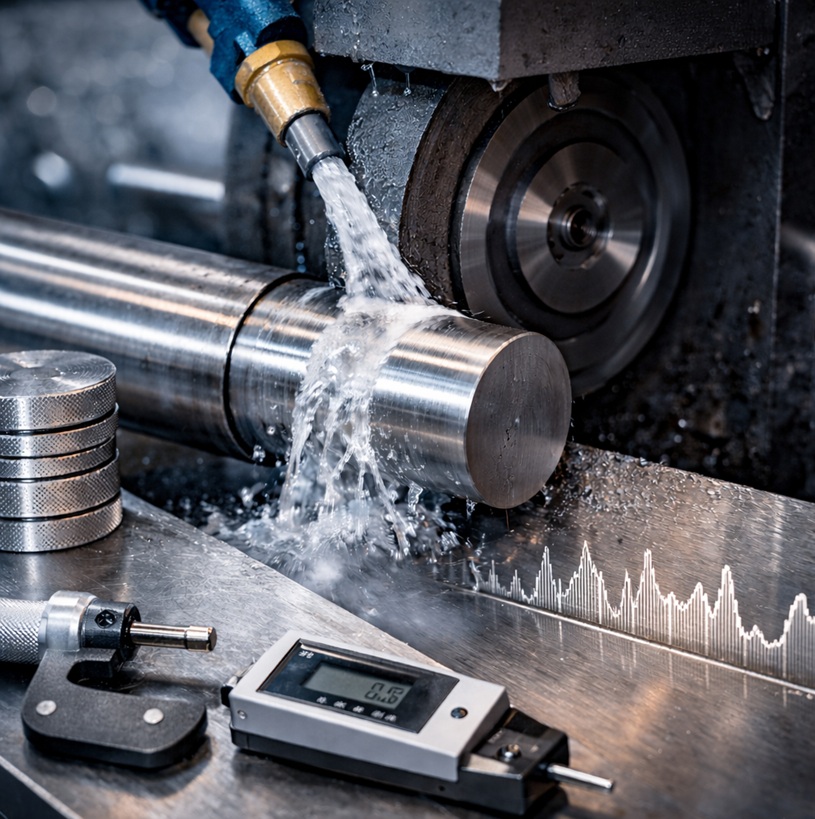
The Invisible Boundary: Burn-Free Removal
Optimizing for productivity requires moving beyond the “safety-first” approach of slow feeds. Engineers must understand the three primary heat-related consequences of aggressive grinding:
- • Visual Burn: Oxidation of the surface, indicating the temperature has exceeded the tempering point.
- • Tensile Residual Stress: Rapid heating and cooling that reduces the fatigue life of the component.
- • Metallurgical Damage: Retempering or “White Layer” formation that renders precision parts non-compliant.
To solve this paradox, we must shift our focus from “safe” parameters to “Deterministic” parameters. This journey begins with the quantization of productivity through the Specific Material Removal Rate (Q’⊂w⊂), the fundamental unit of measure for high-efficiency grinding. By mastering this metric, we can calculate the exact thermal limits of our system and push productivity to its physical edge without crossing into the zone of damage.
On real shop floors, this “productivity paradox” is not theoretical. It often appears as a part that looks perfectly ground at first glance, only to fail inspection later due to hidden thermal damage that no operator intended to create.
2. Theoretical Engine: The Specific Material Removal Rate (Q′w)
To optimize productivity, we must move away from qualitative terms like “fast” or “heavy” and utilize the Specific Material Removal Rate (Q′w). This metric represents the volume of material removed per unit width of the grinding wheel per second (mm²/s). It is the most critical benchmark for comparing process efficiency across different machines and wheel types, as it directly correlates with the thermal energy generated in the contact zone.
Specific Material Removal Rate Formula
Q′w = vw × ae
The Correlation Between Q′w and Temperature
As Q′w increases, the total grinding power (Pc) rises. However, the temperature at the workpiece surface (Tmax) does not follow a simple linear path. It is influenced by the Peclet Number (Pe), a dimensionless value that describes the ratio of heat transported by the motion of the workpiece to the heat conducted into it. By increasing vw while keeping Q′w constant, we can “wash away” the heat more effectively, allowing for higher productivity without reaching the burn threshold.
Benchmarking Productivity Levels
Engineers can use Q′w to categorize the intensity of their grinding operation and determine the required cooling strategy:
The challenge in increasing Q′w lies in the Specific Energy (u). At low removal rates, the “Size Effect” causes u to be extremely high, generating massive heat relative to the material removed. By strategically increasing the Q′w into the high-performance zone, we can actually lower the specific energy, making the process more efficient. This leads us to our first major strategy: utilizing speed to mitigate force.
Note: Practical thresholds vary by material, wheel specification, machine dynamics, and coolant system design; validate any target values through controlled trials and monitored trends.
3. Strategy 1: The “High-Speed, Low-Force” Approach
One of the most effective ways to drive higher productivity while avoiding thermal damage is to leverage high wheel speeds (vs). This strategy focuses on reducing the Maximum Undeformed Chip Thickness (hcu). By spreading the material removal across more cutting edges per unit of time, we can maintain a high Q′w while significantly lowering the mechanical force exerted by each individual abrasive grain.
The Mechanics of Chip Thinning
As the wheel speed increases, the volume of material each grain must remove decreases. This “thinning” of the chip reduces the normal grinding force (Fn), which is the primary driver of frictional heat. When Fn is lowered, the energy partitioning into the workpiece (ε) is reduced, allowing for an increase in the feed rate (vw) to regain productivity without crossing the burn threshold.
Balancing Force and Friction
While increasing vs reduces mechanical force, it simultaneously increases the number of frictional interactions per second. This creates a “thermal crossover point.” If the wheel speed is too high without sufficient lubrication, the cumulative frictional heat can outweigh the benefits of force reduction. Therefore, high-speed grinding must always be paired with aggressive Dressing to ensure grains remain sharp, minimizing the “rubbing” phase of the grit-workpiece interaction.
Dynamic Considerations
High-speed strategies require superior machine dynamics. As wheel speeds exceed 60 m/s (or 120 m/s for CBN), the Centrifugal Force on the wheel and the Spindle Stiffness become limiting factors. Any unbalance at these speeds will induce forced vibrations that can compromise surface integrity. Thus, the “High-Speed, Low-Force” approach is a holistic strategy that integrates abrasive sharpness, machine rigidity, and precise kinematic balancing.
While speed manages the intensity of the cut, the geometry of the interaction area determines how that heat is distributed. In the next section, we examine how the physical contact length between the wheel and the part can be optimized to act as a heat sink.
4. Strategy 2: Optimizing the Grinding Zone Geometry
Productivity is often limited by how the heat is concentrated within the Contact Length (lg). In grinding, the geometry of the interface dictates the “thermal footprint.” A longer contact length allows the grinding energy to be distributed over a larger area, but it also creates a significant barrier for coolant penetration. Managing this geometric trade-off is essential for high-MRR operations like Creep-feed Grinding.
Conformity and Heat Concentration
The Equivalent Diameter (deq) determines the length of the arc of contact. In Internal Grinding, high conformity (where the wheel and hole diameters are close) results in a very large deq and a long contact zone. While this helps in distributing the force, the “closed” geometry traps heat and prevents the Bulk Cooling effect of the metalworking fluid, making internal grinding exceptionally prone to burn at high removal rates.
Deep Cut vs. Shallow Cut Strategies
Two distinct paths exist for increasing productivity:
• The Creep-feed Path: Large depth of cut (ae) at very low work speeds (vw). This maximizes the contact length, which can be beneficial for keeping the maximum surface temperature lower, provided the coolant can reach the interface.
• The Pendulum Path: Small ae at very high vw. This minimizes the time a single point on the workpiece is exposed to the heat, utilizing the Peclet Effect to “outrun” the thermal conduction.
The “Coolant Shield” and Contact Length
As the contact length increases, the “wedge” where coolant enters becomes narrower. This creates a hydrodynamic pressure that can actually lift the wheel slightly or, more dangerously, prevent the fluid from reaching the center of the cut. For high-productivity ae, the wheel must have Induced Porosity to carry the fluid physically into the contact zone, bypassing the geometric bottleneck.
Geometry provides the framework for heat distribution, but the Metalworking Fluid (MWF) is the primary vehicle for heat removal. In the next section, we look at the fluid dynamics required to ensure that the “coolant shield” remains effective even under extreme removal rates.
5. Strategy 3: Fluid Dynamics and Heat Dissipation
As the Specific Material Removal Rate (Q′w) increases, the Metalworking Fluid (MWF) must evolve from a simple lubricant to a high-performance energy barrier. At high productivity levels, the primary challenge is not the choice of fluid, but the Fluid Dynamics—ensuring the coolant actually penetrates the high-pressure air barrier generated by the rotating wheel.
The Velocity Matching Strategy
A common failure in high-speed grinding is “film boiling,” where the coolant turns into steam before it can absorb heat from the contact zone. To prevent this, the Jet Velocity (vj) of the coolant must be matched to the Wheel Speed (vs). If vj is less than 0.8 × vs, the air boundary layer around the wheel will deflect the coolant, leading to an immediate thermal spike and grinding burn.
Nozzle Design and Coherent Jets
To achieve high-efficiency cooling, the nozzle must produce a Coherent Jet—a solid stream of fluid that does not disperse or entrain air before reaching the grinding zone. Aerated coolant has significantly lower thermal conductivity. Utilizing “Laminar Flow” nozzles and maintaining high pump pressure (typically > 20 bar for high-MRR) is essential to overcome the centrifugal forces of the wheel.
The “Scrubbing” Effect
High-pressure nozzles serve a secondary purpose: Wheel Cleaning. By directing a secondary high-pressure jet (cleaning nozzle) at the wheel face, swarf and loaded metal particles are “scrubbed” out of the wheel pores. A clean, open wheel topography allows more coolant to be physically carried through the contact zone, drastically improving the thermal partitioning ratio (ε).
Mastering fluid dynamics provides the physical protection needed for high-speed removal. However, to push productivity to its absolute limit, we must be able to detect the “pre-burn” conditions through real-time monitoring. In the next section, we examine the indicators that signal when a process is reaching its thermal capacity.
6. Monitoring and Prevention: Thermal Damage Indicators
To push the boundaries of productivity without risking scrap, engineers must shift from reactive inspection to proactive monitoring. Thermal damage often manifests as a trend in process data before it becomes visible as “blue burn” on the workpiece. By tracking specific energy consumption and power spikes, we can identify the exact moment the process loses its thermal stability.
Experienced operators often say they can “feel” when a process is drifting thermally, but translating that intuition into measurable signals like power trends and acoustic emissions is what turns experience into repeatable engineering control.
Power Monitoring and Critical Power (Pcrit)
The spindle power signal is the most direct indicator of thermal health. Every material-wheel combination has a Critical Power (Pcrit) threshold beyond which the energy density in the contact zone exceeds the cooling capacity of the fluid. When the spindle power surpasses this limit, the Specific Energy (u) rises sharply, signaling that the wheel has glazed and is now “rubbing” rather than cutting.
Critical Grinding Power Threshold
Pcrit = ucrit × Q′w × b
Acoustic Emission (AE) and Chip Morphology
Beyond electronic power signals, the physical output of the process provides vital clues. Acoustic Emission sensors can detect the high-frequency sounds of grain fracture and bond failure, which often precede a thermal event. Similarly, observing the Chip Color and shape is a reliable “low-tech” diagnostic tool: silver-grey chips indicate healthy cutting, while straw-colored or blue chips indicate that the temperature has reached 400°C to 700°C.
Effective monitoring allows the process to run at the edge of its capability. However, some advanced processes are designed to live far beyond traditional limits. In the next section, we explore High-Efficiency Deep Grinding (HEDG), a method that uses extreme speed to paradoxically reduce thermal damage.
7. Advanced Synthesis: High-Efficiency Deep Grinding (HEDG)
The pinnacle of grinding productivity is reached with High-Efficiency Deep Grinding (HEDG). This process paradoxically combines a very large depth of cut (ae) with extremely high wheel speeds (vs > 150 m/s) and work speeds (vw). While traditional logic suggests this would lead to immediate burn, HEDG utilizes the Size Effect and adiabatic shearing to move material so quickly that the heat has no time to conduct into the workpiece.
The Adiabatic Heat Barrier
In HEDG, the Peclet Number (Pe) is exceptionally high. The workpiece moves so fast relative to the thermal diffusion rate of the metal that most of the grinding energy is carried away by the chips before it can penetrate the surface. This creates a “thermal barrier” effect. As vw increases, the Thermal Partitioning Ratio (ε)—the fraction of total energy entering the part—drops significantly, often to less than 5%.
Workpiece Temperature vs. Speed Relationship
Tmax ∝ u ⋅ (vw ⋅ ae)1/2 / (k ⋅ ρ ⋅ c)1/2
Requirements for HEDG Implementation
Transitioning to HEDG is not possible on standard grinding machines. It requires a specific hardware ecosystem:
- • High-Speed Spindles: Carbon-fiber reinforced wheels or plated CBN wheels capable of exceeding 200 m/s.
- • Extreme Rigidity: Dynamic stiffness (kdyn) must be high enough to resist the massive momentum of the fast-moving workpiece.
- • High-Pressure MWF: Coolant must be delivered at pressures exceeding 50 bar to match the extreme wheel velocities.
HEDG represents the ultimate synergy of speed, geometry, and fluid dynamics. By operating in this regime, manufacturers can achieve removal rates comparable to milling while maintaining the precision and surface integrity of grinding. This brings us to the final summary: the checklist for deterministic productivity.
8. Conclusion: Checklist for Deterministic Productivity
Optimizing grinding productivity without thermal damage is a transition from empirical guesswork to deterministic control. By managing the energy balance through kinematic speed, contact geometry, and fluid dynamics, high material removal rates become a stable production reality. The “Safe Zone” for grinding is not a fixed coordinate but a dynamic window that expands as our engineering precision improves.
The Final Optimization Workflow
Before increasing your feed rates, verify the following pillars of high-productivity grinding:
✅ Strategic Productivity Checklist
- • Kinematic Alignment: Is vs high enough to keep hcu small while vw is increased for productivity?
- • Dressing Condition: Is the wheel being dressed “open” enough to maintain a low specific energy (u)?
- • Coolant Delivery: Does the jet velocity (vj) match the wheel speed to break the air barrier?
- • Power Baseline: Have you established the Pcrit for this specific material-wheel combination?
Looking Forward: Smart Grinding Systems
The future of high-productivity grinding lies in Adaptive Control. Systems that can sense power fluctuations and automatically adjust the work speed (vw) or trigger an emergency dressing cycle will eliminate the fear of “scraping” expensive components. However, even the most advanced AI controller must be grounded in the fundamental physics of Q′w and thermal partitioning discussed in this report.
The Deterministic Rule
“Productivity is limited not by the machine’s motor, but by the ability of the fluid to transport energy away from the surface.”
References & Further Reading
Technical Publications & Industrial Standards
- • Rowe, W. B. (2014). Principles of Modern Grinding Technology. Academic Press. (Focus: Thermal damage prevention and energy partitioning models).
- • Marinescu, I. D., et al. (2007). Handbook of Machining with Grinding Wheels. CRC Press. (Focus: Specific material removal rates and high-efficiency grinding strategies).
- • Malkin, S. (1984). Grinding Mechanisms and Grinding Temperatures. Journal of Applied Metalworking. (Focus: Foundational research on the critical power threshold for grinding burn).
Curated Internal Resources: High-Efficiency Series
To further explore the limits of material removal and thermal process control, we recommend our specialized engineering deep-dives:
Industrial Research Institutions
- CIRP: Research on high-performance abrasive processes and thermal modeling.
- Fraunhofer Institute for Production Technology (IPT): Applied studies on eco-efficient cooling and productivity in heavy-duty grinding.
© 2026 Advanced Machining Intelligence | Strategic Resource for Deterministic Grinding and High-Efficiency Production