1. Introduction: The Velocity Frontier in Modern Machining
In the competitive landscape of precision manufacturing, the transition from Conventional Grinding to High-Speed Grinding (HSG) represents more than a simple increase in spindle RPM; it is a fundamental shift in the physics of material removal. Conventional grinding typically operates at wheel peripheral speeds (vs) between 30 m/s and 45 m/s, utilizing the mechanical strength of vitrified alumina or silicon carbide wheels. In contrast, HSG pushes these boundaries into the frontier of 80 m/s to 200 m/s+, requiring advanced superabrasives and specialized machine architectures. Choosing between these two paths is the most critical Process Selection decision an engineer can make, as it dictates the balance between throughput, thermal risk, and capital intensity.
Defining the Threshold of Speed
The demarcation between conventional and high-speed processes is defined by the Dynamic Behavior of the grinding wheel and the resulting chip formation. In conventional speeds, the process is dominated by high specific forces and significant heat conduction into the workpiece. As vs crosses the 60–80 m/s threshold, the Maximum Undeformed Chip Thickness (hcu) decreases dramatically for a given material removal rate. This “thinning” of the chip allows for a more efficient cutting mechanism, but it introduces a new set of challenges: centrifugal stress on the wheel bond and the requirement for extreme Dynamic Stiffness (Km) in the machine tool.
The Selection Paradox: Productivity vs. Risk
The allure of HSG lies in its ability to condense production lines. A single high-speed grinding cell can often replace three or four conventional machines, significantly reducing Floor Space Costs and Direct Labor Burden. However, this productivity comes with a “Thermal Debt” risk. While high speeds can theoretically carry heat away in the chips, any disruption in coolant delivery or wheel sharpness at 120 m/s results in a near-instantaneous Martensitic Burn.
Therefore, the strategic objective of this analysis is to identify the Economic Tipping Point. We must determine where the Operational Expenditure (OPEX) savings from faster cycle times (tc) outweigh the significantly higher Capital Expenditure (CAPEX) required for high-frequency spindles, reinforced guarding, and premium CBN (Cubic Boron Nitride) tooling.
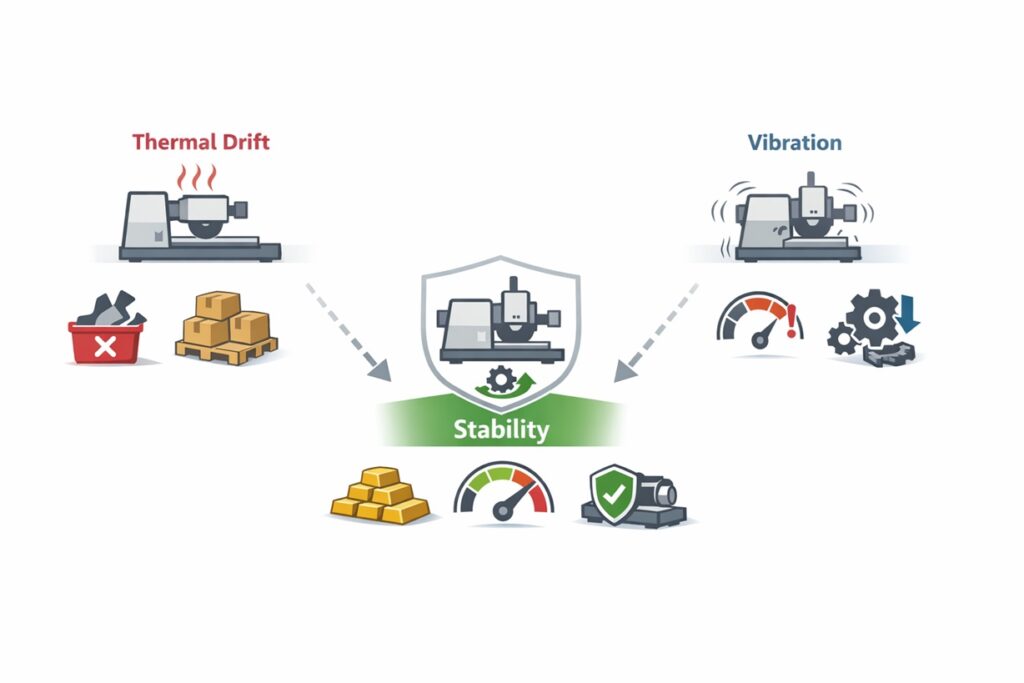
Executive Vision: “Speed is a double-edged sword in precision grinding. While it offers the fastest route to high-volume profitability, it removes the ‘safety net’ of conventional physics. Mastering the trade-offs between cost and risk is the only way to ensure your velocity translates into a sustainable margin.”
2. The Physics of Speed: Chip Formation and Specific Energy
To justify the transition to High-Speed Grinding (HSG), one must look beyond cycle time and examine the fundamental Mechanical Efficiency of the cut. At conventional speeds, a significant portion of the energy is wasted on “plowing” and “rubbing” rather than actual material removal. HSG fundamentally alters this dynamic by manipulating the kinematics of Chip Formation. By increasing the velocity of the abrasive grain, we change the way the workpiece material reacts to stress, shifting the process toward a regime of higher precision and lower specific force.
The “Size Effect” and Maximum Chip Thickness (hcu)
The primary physical advantage of HSG is the dramatic reduction in the Maximum Undeformed Chip Thickness (hcu). As the wheel peripheral speed (vs) increases while keeping the workpiece feed rate (vw) constant, the volume of material removed by each individual abrasive grain decreases. The mathematical relationship is expressed as:
When vs is doubled or tripled, the hcu drops significantly. This leads to the “Size Effect” phenomenon: although smaller chips require more energy *per unit volume* to create due to material strengthening at the micro-scale, the overall mechanical load on each grain is lower. This allows the abrasive to stay sharp longer and reduces the Specific Grinding Force (F’n), which in turn minimizes part deflection and improves dimensional accuracy.
Specific Grinding Energy (us) Reduction
Specific Grinding Energy (us) is the energy required to remove a unit volume of material (J/mm³). In conventional grinding, a large amount of us is consumed by plastic deformation (plowing) without chip separation. As we enter the HSG regime, the high strain rate causes the material to behave more like a brittle solid, facilitating cleaner chip fracture.
This shift leads to a notable reduction in us as speed increases. For hardened steels and superalloys, HSG can reduce the energy partition entering the workpiece because the cutting mechanism is so efficient that the heat has less time to conduct into the bulk material. This is why HSG is often the preferred choice for Difficult-to-Machine (DTM) materials—it leverages velocity to overcome material toughness.
Ductile-to-Brittle Transition in Ceramics
In the processing of advanced ceramics or glass, HSG allows for Ductile Regime Machining. By maintaining an extremely low hcu through high vs, it is possible to remove material through plastic flow rather than brittle fracture. This eliminates subsurface micro-cracks, resulting in a surface finish that is often superior to conventional grinding, even at significantly higher production rates.
The Physics Insight: “Velocity is a substitute for force. By increasing vs, we trade brute force for kinetic efficiency. In HSG, the abrasive grain doesn’t just push the material; it outruns the material’s ability to deform plastically, resulting in a cleaner, faster, and more precise cut.”
3. Thermal Dynamics: The “Flash Heat” Phenomenon
In conventional grinding, heat is the primary enemy of surface integrity, often leading to martensitic burn and tensile residual stress. However, High-Speed Grinding (HSG) introduces a thermal paradox: as the wheel speed (vs) increases, the total energy expended per unit volume of material removed (us) actually decreases. This phenomenon, often referred to as “Flash Heat,” creates a scenario where the grinding zone reaches extreme temperatures for a micro-fraction of a second, yet the bulk workpiece remains significantly cooler than in conventional processes. Understanding this dynamic is essential for managing the risk of thermal damage at high velocities.
Energy Partition (e) and the Chip-Carry Effect
The thermal safety of a grinding process depends on the Energy Partition (e)—the fraction of total grinding energy that enters the workpiece as heat. In conventional grinding, 60% to 80% of the heat is typically conducted into the part. In HSG, the extremely high strain rates and the efficiency of the cutting mechanism shift this balance.
Because the abrasive grains move at such high velocities, the material is sheared and removed as a “chip” before the heat has time to conduct into the bulk of the steel. This results in a higher percentage of energy being carried away by the chips themselves. This “Convective Chip Cooling” is why HSG can achieve material removal rates (MRR’) five to ten times higher than conventional grinding without reaching the burn threshold, provided the process remains stable.
The Peclet Number (Pe) and Thermal Penetration
The relationship between the speed of the heat source and the rate of thermal diffusion is quantified by the Peclet Number (Pe). In the context of HSG, where both wheel speed (vs) and workpiece feed rate (vw) are elevated, the Pe is substantially higher than in conventional setups:
A higher Pe means that the heat source (the grinding zone) moves across the surface faster than the heat can penetrate into the depths of the material. This results in a very thin Thermal Boundary Layer. From a cost-risk perspective, this is a major advantage: while the immediate surface might experience a high “flash” temperature, the underlying metallurgical structure is protected. However, if the process slows down due to spindle drag or excessive force, the Pe drops, and the heat instantly “soaks” into the part, causing a catastrophic scrap event.
The Film Boiling Risk at Extreme Velocity
Despite the efficiency of HSG, it carries a unique risk: Film Boiling. As temperatures in the contact arc spike, the grinding fluid can vaporize, forming a gaseous “blanket” that insulates the part and prevents further cooling. In HSG, this transition happens much faster than in conventional grinding.
To mitigate this risk, HSG requires high-pressure, coherent-jet coolant delivery that can overcome the “air knife” generated by the high-speed wheel. Failing to break this air barrier results in “dry grinding” at 100 m/s, which will destroy a $10,000 CBN wheel and a high-value workpiece in seconds. This highlights the Operational Risk inherent in high-speed processes—there is no margin for error in fluid dynamics.
The Thermodynamic Axiom: “In High-Speed Grinding, speed is your primary coolant. By outrunning the thermal diffusion rate, we protect the metallurgical integrity of the part. But remember: if you lose your velocity or your fluid coherence, the ‘flash heat’ becomes a flash fire.”
4. Hardware Requirements: The CAPEX Barrier
The transition from conventional to High-Speed Grinding (HSG) is not merely a software adjustment or a change in wheel specification; it requires a fundamental upgrade in the machine tool’s physical architecture. The Capital Expenditure (CAPEX) for an HSG-capable machine can be 2 to 3 times higher than a conventional grinder. This “CAPEX Barrier” exists because at peripheral speeds exceeding 80 m/s, the centrifugal forces, vibration frequencies, and kinetic energy reach levels that would cause a standard machine to fail. To justify this investment, a manufacturer must understand the engineering necessity of the high-stiffness components and specialized subsystems required to stabilize a high-velocity process.
Dynamic Stiffness (Km) and Vibration Damping
In HSG, the frequency of grain engagement is significantly higher, which can easily excite the Natural Resonant Frequencies of the machine structure. To prevent regenerative chatter, an HSG machine must possess exceptional Static and Dynamic Stiffness (Km).
While conventional machines often use standard grey cast iron, HSG machines utilize Mineral Casting (Polymer Concrete) or advanced damping materials. Mineral casting offers up to 10 times the vibration damping capacity of traditional iron. This superior damping ensures that the high-frequency harmonics generated by a spindle rotating at 15,000–30,000 RPM do not translate into surface waves on the workpiece. This structural integrity is a primary driver of the high entry cost but is non-negotiable for achieving a stable Cpk.
High-Frequency Spindles and Thermal Management
The heart of the HSG system is the Motorized Spindle. Unlike belt-driven conventional spindles, HSG spindles must be balanced to G0.4 or higher to avoid catastrophic bearing failure at high velocities. These spindles often utilize Hybrid Ceramic Bearings, which offer lower friction and higher thermal stability than steel bearings.
Thermal management of the spindle itself becomes a significant CAPEX item. High-speed rotation generates massive internal heat, which can cause Spindle Growth and positional drift. To mitigate this, HSG machines are equipped with active liquid-cooling jackets and real-time sensor monitoring to maintain thermal equilibrium. This complexity adds tens of thousands of dollars to the machine’s price tag but ensures that the micron-level precision is maintained over a full production shift.
Kinetic Energy and Safety Engineering
Safety is the most overlooked CAPEX driver in HSG. Kinetic energy (Ek) increases with the square of the velocity:
A wheel burst at 120 m/s is equivalent to a high-speed collision; the machine’s guarding must be structurally reinforced with heavy-duty steel and specialized safety glass. Furthermore, automatic Fire Suppression Systems are often mandatory because the mist generated by high-pressure oil coolants at high speeds is highly flammable. These safety protocols represent a “Mandatory CAPEX” that does not directly contribute to MRR’ but is vital for protecting the operator and the facility.
The Hardware Axiom: “You cannot perform High-Speed Grinding on a conventional platform by simply turning up the RPM. HSG requires a fortress of stability. The CAPEX you pay at the start is the premium for the structural integrity required to survive at the edge of physics.”
5. Tooling Economics: CBN vs. Conventional Abrasives
The shift into the High-Speed Grinding (HSG) regime necessitates a fundamental change in abrasive selection. Conventional alumina (Al2O3) wheels, while cost-effective for low-velocity operations, reach their physical and chemical limits beyond 60 m/s. At these speeds, the rate of bond fracture and grain wear escalates exponentially. Consequently, the economic viability of HSG relies on the integration of Superabrasives, specifically Cubic Boron Nitride (CBN). Although the purchase price of a CBN wheel can be 50 to 100 times higher than its conventional counterpart, the optimization of Operational Expenditure (OPEX) through extended tool life and process stability often yields a lower total cost-per-part.
The Failure of Conventional Abrasives at High Speed
Conventional abrasives fail at high velocities due to two primary mechanisms: Chemical Diffusion Wear and Mechanical Bursting Stress. At speeds exceeding 80 m/s, the instantaneous temperatures at the grinding interface surpass the chemical stability threshold of alumina. This causes the abrasive to react with the ferrous workpiece, leading to rapid “attritious wear” and the loss of grain sharpness. Furthermore, standard vitrified bonds lack the tensile strength to withstand the massive centrifugal forces of HSG. In contrast, CBN possesses extreme hardness and superior thermal conductivity, allowing it to maintain sharp cutting edges while efficiently dissipating heat away from the bond, preventing premature wheel failure.
G-Ratio and Long-term OPEX Optimization
The most critical metric for evaluating tooling economics is the G-Ratio—the ratio of the volume of material removed to the volume of wheel wear. While a conventional wheel might yield a G-Ratio between 20 and 80, high-performance CBN wheels can achieve ratios of 2,000 to 10,000 or more.
This massive increase in tool life extends far beyond simple abrasive savings. Reduced wheel wear means that Dressing Frequency is slashed. In a mass production environment, this translates to significantly lower Non-Productive Time and a dramatic stabilization of the process Cpk. By minimizing the drift in wheel diameter (ds), the manufacturer ensures consistent surface integrity and eliminates the labor costs associated with constant offset adjustments.
Strategic Dressing: The Secret to High-Speed Stability
To unlock the full potential of CBN in HSG, advanced Dressing Strategies are required. Precise conditioning of the wheel surface using diamond rotary dressers is mandatory to control the active grain protrusion height. While the CAPEX for these dressing systems is high, they allow for a deterministic control of Surface Roughness (Ra) and grinding forces. This level of control is what makes HSG a “zero-defect” capable process, justifying the high initial investment through the elimination of rework and scrap.
The Tooling Axiom: “Conventional abrasives are often the choice of the purchasing department, but CBN is the choice of the production manager. In High-Speed Grinding, the premium paid for superabrasives is an investment in the elimination of variability and the maximization of spindle utilization.”
6. Risk Assessment: The Failure Modes of High Velocity
High-Speed Grinding (HSG) offers a quantum leap in productivity, but from a mechanical perspective, it pushes the “Safety Margin” of the process to its absolute limit. As peripheral speeds increase, the mechanical and thermal risks escalate exponentially rather than linearly. Because the kinetic energy of the system is proportional to the square of the velocity (vs2), even a minor deviation can lead to catastrophic tool failure or significant equipment damage. Selecting HSG requires a rigorous understanding of these unique Failure Modes and the implementation of advanced technical safeguards.
Centrifugal Stress: The Mechanical Limit of Bond Systems
At the core of HSG risk management is Centrifugal Stress. When a wheel rotates at speeds exceeding 120 m/s, the internal bond system must withstand immense tensile forces to keep the abrasive grains in place. The relationship is defined by:
where σc is the centrifugal stress and ρ is the density of the wheel. Any microscopic defect or non-uniformity in the bond can trigger a “Wheel Burst,” where the tool disintegrates instantaneously. To mitigate this, HSG wheels must undergo stringent Burst Speed Testing (often at 1.5x the operating speed) and typically utilize high-strength hybrid cores made of steel or carbon-fiber-reinforced polymers. This adds a layer of design complexity and cost that is absent in conventional grinding.
The “Air Knife” Barrier and Cooling Failure
From a thermal standpoint, the most dangerous failure mode is Coolant Blockage. A high-speed rotating wheel generates a powerful boundary layer of air that acts as an “Air Knife,” physically repelling the grinding fluid. If the coolant jet pressure is insufficient to break through this barrier, the contact zone experiences “Dry Grinding” conditions.
In an HSG environment, this leads to an immediate thermal spike, destroying the workpiece and potentially melting the CBN grains within milliseconds. Effective risk mitigation requires synchronizing the jet velocity (vj) with the wheel speed (vs) and the use of physical Air Scrapers to disrupt the boundary layer, ensuring the fluid reaches the actual interface.
Micro-instability and High-Frequency Harmonics
At extreme velocities, standard vibration monitoring is often insufficient. High-speed spindles generate High-Frequency Harmonics where even a tiny unbalance manifests as significant vibration energy. These micro-instabilities cause periodic chatter marks on the workpiece and accelerate the non-uniform wear of the expensive superabrasive tool. Managing this risk requires the integration of Acoustic Emission (AE) sensors and active, real-time balancing systems to ensure the process remains within the stable regime.
The Risk Axiom: “In High-Speed Grinding, safety is not an auxiliary feature; it is a structural necessity. If you increase the velocity without a corresponding upgrade in risk mitigation, you are not optimizing production—you are simply accelerating the path to catastrophic failure.”
7. Financial ROI Analysis: A Direct Comparison
The decision to implement High-Speed Grinding (HSG) is ultimately an exercise in Financial Modeling. While the technical advantages of velocity are clear, the economic justification depends on the volume of production and the value density of the parts being manufactured. An HSG system requires a massive upfront Capital Expenditure (CAPEX), but it is designed to drive down the Operational Expenditure (OPEX) per part. To determine the true Return on Investment (ROI), a manufacturer must look beyond the machine price tag and analyze the Total Cost of Ownership (TCO) over a 5-to-10-year horizon.
TCO Structure: CAPEX vs. OPEX
In a conventional grinding setup, the machine cost is relatively low, but the Variable Costs—labor, energy, wheel dressing, and scrap—are high due to longer cycle times and lower process stability. In HSG, the Fixed Costs dominate the early stages of the project, but the extreme Material Removal Rate (MRR’) allows for a dramatic reduction in the labor cost per unit.
Consider a high-volume automotive component production line. If HSG reduces the cycle time from 60 seconds to 20 seconds, one HSG machine effectively does the work of three conventional machines. This consolidation results in:
- Reduced Labor Burden: Fewer operators required per shift for the same output.
- Floor Space Optimization: Lower facility overhead and utility costs due to a smaller footprint.
- Inventory Reduction: Faster throughput reduces the Work-in-Process (WIP) inventory and the associated carrying costs.
The Quality Debt and Scrap Factor
The “Hidden ROI” of HSG lies in the elimination of Quality Debt. Because HSG typically utilizes stable superabrasives like CBN, the process Cpk remains much higher over thousands of parts compared to conventional alumina wheels that drift in diameter rapidly.
If a conventional line has a 2% scrap rate due to thermal damage or dimensional drift, and an HSG line reduces this to 0.2%, the annual savings on a high-value part (e.g., $500 aerospace valve) can exceed $100,000. This Yield Improvement is often the deciding factor that tips the ROI in favor of high-speed technology for high-value components.
The ROI Axiom: “HSG is a volume-driven investment. If your production numbers are low, the CAPEX will crush your margins. But once you cross the break-even volume, the operational efficiency of HSG creates a profit engine that conventional machines can never match.”
8. Conclusion: Strategic Process Selection Matrix
Choosing between High-Speed Grinding (HSG) and Conventional Grinding is not a binary choice of “better” or “worse,” but a strategic alignment of technology with business objectives. As this report has detailed, HSG offers an unparalleled Operational ROI through cycle time reduction and superior material removal efficiency, yet it demands a high-threshold CAPEX and a sophisticated risk-management infrastructure. Conversely, Conventional Grinding remains the bedrock of manufacturing flexibility, offering lower entry costs and a wider safety margin for low-to-medium volume production.
The Decision Framework: Three Pillars of Selection
To navigate this selection, process engineers must evaluate their production requirements against three primary pillars:
- Pillar 1: Production Volume and Lifecycle. HSG is a “Volume Play.” If the component has a long lifecycle and requires millions of units, the Total Cost of Ownership (TCO) advantages of speed and superabrasive longevity are undeniable. For short-run prototypes or highly variable batches, Conventional Grinding’s low setup cost is superior.
- Pillar 2: Material and Surface Integrity. For “Difficult-to-Machine” (DTM) materials like Inconel or technical ceramics, the high-speed regime provides the Ductile-Regime Machining needed for crack-free surfaces. If the material is standard carbon steel with moderate tolerances, the conventional approach is often more than sufficient.
- Pillar 3: Technical Maturity and Infrastructure. HSG is a systemic commitment. It requires high-pressure coolant systems, real-time Acoustic Emission (AE) monitoring, and a workforce trained in precision superabrasive dressing. Without this infrastructure, HSG becomes a liability rather than an asset.
The Future Vision: Intelligent Velocity
As we move toward Industry 4.0, the gap between these two technologies is closing through Digital Twin simulation and adaptive control. Future grinding systems will not be “fixed” in one speed regime; they will utilize Autonomous Optimization to shift velocities based on the real-time state of the wheel and the thermal sensors. This will allow manufacturers to harvest the productivity of HSG while maintaining the robustness of conventional safety margins.
Final Proclamation: “Velocity is the ultimate lever of manufacturing profit, but only when it is supported by a foundation of structural and thermal stability. Conventional grinding offers safety, but High-Speed Grinding offers dominance. Choose the speed that aligns with your financial risk profile and your production volume goals.”
References & Internal Technical Resources
Primary Engineering References
- • Malkin, S., & Guo, C. (2008). Grinding Technology: Theory and Applications of Machining with Abrasives. Industrial Press. (Focus: High-Speed Mechanisms and Energy Partition).
- • Altintas, Y. (2012). Manufacturing Automation: Metal Cutting Mechanics, Machine Tool Vibrations, and CNC Design. Cambridge University Press. (Focus: Spindle Dynamics and Machine Stiffness).
- • Tawakoli, T. (1993). High Efficiency Deep Grinding (HEDG): With Special Reference to the Selection of Wheel and Process Parameters. VDI Verlag.
Internal Deep-Dive Series: High-Velocity Process Implementation
To successfully transition from conventional to high-speed grinding while maintaining Cpk and cost efficiency, please refer to these integrated modules: