1. Introduction: Stability as the Foundation of Cost Leadership
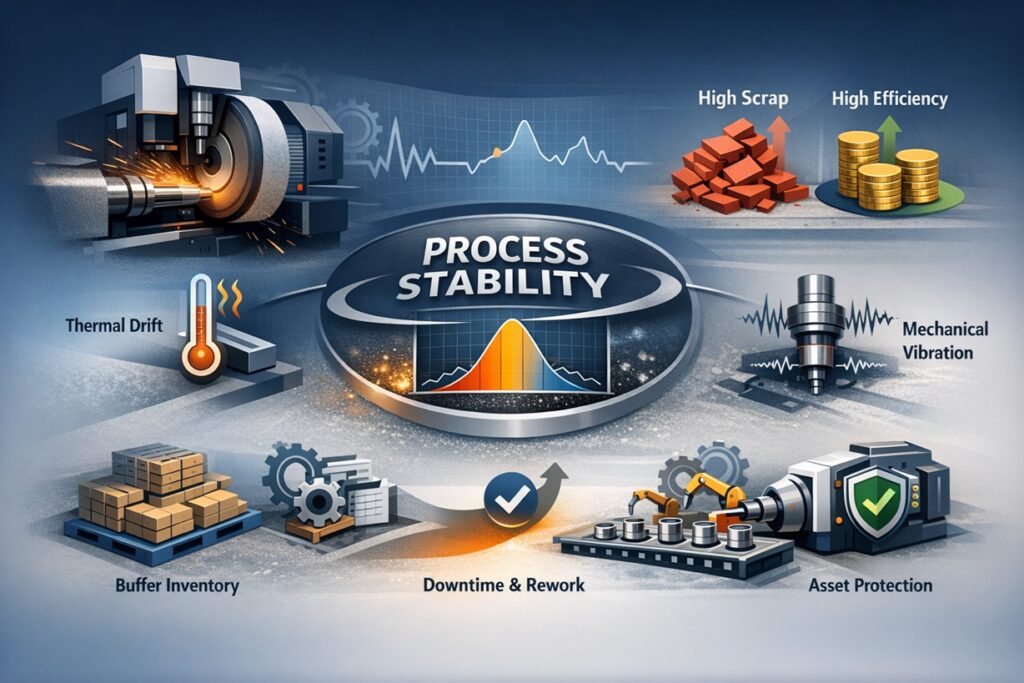
In the high-stakes domain of precision grinding, the term “Stability” is often erroneously restricted to the absence of mechanical chatter or vibration. However, from a Manufacturing Economics perspective, process stability is a much broader and more critical metric: it is the ability of a production system to maintain consistent output quality and cycle times over long durations despite external and internal disturbances. A process that lacks stability is a process that lacks Financial Predictability. While many facilities focus on maximizing the material removal rate to lower unit costs, these gains are frequently erased by the volatility of an unstable process window.
The Statistical vs. Physical Reality of Stability
True grinding stability must be measured through the lens of the Process Capability Index (Cpk). While Ppk measures the performance of a sample, Cpk indicates how well the process can stay within tolerances when faced with the “drifts” of real-world manufacturing—such as wheel wear, coolant temperature fluctuations, and material hardness variances. An unstable process characterized by a low Cpk acts as a hidden tax on the factory floor, requiring constant manual intervention, 100% inspection protocols, and a perpetual cycle of “firefighting” by quality engineers.
The Multiplier Effect of Volatility
The financial impact of instability follows a Multiplier Effect. When a grinding process is unstable, the variance doesn’t just result in occasional scrap; it destabilizes the entire supply chain. Manufacturing leads are forced to implement “Safety Buffers” in the form of excess Work-in-Progress (WIP) inventory and extended lead times to compensate for the unpredictability of the grinding station. These buffers represent Trapped Capital that could otherwise be deployed for innovation or expansion.
To achieve true cost leadership, a facility must move beyond “Average Quality” and focus on Variance Reduction. The costs associated with instability are typically distributed across four submerged categories:
- Regulatory and Compliance Debt: The high cost of 100% Non-Destructive Testing (NDT) to catch thermal damage in unstable batches.
- Energy and Consumable Waste: Wasted energy and abrasive material consumed by non-conforming parts.
- Logistical Friction: Disruption of Lean Manufacturing flows due to unscheduled rework and batch quarantines.
- Asset Depreciation: Accelerated wear on spindles and bearings due to the mechanical shocks of unstable grinding kinematics.
Establishing the “Stable” Process Window
The purpose of this analysis is to demonstrate that Investing in Stability is not a luxury, but a high-ROI financial strategy. By mastering the variables that cause instability—thermal drift, vibration, and dressing inconsistency—a manufacturer can compress the cost of quality and secure a permanent competitive advantage. We will move away from the traditional view of “Quality at any cost” and toward the modern reality of “Profitability through Stability.”
Executive Axiom: “In the precision world, speed is meaningless without stability. A process that produces 1,000 parts per hour but scraps 100 of them is far more expensive than a stable process that produce 800 parts with zero defects.”
2. The Physics of Instability: Thermal and Mechanical Fluctuations
To achieve long-term cost reduction, one must move beyond the symptoms of instability and address its primary physical root causes: Thermal Drift and Mechanical Vibration. In precision grinding, the machine tool is not a rigid, static object, but a dynamic system that reacts to the heat generated during the process and the centrifugal forces of the rotating spindle. When these physical parameters fluctuate, the Process Window shrinks, forcing the facility into a cycle of constant manual compensation and unplanned downtime—the two biggest drivers of Hidden Manufacturing Costs.
Thermal Equilibrium and Positional Drift (Et)
Heat is the greatest enemy of grinding stability. During a production shift, the machine absorbs energy from high-speed spindles, hydraulic systems, and the grinding contact zone itself. This results in Thermal Expansion (Et) of the machine casting and spindle assembly. Without reaching a state of Thermal Equilibrium, the relative position between the wheel and the workpiece will “drift” over time.
Mathematically, the positional error (ΔL) can be represented as:
ΔL = α × L × ΔT
where α is the coefficient of thermal expansion and ΔT is the temperature change. In a facility lacking climate control or spindle cooling, a ΔT of just 5°C can cause a dimensional drift of 15-30 μm. From a cost perspective, this drift forces operators to stop production frequently to perform “offsetting,” leading to a significant loss of Spindle Utilization and increased labor overhead.
Mechanical Stiffness (Km) and the Chatter Threshold
The second pillar of stability is the Static and Dynamic Stiffness (Km) of the machine-tool-workpiece system. Grinding involves high normal forces that act to “push” the wheel away from the part. If the system stiffness is insufficient or inconsistent, it triggers Self-Excited Vibration, known as “Chatter.”
Chatter is the ultimate killer of process stability. It manifests as regenerative waves on the wheel surface and periodic marks on the workpiece. Operating near the Stability Lobe limit is financially risky; a slight increase in material hardness or a minor change in wheel sharpness can instantly push the process into the unstable zone. This results in an immediate 100% scrap rate for the affected parts and necessitates an unscheduled wheel dressing cycle, further eroding the G-Ratio and increasing consumable costs.
The Convergence of Fluctuations
Instability is rarely caused by a single factor; it is the Non-linear Interaction between thermal drift and mechanical compliance. For example, as the spindle heats up, the bearing clearances change, which in turn reduces the dynamic stiffness and makes the process more prone to chatter.
To manage the Total Manufacturing Cost, a facility must invest in “Stability Hardware”—such as mineral-cast beds for better damping, active cooling for spindles, and real-time sensor monitoring. While these represent a higher CAPEX, they effectively “buy” a wider process window, allowing for higher feed rates and significantly lower quality-related OPEX.
The Physicist’s Perspective: “Precision is a state of equilibrium. In grinding, if you cannot control the temperature and the vibration, you are not manufacturing—you are simply hoping for the best. Engineering for stability is the only way to transform hope into profit.”
3. Quantifying the “Real” Scrap and Rework Burden
In an unstable grinding environment, the cost of quality is often calculated using only the most visible metrics: the number of parts thrown into the scrap bin. However, this is a dangerous underestimation of the Real Scrap and Rework Burden. When a process is inherently unstable, the financial damage extends into the “Detection Lag”—the period during which the machine continues to produce non-conforming parts before the instability is identified. This chapter dissects how variance in the grinding process creates a cascade of expenses that erode manufacturing margins far beyond the material value of the workpiece.
The “Detection Lag” and Cumulative Batch Loss
Unlike turning or milling, grinding is often a final-stage finishing process. This means any part entering the grinding cell already carries the cumulative costs of forging, machining, and heat treatment. If the grinding process is unstable due to Thermal Drift (Et), it may produce dozens of parts that are slightly out of tolerance before a standard sampling check catches the error.
This “Batch Loss” is a direct result of process instability. Economically, the cost of scrap in grinding (Cscrap) must be calculated as:
Cscrap = Cmaterial + ∑Cprevious_ops + Cgrinding_overhead
Because grinding is the Value Peak of the production line, the cost of one scrapped part here is often 20x higher than a scrap event in the roughing stage. An unstable process effectively turns the final production step into a financial gamble.
Rework Inefficiency: The Hidden Labor Trap
When stability is low, many parts fall into the “marginal” zone—not quite scrap, but requiring rework. Management often views rework as a way to “save” the part, but the Rework Inefficiency is staggering. Reworking a part requires a secondary setup, which interrupts the Single-Piece Flow of the production line.
Furthermore, reworking a thermally sensitive part is technically difficult. Removing an extra 5-10 μm of material from a part that has already reached its Critical Temperature Threshold during the first pass often leads to secondary “Rework Burn.” The labor time spent attempting to save a $50 part often exceeds $200 in machine burden and technical wages. In a stable process with high Cpk, this rework cycle is eliminated, reclaiming thousands of hours of productive capacity annually.
Micro-Instability: Tensile Residual Stress and Latent Defects
The most insidious cost of instability is the Latent Defect. A process might be dimensionally stable but thermally unstable. Fluctuations in coolant pressure or wheel loading can cause localized spikes in surface temperature (Tmax), inducing Tensile Residual Stress without visible burn.
These parts pass dimensional inspection but are prone to premature fatigue failure in the field. The “Real Burden” here is the potential for Warranty Claims and Recalls. A process with a variance in residual stress is a process carrying a massive, unquantified financial liability. Stability is not just about making parts that fit; it is about making parts that last.
The Cost Accountant’s Axiom: “Scrap is the visible symptom of instability; lost time and field liability are the underlying diseases. In finishing operations, you don’t just scrap a part—you scrap all the hard work your factory did for the last 10 steps.”
4. Impact on Machine and Tooling Utilization
Maximizing the return on investment for high-end grinding machinery requires more than just high-speed operation; it requires Predictable Utilization. In an unstable process, the machine’s primary function—generating profit through material removal—is constantly interrupted by the need for adjustments and “tweak” cycles. These interruptions constitute a form of Micro-Downtime that is rarely captured in standard OEE reports but acts as a massive drain on the Overall Equipment Effectiveness (OEE). When stability is compromised, the efficiency of both the machine and its consumables (tooling) collapses, leading to an exponential increase in the cost per part.
Setup, Calibration, and the “Hidden” Idle Time
An unstable process forces the operator into a reactive mode. If the Positional Drift (Et) is not controlled, every few cycles require a manual measurement and offset entry. This non-productive time is a direct opportunity cost. For a machine with a burden rate of $300/hour, losing just 5 minutes of production every hour to “stability checks” results in a hidden loss of $25,000 per shift annually.
Stability allows for Long-Run Autonomy. In a stable process, the relationship between the dressing cycle and the G-Ratio is deterministic, allowing for automated compensation logic that eliminates the need for human intervention. The transition from reactive tweaking to autonomous stability is the primary differentiator between a high-margin facility and one struggling to break even.
Abrasive Life Consistency: Predictive vs. Random Wear
The economic performance of a grinding wheel is defined by its G-Ratio (volume of metal removed per volume of wheel wear). In a stable process, wheel wear follows a linear, predictable path. However, in an unstable process—characterized by chatter or inconsistent coolant flow—the wheel is subjected to Impulse Loading and Mechanical Shock.
This instability causes “catastrophic grain pull-out” rather than gradual attrition. Instead of utilizing 90% of the abrasive layer, an unstable process may force the early disposal of a wheel because it has become “out-of-round” due to vibration. From a financial standpoint, this transforms a $10,000 vitrified CBN wheel from a long-term asset into a volatile consumable. Stability ensures that you consume only as much abrasive as the physics of the cut requires, rather than losing the tool to the chaos of the process.
Asset Longevity: The Mechanical Cost of Instability
Process instability is not just a quality issue; it is a mechanical health issue for the machine itself. Chatter and high-frequency vibrations induced by instability transmit harmonic shocks directly into the Spindle Bearings and Linear Guideways.
- Bearing Degradation: Continuous vibration leads to “micro-pitting” and brinelling of spindle bearings, shortening their lifecycle from a projected 20,000 hours to less than 8,000 hours.
- Drive System Stress: Rapid, corrective movements of the servo motors to compensate for drift increase the wear on ball screws and encoders.
A major spindle overhaul can cost $20,000 to $40,000, plus the cost of 2 weeks of lost production. By stabilizing the grinding kinematics, a facility is effectively performing Preventive Maintenance at the spindle tip, preserving the capital value of the machine for years beyond its standard depreciation schedule.
The Maintenance Axiom: “You can either spend your money on stability systems today, or you will spend it on spindle rebuilds and wasted wheel abrasive tomorrow. Stability is the cheapest form of insurance for your most expensive factory assets.”
5. The Chain Reaction: Logistics and Supply Chain Costs
The financial impact of grinding instability is rarely contained within the walls of the machining cell. In a modern Just-In-Time (JIT) or Lean manufacturing environment, the grinding station often acts as a critical gateway to assembly and final shipping. When a process is unstable, it creates a “Stutter” in the production heartbeat, triggering a Chain Reaction of logistical inefficiencies. These costs are often categorized as “General Overhead,” but they are directly attributable to the variance at the spindle. Stabilizing the process is therefore a prerequisite for achieving true Supply Chain Agility and minimizing the hidden capital trapped in inefficient logistics.
Buffer Inventory: The Cost of Hiding Instability
The most common response to an unstable grinding process is the creation of Safety Buffers. Because the production manager cannot predict if the grinding cell will produce 100% yield or 70% yield on any given day, they are forced to increase the Work-in-Progress (WIP) inventory at every stage leading up to the grinder.
This excess inventory is “Trapped Capital.” Economically, the cost of carrying this inventory (Cinventory) includes not only the floor space but also the Weighted Average Cost of Capital (WACC). For a facility with $1,000,000 in safety stock due to process volatility, a 10% WACC represents a pure $100,000 annual loss in liquidity. Stability allows a facility to “lower the water level,” revealing and eliminating these hidden piles of waste that unstable processes require for survival.
Delivery Liability and the Premium Freight Trap
In Tier-1 automotive and aerospace supply chains, a “Stock Out” or late delivery can trigger massive financial penalties—often thousands of dollars per minute of assembly line stoppage. When a grinding instability causes a sudden batch rejection, the manufacturer must scramble to catch up.
This lead to the Premium Freight Trap: the use of expedited air shipping to meet original deadlines despite production delays. These emergency logistics costs can instantly wipe out the entire profit margin of a contract. Furthermore, there is the Intangible Asset Degradation: a supplier known for “unstable delivery performance” will be penalized in future contract biddings, a long-term cost that is rarely captured in a standard scrap report but is existential in nature.
The Fallacy of Lean Grinding Without Stability
Many organizations attempt to implement Lean Manufacturing principles (such as Kanban or One-Piece Flow) without first securing Process Stability. This is a strategic error. Lean systems are intentionally “fragile”—they remove the buffers that hide problems.
In an unstable grinding cell, the lack of buffers means that a single chatter event or thermal drift immediately stops the entire downstream assembly line. This creates a state of “Chaos Management” rather than “Flow Management.” To achieve the cost-saving benefits of Lean, a facility must first invest in the Cpk stability of the grinding operation. Only when the process is predictable can the logistical waste truly be stripped away without collapsing the system.
The Supply Chain Insight: “Instability at the grinder is a virus that infects the entire factory. You can optimize your trucks and your warehouses all you want, but if your grinding spindle is unpredictable, your supply chain will always be expensive and fragile.”
6. Monitoring and Sensory Systems for Stability
In the pursuit of Zero-Defect Manufacturing, relying on end-of-line inspection is a fundamentally reactive strategy that accepts instability as a given. To achieve true cost leadership, a facility must transition to an Active Stability Model, where the process is monitored in real-time to detect and mitigate variance before it results in non-conformance. Modern sensory systems, integrated directly into the machine’s CNC architecture, provide the “eyes and ears” necessary to maintain the process within the optimized Stability Window. These technologies represent the bridge between traditional machining and the data-driven efficiency of Industry 4.0.
Acoustic Emission (AE): The Micro-Variance Guardian
Acoustic Emission (AE) sensors detect high-frequency elastic waves generated by the mechanical deformation and fracture of materials at the grinding interface. Unlike traditional vibration sensors, AE can detect events at the micro-millisecond level, such as the initial Wheel-Workpiece Contact (Gap Elimination) or the onset of Martensitic Transformation (Grinding Burn).
From a stability standpoint, AE monitoring allows for Adaptive Dressing. Instead of dressing the wheel based on a fixed, conservative interval, the system monitors the AE signal intensity. If the signal indicates that the wheel has become “glazed” or “loaded,” it triggers an immediate dressing cycle. This ensures that the process always operates at peak sharpness, eliminating the dimensional drift and thermal spikes caused by a dull tool. The ROI is realized by extending the Wheel Life through fewer unnecessary dressing cycles while guaranteeing 100% surface integrity.
Spindle Power Analysis and Closed-loop Control
High-frequency Spindle Power Monitoring is a powerful tool for maintaining mechanical stability. By analyzing the Specific Grinding Energy (us) in real-time, the system can detect fluctuations in material removal rates caused by incoming part hardness variations.
Integrating this data into a Closed-loop Adaptive Control system allows the machine to adjust its feed rate (vf) dynamically. If the power draw exceeds a stability threshold (indicating potential chatter or thermal overload), the controller automatically reduces the feed to stabilize the process. This prevents “Spindle Stall” and catastrophic wheel breakage, preserving the expensive Asset Value of the machine while maintaining the highest possible throughput that the current physical conditions allow.
Digital Twin Integration: The Virtual Stability Map
The most advanced stage of stability management involves the use of Digital Twins—virtual models of the grinding process that run in parallel with the physical machine. These models use historical sensory data and the physics of the Stability Lobe to predict when a process is likely to drift toward instability.
A Digital Twin allows engineers to run “What-if” scenarios: “If we increase the wheel speed (vs) by 10%, will the process remain stable as the wheel diameter decreases?” By identifying the Optimal Process Window in the virtual space, the facility avoids the high cost of trial-and-error on the shop floor. This reduces the Commissioning Time for new parts and ensures that every production run starts in a state of pre-validated stability, effectively eliminating “First-off” scrap and reducing the Total Manufacturing Cost.
The Smart Factory Insight: “In the absence of data, stability is an accident. In the presence of real-time monitoring, stability is a choice. Sensors don’t just find problems; they provide the intelligence needed to maintain the profit-making zone of the machine.”
7. Financial ROI of Stability Investments: CAPEX vs. Long-term OPEX
For many manufacturing executives, the decision to invest in “Stability-Enhancing” technologies—such as mineral-cast machine beds, high-frequency spindle chillers, or advanced AE monitoring suites—is often seen through the lens of a high Capital Expenditure (CAPEX). However, a true Total Cost of Ownership (TCO) analysis reveals that these investments are, in fact, high-yield financial strategies. The initial price premium of a stable machine tool is rapidly offset by the dramatic reduction in Operational Expenditure (OPEX). This chapter quantifies how the improvement of the Process Capability Index (Cpk) directly correlates with the expansion of the bottom-line profit margin.
The Economics of Cpk: Reducing the “Quality Tax”
The direct link between process stability and profitability is most clearly seen in the relationship between Cpk and the cost of quality. A process with a Cpk of 1.0 is statistically “at the limit,” producing roughly 2,700 defects per million opportunities (DPMO). This requires 100% inspection, which acts as a “Quality Tax” on every part produced.
By investing in hardware stability that pushes the Cpk to 1.67 or higher (Six Sigma levels), the defect rate drops to virtually zero. This allows the facility to transition from expensive 100% NDT (Non-Destructive Testing) to Statistical Sampling. In a high-volume automotive line, eliminating the labor and equipment costs of manual inspection can save $100,000 to $250,000 per year per line. The ROI of Stability is not just in the parts you save, but in the inspectors and testing machines you no longer need.
Asset Lifespan and Depreciation Shield
A stable process acts as a Depreciation Shield for the machine tool. When a machine operates in a state of chronic instability (chatter, thermal drift, over-loading), it undergoes accelerated mechanical aging. A “cheap” machine tool with poor damping might have a useful life of only 7 years before its spindle and guideways require a major rebuild.
Conversely, a high-stability machine utilizing mineral casting (which has 10x better damping than cast iron) can maintain its Geometric Accuracy for 15 years or more. From a balance sheet perspective, the ability to amortize the machine cost over a longer period while maintaining high resale value significantly lowers the Capital Intensity per part. Stability is not just an operational goal; it is a capital preservation strategy.
Case Study: Stabilizing the “Process Window”
Consider a Tier-1 supplier of transmission shafts. By investing in an Adaptive Control system to stabilize their rough-grinding operation, they were able to increase their Material Removal Rate (MRR’) by 20% without increasing the risk of thermal damage. This was possible because the stability system automatically reduced the feed rate during transient hardness spikes, allowing the machine to safely operate closer to the “Burn Threshold” during normal conditions. This 20% increase in throughput effectively created the capacity of “one extra machine” for every five machines on the floor—a pure CAPEX Avoidance strategy.
The Financial Axiom: “Stability is the multiplier of manufacturing performance. You don’t pay for stability; it pays you. Every dollar spent on hardening your process against variance returns five dollars in reclaimed scrap, inspection labor, and asset life.”
8. Conclusion: Building a Fortress of Predictable Profit
As demonstrated throughout this technical analysis, Grinding Process Stability is far more than a specialized quality metric; it is the fundamental engine that drives Manufacturing Cost Leadership. In an industrial era characterized by hyper-compressed margins and increasingly stringent tolerance requirements, the ability to maintain a predictable process window is the ultimate competitive advantage. By shifting the focus from “Speed at any cost” to “Profitability through Stability,” organizations can dismantle the “Hidden Tax” of variance and build a manufacturing foundation that is resilient against the fluctuations of material, environment, and human error.
Strategic Shift: From Detection to Prevention
The traditional manufacturing model relies on detecting failures after they occur—a strategy that inherently accepts the cost of scrap, rework, and 100% inspection. The Stable Manufacturing Model reverses this logic. By investing in high-stiffness hardware (Km) and real-time sensory feedback (AE/Power), a facility prevents the deviation from happening in the first place. This transition allows for the elimination of non-value-added steps, such as secondary Nital Etching or manual dimensional verification, effectively streamlining the Total Cost of Ownership (TCO).
The Zero-Defect Vision in Smart Manufacturing
In the context of Industry 4.0, stability is the prerequisite for Autonomous Manufacturing. A Digital Twin or an AI-driven controller cannot effectively manage a process that is physically chaotic or thermally unstable. Achieving a high Cpk is the first step toward the “Dark Factory” vision, where the grinding process remains within its thermal and mechanical limits without constant human oversight. The stability we build today is the infrastructure for the automated profitability of tomorrow.
Final Proclamation: Stability as a Moral and Economic Imperative
Ultimately, mastering the physics of stability is the final frontier in the quest for operational excellence. A factory that understands the causes of variance understands the mechanics of profit. By building a “Fortress of Predictable Profit,” manufacturers don’t just survive in a volatile market—they lead it. In the precision world, Stability is Profitability. This realization must drive every capital investment, every engineering protocol, and every operational decision on the shop floor.
The Closing Vision: “A stable grinding process is like a quiet, well-oiled machine: you don’t hear the chaos of rework, you don’t smell the smoke of grinding burn, and you don’t see the red ink of scrap. You only see the steady, predictable flow of high-margin parts leaving the shipping dock. Precision is silence; stability is profit.”
References & Internal Technical Resources
Primary Engineering References
- • Malkin, S., & Guo, C. (2008). Grinding Technology: Theory and Applications of Machining with Abrasives. Industrial Press.
- • Altintas, Y. (2012). Manufacturing Automation: Metal Cutting Mechanics, Machine Tool Vibrations, and CNC Design. Cambridge University Press.
- • Montgomery, D. C. (2019). Introduction to Statistical Quality Control. Wiley.
Internal Deep-Dive Series: Integrated Process Optimization
To technically implement the stability and Cpk optimization strategies detailed in this report, please refer to the following core modules: