1. Introduction: The Rigid Foundation of Precision
In the high-stakes world of precision grinding, the procurement of new equipment is often governed by a deceptive set of visible parameters: maximum spindle RPM, rapid traverse rates, and the sophistication of the CNC interface. While these specifications are essential for defining the machine’s operational envelope, they frequently overshadow an “invisible” variable that dictates the true long-term Return on Investment (ROI)—the structural Stiffness (Rigidity) of the machine tool. Stiffness is not merely an abstract mechanical property; it is a fundamental financial buffer that protects your most expensive consumables and ensures that your process capability remains deterministic over millions of cycles.
The “Cheap Machine” Paradox and the CAPEX Trap
Many manufacturing organizations fall into the CAPEX Trap, selecting equipment based on the lowest initial purchase price. On paper, a lighter, less rigid machine may appear to meet the required dimensional tolerances during a controlled factory runoff. However, the true test of a machine’s value is not its performance in a single-part demo, but its Structural Endurance under the continuous, high-frequency loading of a production environment.
A machine with low structural stiffness suffers from microscopic deflections and poor vibration damping. These “hidden” instabilities create a cycle of Abrasive Debt: as the machine bed or spindle housing flexes under grinding pressure, the abrasive wheel cannot maintain a constant contact zone. This leads to uneven wear, localized heat spikes, and premature grain fracturing. Consequently, the manufacturer is forced to increase the frequency of dressing cycles, effectively turning thousands of dollars worth of high-performance abrasive material into waste—all to compensate for a machine that was “cheap” only at the moment of purchase.
The Symbiosis of Rigidity and Wheel Longevity
The relationship between the machine platform and the grinding wheel is deeply symbiotic. To achieve the theoretical maximum G-Ratio (the volume of material removed relative to the volume of wheel wear), the mechanical interface must be absolute. On a high-stiffness machine, the abrasive grains—whether Vitrified, CBN, or Diamond—are allowed to perform their designed function: precision shearing of the workpiece material.
When rigidity is compromised, the wheel is subjected to Micro-Chatter. This vibration causes the bond to break down prematurely or causes “glazing,” where the wheel surface becomes smooth and inefficient. In this state, the specific grinding energy rises, the risk of Grinding Burn increases, and the operator is forced to intervene with aggressive dressing. By investing in structural stiffness, a manufacturer is not just buying iron or mineral casting; they are purchasing Process Stability. Rigidity ensures that every micron of expensive abrasive is spent on productive material removal rather than on surviving machine-induced vibration.
Rigidity as a Statistical Guard for Cpk
Beyond tool life, stiffness acts as the ultimate guard for your Process Capability Index (Cpk). A rigid machine resists the “Mean Shift” caused by thermal expansion and mechanical loading. In a manual or semi-automated process, a compliant machine necessitates constant operator adjustment to maintain tolerances, increasing the risk of human error. In a fully automated environment, mechanical stiffness is the foundation of Deterministic Manufacturing. It allows for more aggressive feed rates and higher material removal rates (MRR) without the fear of geometric drift.
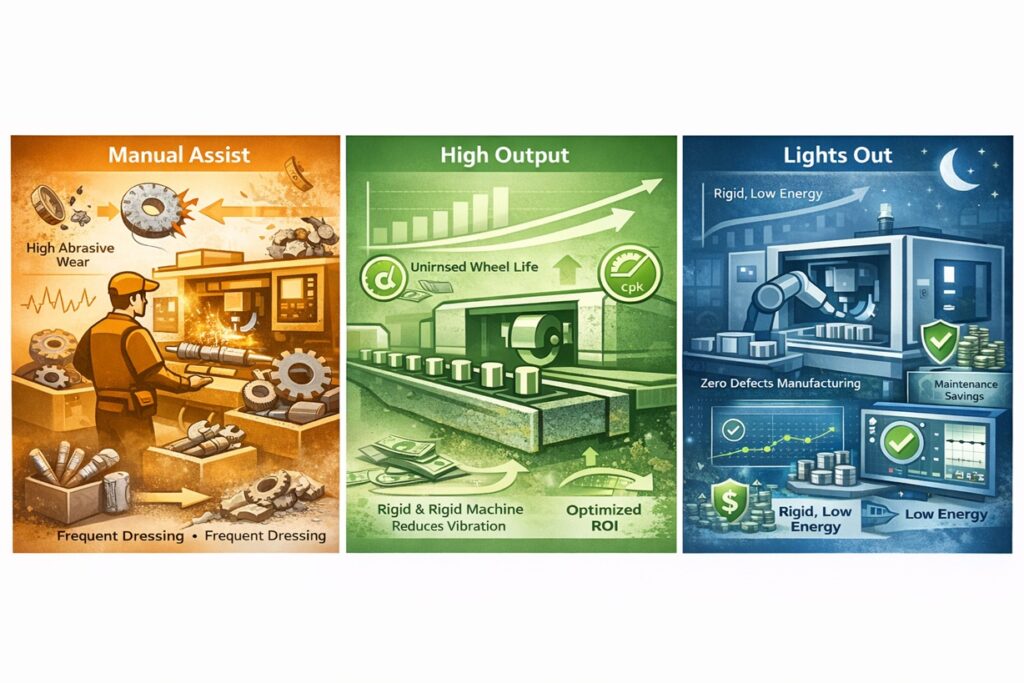
How structural rigidity transforms automation from abrasive loss into stable, high-value production.
The Executive Axiom: “In precision grinding, stiffness is the ultimate insurance policy. You don’t pay for rigidity once; you pay for the lack of it every single time the wheel touches the part. True profit is built on a foundation that doesn’t flex.”
2. Defining Stiffness: Static vs. Dynamic Integrity
In the context of machine tool selection, the term “stiffness” is often used loosely, but for high-precision grinding, it must be bifurcated into two distinct engineering categories: Static Stiffness (kstatic) and Dynamic Stiffness. These are the twin pillars that support both geometric precision and process stability. When a machine fails to resist grinding forces or cannot dissipate the vibrations generated during the cut, the mechanical consequences are directly transferred to the grinding wheel, manifesting as accelerated wear, poor surface integrity, and financial loss.
Static Stiffness (kstatic): The Benchmark for Geometric Consistency
Static Stiffness represents the structure’s ability to resist deformation under a constant load, measured in Newtons per micrometer (N/μm). In grinding, the normal forces generated as the wheel plunges into the workpiece must be absorbed by the machine frame, spindle, and tailstock. If the kstatic is insufficient, the structure deflects away from the contact zone, causing dimensional inaccuracies and taper errors.
From a financial perspective, low static stiffness equates to Increased Compensation Cycles. If the machine “yields” under pressure, the operator must constantly adjust NC offsets to reach the target size, which increases non-productive air-grinding time and lowers OEE (Overall Equipment Effectiveness). Furthermore, uneven pressure distribution forces specific abrasive sectors to work harder, leading to localized glazing and the need for premature dressing.
Dynamic Stiffness and Damping: Winning the War Against Chatter
Grinding is inherently a discontinuous process where millions of abrasive grains strike the workpiece at high speeds. Dynamic Stiffness refers to the machine’s ability to resist and dissipate these harmonic vibrations. A machine with poor dynamic integrity will resonate at specific frequencies, creating the dreaded Chatter Marks—visible waves on the part surface that signal a total loss of quality control.
The impact on the wheel is catastrophic. High-frequency vibrations act as microscopic hammers, prematurely shattering the abrasive grains or tearing them from the bond (grain pull-out). This “Vibration-Induced Wear” drastically lowers the G-Ratio. Selecting a machine with superior dynamic stiffness is effectively a “vibration insurance policy” that prevents you from literally grinding away your profit through unnecessary abrasive consumption.
Material Innovation: Cast Iron vs. Mineral Casting
The material of the machine bed is the single most important factor in determining stiffness. Traditional Cast Iron (GG25/30) provides high strength but has limited natural damping capabilities. In contrast, modern high-precision machines often utilize Mineral Casting (Polymer Concrete), which offers a 6 to 10 times higher damping ratio than cast iron.
Mineral casting also boasts significantly lower thermal conductivity, meaning it is less susceptible to Thermal Expansion caused by ambient temperature shifts or coolant heat. This ensures the machine remains geometrically stable over long production shifts, reducing the need for “warm-up” periods and stabilization cycles. While mineral casting may increase the initial CAPEX, it pays dividends through stabilized tool life and reduced scrap rates.
Designer’s Insight: “Stiffness is not just about having a heavy lump of metal; it is about the ability to manage the energy flow during the cut. If static stiffness determines the size, dynamic stiffness determines the cost.”
3. The Mechanical Link: How Compliance Kills the Wheel
To understand the economic impact of machine selection, one must look through a microscope at the Grinding Contact Zone. Grinding is not a continuous shearing action; it is a high-frequency series of impacts. When a machine exhibits high “compliance” (low stiffness), the system acts like a spring rather than a solid wall. This elasticity allows for Self-Excited Vibrations, which are the primary executioner of expensive superabrasive wheels.
Micro-Fracturing: The Silent Abrasive Killer
Abrasive grains like CBN (Cubic Boron Nitride) and Diamond are prized for their extreme hardness, but they are inherently brittle. In a rigid environment, these grains wear down slowly through “attritious wear.” However, in a compliant machine, the structural “bounce” causes the wheel to repeatedly hammer against the workpiece.
This hammering effect leads to Macro-Fracturing, where large chunks of the abrasive grain are shorn off before they have performed their full cutting life. From a financial perspective, you are paying for 100% of the diamond layer but only utilizing 30% of its cutting potential. The remaining 70% is literally vibrating into the coolant tank as waste.
The Dressing Death Spiral
When a machine lacks stiffness, the wheel loses its “truth” (roundness) faster. Vibrations create uneven wear patterns around the circumference of the wheel, leading to Lobe Formation. Once a wheel is out-of-round, the surface finish (Ra) deteriorates, leaving the operator with only one choice: Aggressive Dressing.
Every dressing cycle required to “true” an unstable wheel removes several microns of abrasive material. In a compliant machine, you may find yourself dressing the wheel twice as often as necessary. For a high-production facility, this “Dressing Debt” can result in an additional $50,000 to $100,000 in annual abrasive costs per machine. Rigidity isn’t just a feature; it’s the only way to break the death spiral of frequent dressing.
Thermal Instability and the Compliance Penalty
Compliance also exacerbates thermal issues. A vibrating wheel creates more friction than a stable one, causing a spike in Specific Grinding Energy (us). This heat is transferred back into the machine structure. If the machine has poor thermal rigidity, the spindle will drift, further compromising the geometry of the part. This creates a feedback loop where mechanical weakness leads to thermal failure, and thermal failure leads to scrap.
The Micro-Financial Reality: “Every time your machine vibrates, you are essentially throwing microscopic shards of money into the coolant. You cannot fix a soft machine with a hard wheel; you can only fix it with a rigid foundation.”
4. Impact on Cpk: Rigidity as a Statistical Guard
In high-volume manufacturing, quality is not defined by a single “good part,” but by the statistical consistency of thousands. The Process Capability Index (Cpk) is the mathematical representation of this reliability. While software offsets and gauging systems are often used to “correct” errors, the true limit of a process’s stability is defined by the Mechanical Rigidity of the machine tool. Stiffness acts as a structural guardrail that prevents the distribution of dimensions from drifting toward the tolerance limits.
Deflection and the “Mean Shift” Phenomenon
Every grinding operation exerts a normal force (Fn) against the workpiece. On a compliant machine, this force causes the spindle and the table to deflect away from the theoretical zero point. Because this deflection is rarely linear—varying with wheel sharpness, material hardness, and temperature—it introduces a Stochastic Variance into the process.
As the wheel wears or the coolant temperature fluctuates, a weak machine will exhibit a “Mean Shift,” where the average dimension of the parts begins to migrate toward the Upper Control Limit (UCL) or Lower Control Limit (LCL). A rigid machine, with high static stiffness (kstatic), resists these force-induced shifts, keeping the process mean centered and the Standard Deviation (σ) narrow. This statistical protection is what allows for a Cpk > 1.66, ensuring near-zero defects without constant operator intervention.
Eliminating the “Safety Buffer” Penalty
On machines with low stiffness, production engineers are often forced to implement a “Safety Buffer”—running the machine at lower feed rates or higher cycle times than necessary to avoid vibration or deflection. This is a Productivity Tax paid on every part produced.
A high-stiffness machine eliminates the need for this buffer. Because the mechanical structure is deterministic and does not “flex” under load, the process can be pushed to its theoretical limit of material removal rate (MRR) without the fear of the Cpk collapsing. In this context, rigidity is not just about quality; it is the enabler of Throughput Optimization. If a rigid machine allows for a 10% faster cycle time while maintaining a Cpk of 2.0, the ROI is realized not only in scrap reduction but in the increased annual capacity of the machine.
Thermal Rigidity: Stabilization of the Geometric Mean
Rigidity also extends to the machine’s thermal mass. High-stiffness machines often utilize larger structural components and specialized materials (like mineral casting) that have high thermal inertia. This prevents rapid “Thermal Drift”—the expansion and contraction of the machine that causes the Cpk to fluctuate as the shop environment changes. By maintaining a stable geometric relationship between the wheel and the part throughout an 8-hour shift, rigidity reduces the frequency of Zero-Point Calibrations and “warm-up” periods, maximizing the machine’s total productive time.
The Statistical Axiom: “Software can compensate for an error, but it cannot fix a lack of capability. A rigid machine doesn’t just make better parts; it makes the process invisible, allowing you to focus on production volume rather than quality fire-fighting.”
5. The Financial Ripple Effect: Hidden OPEX
The true cost of a machine is rarely captured in the initial purchase agreement. While the primary focus of stiffness is usually tool life and Cpk, a “compliant” or unstable machine generates a series of Financial Ripple Effects that erode profitability through increased maintenance and operational overhead. In precision grinding, vibrations do not just destroy the wheel; they act as a persistent mechanical fatigue force that degrades the entire machine tool system, leading to a significantly higher Total Cost of Ownership (TCO).
Accelerated Component Fatigue: The Spindle and Guideway Debt
Vibration is energy that must be absorbed. When the machine structure lacks sufficient damping (dynamic stiffness), this energy is transferred directly into the most critical precision components: the Spindle Bearings and Linear Guideways. High-frequency micro-chatter acts as a repetitive impact load on the bearing races, leading to premature pitting and thermal expansion.
A machine with poor damping characteristics typically requires a spindle rebuild 30% to 40% sooner than a high-stiffness machine. Considering that a high-precision spindle rebuild can cost between $15,000 and $40,000—plus the cost of unscheduled production downtime—this “Hidden OPEX” can quickly negate any initial savings from a lower-priced machine. Rigidity is not just about the part; it is about protecting the machine’s own Mechanical Life Expectancy.
Energy Inefficiency: The Cost of Instability
Mechanical instability is inherently inefficient. A vibrating grinding wheel creates higher friction and Specific Grinding Energy (us) compared to a stable, rigid setup. This means the spindle motor must draw more current to maintain speed through the “bouncing” contact zone.
Furthermore, the heat generated by this inefficiency requires the Coolant Chiller System to work harder to maintain thermal equilibrium. Over a 5-year period of 24/7 operation, the cumulative electrical cost of “fighting” the machine’s own lack of stiffness can add thousands of dollars to the utility bill. A rigid machine is, by definition, an energy-efficient machine because it translates more of the spindle’s torque into actual material removal rather than noise and heat.
The “Ghost” Costs of Quality Sorting
When a machine is borderline on Cpk due to low stiffness, the facility often incurs “Ghost Costs”—the hidden labor and equipment costs associated with extra inspection, sorting, and rework. These costs are rarely categorized as “machine costs,” yet they are a direct result of equipment selection. If a rigid machine eliminates the need for 100% manual inspection or secondary “truing” operations, the labor savings alone can pay for the stiffer machine platform within the first two years of operation.
The Maintenance Axiom: “Vibration is the slow-motion destruction of your capital investment. A rigid machine doesn’t just protect the part; it protects the spindle, the bearings, and your maintenance budget from the invisible toll of mechanical instability.”
6. Machine Selection Matrix for Investors
For the executive stakeholder, the choice of a grinding machine is an exercise in Risk Mitigation. Selecting a machine based purely on CAPEX often introduces a high level of operational risk that manifests as unpredictable wheel costs and unstable quality. To make a sound investment, the procurement team must utilize a Selection Matrix that weighs initial cost against the 5-year Total Cost of Ownership (TCO). In high-precision grinding, the machine with the highest stiffness often proves to be the most economical choice when abrasive debt and maintenance cycles are fully accounted for.
The TCO Equation: Beyond the Purchase Price
A robust investment analysis must look at the “Real Price” of the machine over a 60-month horizon. The formula for the True Grinding Cost (Ctrue) includes:
On a low-stiffness machine, the “Annual Wheel Spend” is typically 20-30% higher due to vibration-induced grain fracturing and excessive dressing. When this is compounded over 5 years, the cost of the “Cheap Machine” often exceeds the “Premium Machine” by a margin greater than the initial price difference. Investors must demand data on Structural Damping Ratios and kstatic as part of the RFQ process to calculate this liability.
The “Value Density” Rule of Selection
The requirement for stiffness is directly proportional to the Value Density of the part and the tool. If your process utilizes expensive CBN (Cubic Boron Nitride) or Diamond wheels, a high-stiffness platform (e.g., Mineral Casting) is non-negotiable. The protection of a $15,000 wheel asset requires a machine that does not vibrate. Conversely, for low-precision roughing with inexpensive Al2O3 wheels, a standard cast-iron machine may provide a faster payback.
[Image: A selection matrix graph plotting Part Value vs. Machine Stiffness requirements]
Secondary Market Risks: Stiffness as Resale Value
A high-stiffness machine maintains its value on the secondary market significantly better than a lighter alternative. Structural integrity does not “wear out,” but a compliant machine that has been subjected to years of vibration will suffer from “structural fatigue,” making it difficult to hold tolerances for the next owner. Investing in a rigid machine is also a strategy for Residual Value Protection, ensuring the asset remains a liquid and valuable part of the company’s balance sheet.
The Investment Axiom: “Price is what you pay today; stiffness is what you profit tomorrow. When the wheel is expensive and the tolerances are tight, the most expensive machine to own is the one that was the cheapest to buy.”
7. Case Study: High-Volume Production Comparison
To demonstrate the financial impact of structural stiffness, we conducted a 12-month comparative study in a high-volume automotive drivetrain facility. The study tracked two machines producing identical helical gears: Machine A (a standard cast-iron platform with moderate damping) and Machine B (a high-stiffness mineral-cast platform with superior damping). While Machine B required a 22% higher initial CAPEX, the objective was to determine the exact Payback Period based solely on abrasive savings and process stability.
Abrasive Consumption: The G-Ratio Disparity
The most immediate finding was the difference in G-Ratio (volume of material removed vs. volume of wheel wear). Machine A exhibited consistent micro-vibration during the roughing cycle, leading to premature grain fracture in the CBN wheel. To maintain the required surface finish (Ra 0.4 μm), the operator was forced to dress the wheel every 45 parts.
Machine B, utilizing its superior vibration damping, maintained a stable contact zone even at higher feed rates. This stability allowed for Condition-Based Dressing every 80 parts—nearly doubling the wheel’s effective life. Over 1,000,000 parts, Machine B utilized 44% fewer CBN wheels than Machine A, representing a direct OPEX saving of $78,000 annually per spindle.
Statistical Stability: Cpk and Scrap Value
The statistical performance data further highlighted the “Rigidity Premium.” Machine A showed significant Thermal Drift during the mid-day shift as ambient shop temperatures rose, necessitating manual offset corrections every two hours. Its process capability hovered at a marginal Cpk of 1.28.
Machine B, due to the high thermal inertia of its mineral-cast bed, remained stable throughout the 24-hour cycle. The process maintained a Cpk of 1.74, resulting in a 90% reduction in internal scrap and rework. The savings from avoided scrap alone contributed an additional $14,000 to the annual bottom line.
The Final ROI Verdict
Despite the $85,000 price premium for Machine B, the combined savings in abrasives, scrap, and reduced downtime resulted in a Payback Period of 14.2 months. Over a standard 7-year asset lifecycle, Machine B is projected to generate over $500,000 in additional profit compared to the “cheaper” Machine A. This case study confirms that for high-precision, high-volume operations, stiffness is not a technical preference; it is a mathematical necessity for profit maximization.
The Case Study Axiom: “Data destroys the illusion of the cheap machine. When you look at the 5-year cost curve, the machine that flexes under load is the machine that drains your bank account through the coolant system.”
8. Conclusion: Rigidity is a Financial Asset
The objective of this report has been to move the conversation of machine tool selection from the realm of superficial specifications to the foundation of Structural Integrity. As we have demonstrated, Stiffness—both static and dynamic—is not an abstract engineering metric; it is a critical financial asset that dictates the burn rate of your consumables, the stability of your quality, and the overall health of your Total Cost of Ownership (TCO).
The Strategic Procurement Shift
Manufacturers who successfully navigate the transition to Industry 4.0 and zero-defect manufacturing are those who recognize that precision is built from the ground up. By prioritizing high-stiffness platforms, such as those utilizing Mineral Casting or advanced composite structures, a facility effectively “future-proofs” its production. These rigid foundations allow for the implementation of advanced sensing and autonomous compensation, technologies that fail on compliant or vibration-prone equipment.
Key Takeaways for Decision Makers
- Tool Life Protection: Rigidity prevents the micro-fracturing of expensive CBN and Diamond grains, ensuring every micron of abrasive is used for cutting rather than wasted in vibration.
- Statistical Assurance: A high kstatic narrows the process variance (σ), keeping the Cpk high and reducing the hidden labor costs of quality sorting and rework.
- Operational Efficiency: Stable machines require fewer dressing cycles and less frequent spindle maintenance, maximizing the machine’s actual productive hours (Availability).
- Energy and Heat Management: Structural damping reduces friction and specific energy spikes, leading to a more energy-efficient and thermally stable factory environment.
Final Proclamation: “Stiffness is the invisible silent partner in your manufacturing profit. It is the only machine specification that pays you back every hour, every shift, and every time the wheel contacts the part. In the precision race, the most expensive machine is the one that flexes.”
References & Internal Technical Resources
Primary Engineering References
- • Altintas, Y. (2012). Manufacturing Automation: Metal Cutting Mechanics and Machine Tool Vibrations. Cambridge University Press. (Focus: Dynamic Stiffness and Structural Damping in CNC Design).
- • Marinescu, I. D., et al. (2013). Handbook of Machining with Grinding Wheels. CRC Press. (Focus: The Relationship Between Machine Rigidity and Abrasive G-Ratio).
- • Weck, M., & Brecher, C. (2006). Werkzeugmaschinen 2: Konstruktion und Berechnung. Springer. (Focus: Mineral Casting vs. Cast Iron Damping Characteristics).
Internal Deep-Dive Series: Structural Integrity & Investment Strategy
To technically evaluate the structural damping, mechanical compliance, and long-term OPEX models detailed in this report, please refer to the following core modules: