1. Introduction: The Hidden Costs of Abrasive Depletion
In the hierarchy of grinding process variables, Wheel Wear is often relegated to the status of an inevitable consumable cost. However, in high-precision manufacturing, excessive or unpredictable abrasive depletion is a primary driver of process instability. When a grinding wheel loses its profile or diameter prematurely, it does not just consume hardware; it degrades dimensional tolerance, necessitates frequent dressing compensation, and increases the Total Machining Cost (TMC) through lost spindle time.
On the shop floor, it usually starts with a simple comment: “The wheel’s wearing faster today.”
But what’s really being spent isn’t just the wheel—it’s spindle time, rework loops, and the quiet uncertainty that creeps into every offset adjustment.
This guide is about turning that gut feeling into something you can explain, measure, and control.
Defining the G-Ratio and Process Efficiency
The fundamental metric for evaluating wheel longevity is the Grinding Ratio, commonly denoted as the G-ratio. It represents the ratio of the volume of material removed (Vw) to the volume of wheel wear (Vs). A declining G-ratio is a leading indicator that the mechanical or thermal loads at the interface are exceeding the structural capacity of the abrasive bond.
The Grinding Ratio Formula
G = Vw / Vs
The Paradox of Aggressive Grinding
There is a delicate thermodynamic balance between preventing Grinding Burn and managing Wheel Wear. To avoid thermal damage, engineers often select “softer” wheels that self-sharpen more readily. However, if the bond strength is too low for the specific removal rate (Q′w), the wheel enters a state of Macro-Wear, where grains are shed before their useful life is exhausted. This transition from stable cutting to rapid depletion represents a loss of deterministic control over the process.
To mitigate these costs, the manufacturing engineer must diagnose whether the wear is Attritious (chemical/thermal dulling), Micro-fracture (grain breakdown), or Bond Failure (macro-depletion). Transitioning to a high-G-ratio process requires an analytical understanding of the abrasive-workpiece interaction, beginning with the fundamental mechanics of how individual grains fail under load.
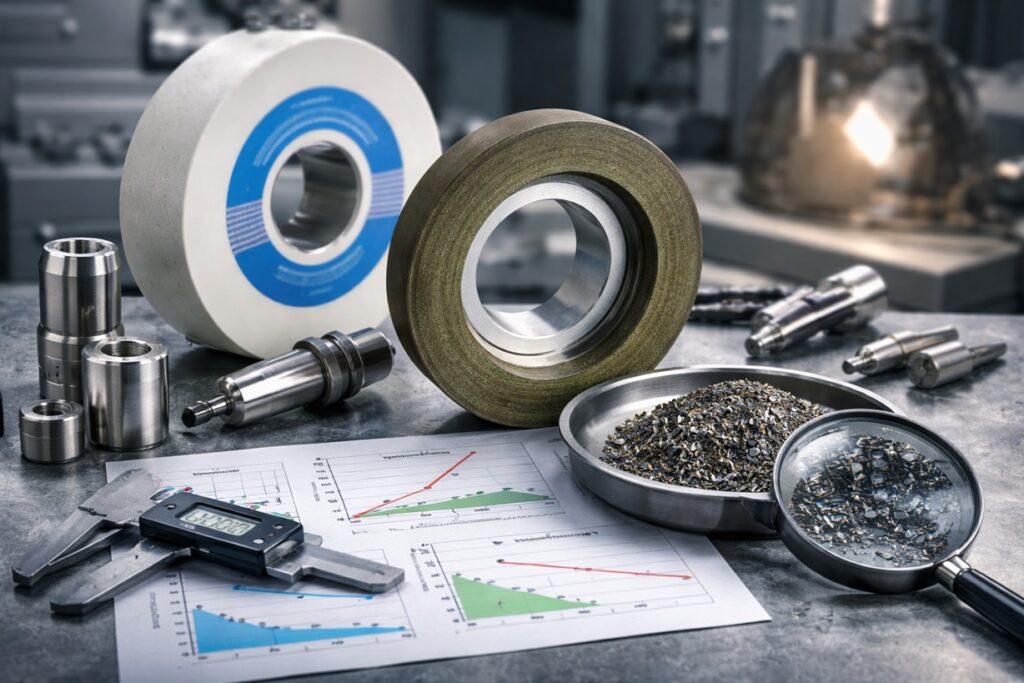
2. Mechanics of Abrasive Wear: Attritious, Micro, and Macro
Abrasive wear is not a singular event but a multi-stage degradation process. To optimize the G-ratio, it is necessary to distinguish between the three primary modes of wear. Each mode is driven by different physical triggers—ranging from chemical diffusion at the grain tip to mechanical overload of the vitrified or resinoid bond.
I. Attritious Wear: The Blunting Mechanism
Attritious wear involves the localized dulling of the abrasive grain tips, creating Wear Flats. This occurs due to a combination of high flash temperatures and chemical diffusion between the abrasive (e.g., Al2O3) and the workpiece (e.g., steel). As the wear flat area (Af) increases, the normal force (Fn) required to maintain penetration rises exponentially, leading to increased friction and eventual thermal damage.
II. Micro-fracture: Controlled Self-Sharpening
Under ideal conditions, the wheel should exhibit Micro-fracture. This is a desirable state where the abrasive grain partially breaks under load to reveal new, sharp cutting edges. This “self-sharpening” effect maintains a constant specific grinding energy (u). If the grain is too tough (high friability), micro-fracture fails to occur, leading back to attritious blunting and glazing.
III. Bond Fracture (Macro-Wear): Rapid Depletion
Bond fracture, or Macro-wear, occurs when the mechanical forces acting on a grain exceed the strength of the bond post (the material holding the grain in place). When this happens, entire grains are dislodged before they have performed their full cutting potential. This leads to a catastrophic drop in the G-ratio and a loss of wheel profile.
Understanding these mechanical failure modes allows us to manipulate the process parameters to stay within the “Micro-fracture Zone.” While bond fracture causes the most rapid volume loss, it is often a secondary symptom of a kinematic mismatch between the wheel speed and the material removal rate.
3. Root Causes 1: Kinematic Mismatch and G-Ratio Dynamics
The longevity of a grinding wheel is primarily governed by the Average Grain Load. A kinematic mismatch occurs when the mechanical stress applied to individual abrasive grains exceeds the elastic limit of the bond matrix. This relationship is mathematically expressed through the Maximum Undeformed Chip Thickness (hcu). When hcu is too large, the wheel suffers from rapid macro-wear; when it is too small, the wheel glazes and heats up.
The Chip Thickness Control Model
To stabilize the G-ratio, the engineer must balance the Wheel Speed (vs) and the Workpiece Speed (vw). Increasing the workpiece speed relative to the wheel speed increases the mechanical force per grain, which accelerates bond fracture. Conversely, increasing wheel speed reduces grain load but can lead to thermal blunting (attritious wear).
Theoretical Chip Thickness Approximation
hcu ≈ [ (vw / vs) × √(ae / deq) ]1/2
G-Ratio Sensitivity to Material Removal Rate (Q′w)
The G-ratio is not a constant value; it is highly sensitive to the Specific Material Removal Rate (Q′w). As Q′w increases, the mechanical energy required to shear the metal increases the force on the bond posts. If the process is pushed beyond the “Critical Kinematic Threshold,” the G-ratio drops non-linearly, signaling a transition from productive grinding to wasteful abrasive destruction.
The “Aggressiveness” Factor
To maintain a high G-ratio, it is often necessary to calculate the Aggressiveness Number. This dimensionless value helps in migrating a proven process between different machines or wheel diameters. If the aggressiveness is too high for the wheel’s grade, macro-wear is inevitable. By fine-tuning the vw/vs ratio, engineers can stabilize the grain engagement depth, ensuring that the wheel is stressed enough to remain sharp but not enough to fall apart.
This kinematic foundation explains why a wheel that performs well on one part may fail “excessively” on another with slightly different geometry or removal requirements. Once the kinematics are balanced, the next logical variable to scrutinize is the compatibility between the wheel’s grade hardness and the material properties of the workpiece.
4. Root Causes 2: Improper Wheel Selection and Grade Hardness
While kinematics define the operational load, the Wheel Grade (or hardness) defines the structural resistance to that load. In grinding terminology, “hardness” does not refer to the hardness of the abrasive grain itself, but to the Retentive Strength of the bond matrix. Choosing an inappropriate grade for a specific material is a primary cause of non-linear wheel wear and process failure.
The Soft Wheel Trap: Excessive Self-Dressing
To avoid the risk of Grinding Burn, operators often lean toward “soft” wheel grades (e.g., Grade H or I). A soft wheel has thinner bond posts, allowing grains to break away easily. While this keeps the wheel sharp, it can trigger Self-Dressing Overdrive, where the wheel wears at an uncontrollable rate. In this state, the wheel cannot maintain its profile for even a single pass, leading to significant dimensional errors and a collapsing G-ratio.
The Hard Wheel Dilemma: Glazing and Force Spikes
Conversely, using a wheel that is too “hard” for the application (e.g., Grade L or M on hardened D2 tool steel) prevents the natural release of blunt grains. This results in Glazing, where the abrasive surface becomes smooth and metallic. To force the glazed wheel to cut, the operator must increase the feed pressure, which eventually causes a massive Bond Fracture event as the accumulated stresses overcome the bond strength all at once.
Structure and Porosity Management
Beyond grade, the Structure Number (spacing between grains) plays a vital role in wear. A “closed” structure lacks the chip clearance necessary for high removal rates. When chips cannot escape, they become trapped, causing the wheel to “load.” The resulting metal-on-metal friction generates excessive tangential force (Ft), which tears grains from the bond prematurely. Selecting a wheel with Induced Porosity is often the most effective way to maintain a high G-ratio in ductile materials.
Correcting wheel wear issues requires aligning the bond retentive strength with the mechanical toughness of the workpiece. However, even the most perfect wheel selection can be undermined by external system influences, specifically the presence of vibrations that introduce erratic mechanical shocks to the abrasive interface.
5. Root Causes 3: Vibration and Dynamic Instability
Even a perfectly specified wheel can suffer from rapid depletion if the grinding system is subject to Dynamic Instability. Vibration acts as a periodic mechanical hammer, subjecting the abrasive grains and their bond posts to cyclic impact loads that far exceed the steady-state forces of the grinding process. This leads to premature Bond Fracture and a localized phenomenon known as “wheel lobing.”
Forced Vibration vs. Regenerative Chatter
Vibrations that accelerate wear generally fall into two categories. Forced vibrations are typically caused by external factors such as an unbalanced wheel, worn spindle bearings, or misalignment. Regenerative Chatter, however, is a self-excited phenomenon where a wear pattern on the wheel surface reinforces a specific vibration frequency, leading to a “runaway” wear state that destroys the wheel’s roundness.
The Impact of Static and Dynamic Stiffness
The system’s resistance to vibration is defined by its Static Stiffness (ks) and Dynamic Stiffness. If the machine tool structure or the workpiece clamping is too flexible, the wheel will “bounce” at the entry or exit of the cut. Each bounce represents a mechanical shock that micro-fractures the bond posts. This is why G-ratios are often significantly lower on older, less rigid machinery compared to modern, high-damping platforms.
Damping and Abrasive Resiliency
To combat vibration-induced wear, many high-performance wheels utilize specialized bond modifiers to increase Internal Damping. For example, resinoid-bonded wheels naturally dampen vibrations better than vitrified wheels, making them suitable for applications where dynamic stability is low. However, the most effective solution is typically to eliminate the source of vibration through high-precision Dynamic Balancing of the wheel assembly before it ever touches the workpiece.
Vibration is the “silent killer” of the G-ratio, often mistaken for an incorrect wheel grade. By stabilizing the dynamic environment, we ensure that wheel wear is governed strictly by the intended kinematics. Once stability is achieved, we can turn our attention to the real-time symptoms that indicate the wheel is entering a failure state.
6. Diagnostics: Identifying Wear Symptoms in the Process
Detecting excessive wheel wear before it results in a scrapped workpiece requires a move from visual inspection to Data-Driven Diagnostics. Because wear occurs at the micron level, the primary symptoms are often reflected in the machine’s sensor feedback and the physical characteristics of the finished part. By monitoring these “process signatures,” operators can intervene before the wheel loses its geometric integrity.
Shop-floor Diagnostic 3-Step
- Power Trend (Pnet):
A gradual rise under constant Q′w suggests glazing/attritious wear.
A sudden drop may indicate macro-wear where grain pull-out reduces effective engagement. - Wheel Diameter Loss Slope (Δds):
If the rate of wheel diameter reduction accelerates beyond the baseline, bond fracture is likely developing, leading to dimensional drift. - Abrasive Content in Swarf:
Increased visible abrasive particles in swarf indicates grain pull-out rather than controlled micro-fracture.
Visual checks via filtration or magnetic traps can provide qualitative confirmation.
Dimensional Drift and Diameter Loss (Δds)
The most direct symptom of a low G-ratio is Dimensional Drift. As the wheel loses diameter (ds) faster than the CNC’s compensation logic expects, the finished part size will begin to “grow.” In automated processes, in-process gauging can track this Δds. A sudden increase in the rate of diameter loss often signals that the wheel has transitioned from stable micro-fracturing to catastrophic bond fracture.
The Spindle Power Signal: A Dual-Edge Indicator
Monitoring the Spindle Power (Pnet) provides a real-time window into the wheel’s sharpness.
• Rising Power: Typically indicates Attritious Wear and glazing. The wheel is becoming dull, increasing friction.
• Falling Power (at constant Q′w): Ironically, a sudden drop in power often indicates Macro-Wear. As grains are ripped from the bond, the wheel effectively “backs away” from the cut, reducing the tangential force (Ft) but failing to maintain the required depth of cut.
Surface Roughness (Ra) and Texture Shifts
Changes in Surface Roughness (Ra) are sensitive indicators of wear morphology. Attritious wear (glazing) usually leads to a decrease in Ra as the wheel acts like a burnishing tool, while bond fracture leads to a significant increase in Ra and the appearance of “grit marks” or torn surface fibers as large abrasive fragments are pulled across the workpiece.
Accurate diagnostics allow the engineer to determine whether the problem is the wheel itself or the parameters applied to it. If the symptoms point to a consistent lack of retentive strength or excessive thermal blunting, we must move toward the implementation of engineering solutions designed to extend wheel life without sacrificing metal removal rates.
7. Solutions: Engineering Adjustments for Extended Wheel Life
Addressing excessive wheel wear requires a dual-pronged approach: optimizing the Mechanical Sharpness of the wheel through dressing and maximizing the Hydrodynamic Efficiency of the coolant. By making these deterministic adjustments, manufacturers can stabilize the G-ratio and extend the interval between tool changes.
Dressing Optimization: Managing Topography
Dressing is the most powerful lever for controlling wear. If a wheel is wearing too fast due to bond fracture, the Dressing Lead (ad) and Dressing Depth (aed) should be reduced to create a more “closed” topography with more active grains, thereby sharing the load. Conversely, if the wheel is glazing (attritious wear), increasing the dressing lead creates a “sharper” topography, forcing the grains to penetrate the material more easily and reducing the friction that leads to thermal blunting.
High-Pressure Scrubbing and Loading Prevention
“Loading”—the adhesion of workpiece metal to the wheel pores—is a primary precursor to bond fracture. As the pores clog, the tangential force (Ft) spikes, tearing grains out. Implementing a High-Pressure Scrubbing Nozzle (operating at 30–50% of the wheel speed) physically ejects metal chips from the wheel structure before they can weld to the abrasive. This maintains the “openness” of the wheel, preserving the G-ratio even at high removal rates.
Abrasive Chemistry: CBN vs. Al2O3
In cases where vitrified aluminum oxide (Al2O3) simply cannot withstand the thermal-chemical blunting, transitioning to Superabrasives like Cubic Boron Nitride (CBN) is the ultimate solution. CBN offers an order of magnitude higher G-ratio due to its exceptional thermal conductivity and chemical inertness with ferrous materials. While the initial tool cost is higher, the reduction in dressing downtime and the stability of the wheel diameter often result in a much lower cost-per-part in high-volume production.
By systematically applying these adjustments, the wheel wear rate transitions from an uncontrollable variable to a predictable parameter. This allows for the final step in abrasive management: finding the strategic equilibrium between cycle time and tool longevity.
8. Strategic Conclusion: Balancing Productivity and Tool Life
Managing excessive wheel wear is ultimately an exercise in Economic Optimization. While the technical goal is to maximize the G-ratio, the strategic goal is to find the “Sweet Spot” where the material removal rate (Q′w) is high enough for high productivity, but low enough to prevent the catastrophic failure of the abrasive bond. Mastering this balance transforms wheel wear from a manufacturing headache into a competitive advantage.
The Convergence of Kinematics and Economics
As demonstrated throughout this report, wheel wear is a deterministic result of the system’s mechanical and thermal loads. By synchronizing the Wheel Speed (vs), managing Chip Thickness (hcu), and ensuring rigid Dynamic Stability, manufacturers can move away from conservative, slow-speed grinding. When the process is stabilized, the “Cost per Part” curve typically reveals that the most efficient operation is not the one with the absolute longest wheel life, but the one with the most predictable wear behavior.
The Path Forward
In the future of Industry 4.0, wheel wear will be managed by digital twins that adjust dressing cycles in real-time based on acoustic emission and spindle power data. However, the fundamental principles of abrasive technology remain unchanged: a wheel must cut, not rub. By applying the practical solutions detailed in this guide—from topography management to high-pressure scrubbing—you can ensure that your grinding process remains both sharp and profitable.
In the end, the goal is simple: a process stable enough that operators don’t have to “play it safe” by slowing everything down.
When wheel wear becomes predictable, productivity rises—and quality gets easier to protect, not harder.
The Deterministic Success Formula
Rigid System + Optimized Kinematics = Predictable G-Ratio
References & Further Reading
Technical Publications & Industrial Standards
- • Marinescu, I. D., et al. (2015). Handbook of Machining with Grinding Wheels. CRC Press. (Focus: Wheel wear mechanisms and bond system selection).
- • Tawakoli, T. (1993). High Efficiency Deep Grinding. VDI-Verlag. (Focus: G-ratio optimization and cooling effects on wear).
- • Klocke, F. (2009). Manufacturing Processes 2: Grinding, Honing, Lapping. Springer. (Focus: Tribological interaction and tool life-cycle analysis).
Curated Internal Resources: Tooling & Stability Series
To further master abrasive longevity and process stability, we recommend our specialized engineering deep-dives:
Industrial Research Institutions
- CIRP: Research on abrasive grain failure mechanics and process modeling.
- Advanced Machining Research Centre (AMRC): Applied studies on high-performance tooling and tool wear monitoring.
© 2026 Advanced Machining Intelligence | Strategic Resource for Deterministic Grinding and Tooling Optimization