1. Introduction: The Paradox of Dressing Economics
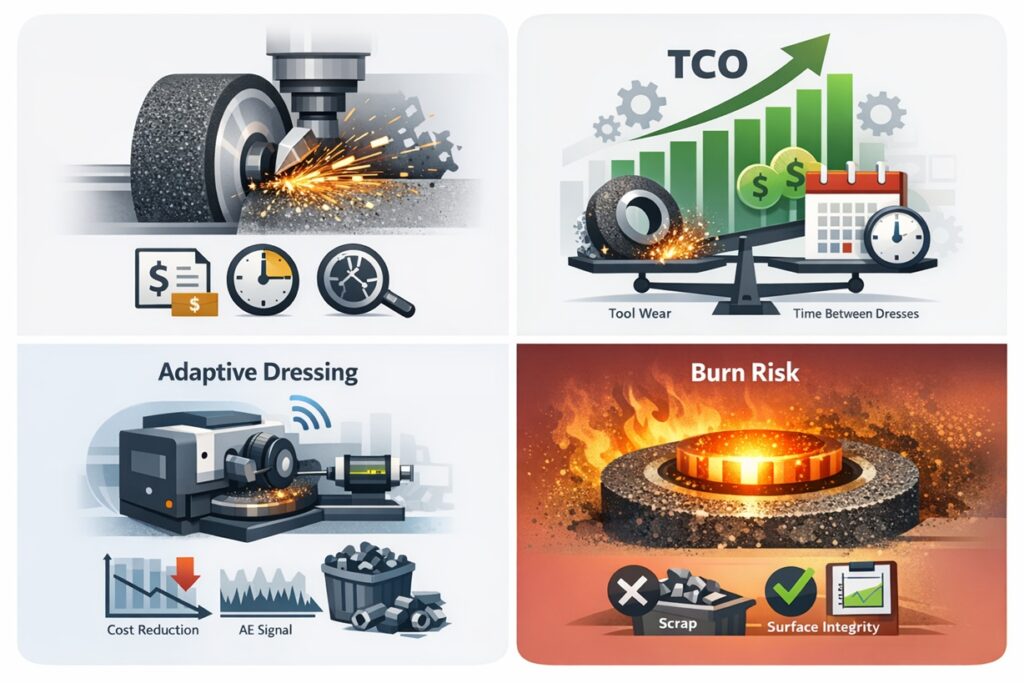
In the world of precision abrasive machining, dressing is often described as a “necessary evil.” It is the process required to regenerate the wheel’s topography by stripping away dull abrasive grains and removing the loaded metallic swarf from the bond’s pores. However, this essential maintenance task presents a profound economic paradox: to ensure the wheel can continue to cut efficiently, we must intentionally destroy a portion of the expensive abrasive tool. In high-volume production environments, up to 70% to 80% of a grinding wheel’s usable volume is typically consumed not by the workpiece, but by the Dressing Tool.
From an operational cost optimization perspective, the “price of the wheel” is far less significant than the “efficiency of its regeneration.” If a dressing strategy is too aggressive, the wheel’s lifespan is prematurely shortened, inflating the Tooling Cost per Part. Conversely, if the dressing is too infrequent or timid, the wheel face becomes “closed,” leading to a spike in Specific Grinding Energy (us), which causes thermal damage (Grinding Burn) and necessitates expensive inspection or scrap. The ultimate goal of a data-driven dressing strategy is to find the “Economic Equilibrium”—the point where the combined costs of abrasive consumption and production downtime are minimized.
Dressing as a Primary Lever for Operational Excellence
Why does dressing impact operational costs so widely? The answer lies in the Non-Productive Time (tnp). Every time the machine spindle slows down or the axes move into a dressing position, the factory is losing valuable “spark time.” In a manufacturing cell where the machine overhead rate (Cm) exceeds $200 per hour, a poorly optimized dressing cycle that takes 30 seconds every 10 parts is a silent profit killer.
Beyond the Invoice: The Hidden Abrasive Budget
To achieve true cost leadership, a facility must transition from Fixed Dressing (e.g., dressing every 20 parts) to Adaptive Dressing based on sensor feedback or empirical wheel-wear models. For instance, in EV gear grinding, maintaining a strict surface roughness (Ra) and profile slope is non-negotiable for NVH (Noise, Vibration, and Harshness) performance. If an engineer understands the relationship between the Dressing Overlap Ratio (Ud) and the active cutting edge density, they can produce parts with superior integrity while reducing the radial depth of dress (ad) from 20 μm to 5 μm per pass. This four-fold reduction in tool consumption directly impacts the bottom line, turning the dressing station from a cost center into a competitive advantage.
The Engineer’s Insight: “We don’t lose money when the wheel is grinding; we lose money when the diamond is dressing. Every micron we shave off the wheel diameter without a corresponding cubic millimeter of metal removed is a failure of process design. Optimization starts by measuring what the dresser is actually doing to your ROI.”
This report serves as a comprehensive roadmap for identifying and mitigating the hidden costs associated with wheel regeneration. By analyzing the mechanics of D-ratio, the selection of Diamond Tooling, and the integration of In-process Monitoring, we will define a strategy that maximizes productivity while minimizing the operational footprint of the dressing process.
2. The Mechanics of Dressing and Wheel Consumption
To optimize the operational cost of dressing, one must first master the physics of the abrasive-dresser interface. The primary objective of dressing is to achieve a specific Wheel Topography—the arrangement and sharpness of active cutting edges—while removing the minimum amount of abrasive material. However, the radial depth of dress (ad) is often set based on conservative “safety margins” rather than calculated necessity. In high-precision grinding, even a 5 μm difference in ad can translate into thousands of dollars in annual abrasive waste per machine.
Quantifying Waste: The D-Ratio and Radial Wear
While the G-ratio measures the efficiency of the grinding process, the D-Ratio (Dressing Ratio) is the critical metric for tool life management. The D-ratio is defined as the volume of material removed from the workpiece divided by the volume of abrasive lost during dressing. In many conventional Al2O3 applications, the D-ratio is alarmingly low, indicating that the dressing tool is the primary consumer of the abrasive budget.
The total radial wear of the wheel (ΔRs) over its life is the sum of Grinding Wear and Dressing Wear. In mass production, the latter often accounts for more than 75% of the total diameter loss. By reducing ad from a standard 20 μm to an optimized 3 μm per pass, a facility can effectively triple the number of parts produced per wheel, dramatically lowering the Total Cost of Ownership (TCO).
The Role of Bond Fracture Mechanics
The cost of dressing is inextricably linked to the Static and Dynamic Stiffness of the wheel’s bond. In Vitrified wheels, the dressing tool acts by fracturing the brittle bond bridges. If the bond is too hard (high Grade), the energy required to dislodge a grain increases, leading to higher Dressing Forces (Fd) and accelerated wear of the diamond dresser.
To optimize cost, engineers must balance the wheel Grade with the dressing aggressiveness. A “Soft” wheel may require more frequent dressing due to rapid grinding wear, but its dressing cycles are fast and require minimal depth. Conversely, a “Hard” wheel may last longer between dresses but requires deep, high-energy dressing passes that destroy the diamond tool and the spindle’s precision over time. Mastering this trade-off is the first step toward reducing the hidden operational expenditures of the grinding department.
Expert Tip: “In precision vitrified grinding, we aim for ‘micro-dressing.’ If you can see visible abrasive dust clouding the coolant during dressing, you are likely over-dressing. The goal is to refresh the grain tips, not to reshape the entire wheel unless truing is the specific objective.”
In the following section, we will analyze how the Dressing Interval acts as the second major lever in cost optimization, focusing on the reduction of non-productive downtime and the implementation of adaptive monitoring.
3. Dressing Interval Optimization: Reducing Non-Productive Time
In the cold calculus of industrial grinding, the Dressing Interval (fd) represents the most potent, yet often underutilized, lever for radical cost reduction. The dressing interval is defined as the specific number of workpieces processed between consecutive regeneration cycles of the grinding wheel. While it may appear to be a simple operational setting, it is, in fact, the primary determinant of a cell’s Overall Equipment Effectiveness (OEE). Every time the grinding spindle retracts to engage with the diamond dresser, the machine enters a state of Non-Productive Time (tnp). In a modern Tier-1 facility where the machine overhead rate (Cm) can range from $180 to $350 per hour, every second of “non-spark time” is a direct erosion of the profit margin.
The Mathematics of Interval Sensitivity and Throughput
To understand the economic sensitivity of fd, one must look at the Net Production Rate (Pn). The relationship is governed by the formula:
ttotal = tc + (td / fd)
where tc is the actual cycle time and td is the time taken for a single dressing cycle. In a high-volume scenario—such as the grinding of EV reduction gear teeth—a standard cycle might be 45 seconds. If the dressing cycle takes 15 seconds and is performed every 10 parts, the “overhead of regeneration” adds 1.5 seconds to every single part produced. By extending the dressing interval from 10 parts to 40 parts through advanced abrasive selection and stable bond chemistry, the overhead per part drops from 1.5 seconds to a mere 0.375 seconds. Over a production run of 200,000 units, this optimization recovers approximately 62.5 hours of machine capacity. At an overhead rate of $200/hour, this represents a direct recovery of $12,500 in hidden capacity without a single dollar of additional capital expenditure (CAPEX).
The “Conservative Safety Trap” vs. Data-Driven Risk
The pervasive reliance on “Fixed-Interval Dressing” (e.g., dressing every 20 parts regardless of wheel state) is what engineers call the Conservative Safety Trap. This approach is born from a fear of Grinding Burn or dimensional scrap. However, this fear often leads to an “over-dressing” culture where 30% to 50% of the dressing cycles are performed on a wheel that is still perfectly sharp. This not only wastes the expensive abrasive layer but also creates a “sawtooth” effect in part quality, where the first part after dressing has a significantly different surface topography than the 20th part.
The strategic transition to Condition-Based Dressing involves monitoring the Spindle Power Load (P) or utilizing Acoustic Emission (AE) sensors. By tracking the RMS signal of the AE sensor, an engineer can detect the exact micro-second when the abrasive grains develop “wear flats” or when the bond pores become loaded with metallic chips. Moving the decision-making process from a fixed counter to a real-time sensor feedback loop allows the dressing interval to be pushed to its physical limit, ensuring that every micron of the abrasive tool is utilized to its maximum potential before being stripped away by the diamond.
Gap Elimination: Killing the “Air Cutting” Ghost
Even within an optimized interval, the dressing cycle itself is often riddled with inefficiency. A major “ghost cost” in dressing is Air Cutting—the time wasted as the diamond tool moves at a slow, conservative dressing feed rate before it makes physical contact with the wheel. Without advanced sensing, operators must start the dressing feed rate far enough away to account for thermal expansion and wheel diameter uncertainty.
Modern Gap Elimination systems use AE sensors to allow the dresser to approach the wheel at rapid traverse speeds. The moment the first diamond grain touches the first abrasive crystal, the sensor sends a signal to the CNC in less than 1 millisecond, instantly switching to the precise dressing feed rate. This “just-in-time” contact eliminates up to 5 to 10 seconds of air cutting per cycle. In high-frequency dressing operations, this small technological intervention can increase the total throughput of a production line by 3% to 5% without any change to the actual grinding parameters.
The Production Rule of Thumb: “If you can’t measure the degradation of the wheel topography, you shouldn’t be dressing it. Every ‘precautionary’ dress is a direct tax on your profitability. The goal of interval optimization is to find the breaking point of the process and then step back exactly one part—this is where the maximum ROI lives.”
In conclusion, optimizing the dressing interval is not merely an exercise in abrasive conservation; it is a strategic maneuver to reclaim wasted machine time and stabilize surface integrity. By moving from fixed cycles to adaptive, sensor-monitored interventions, a facility can transform its dressing station from a source of downtime into a precision-engineered driver of throughput. In the next section, we will analyze how the Diamond Tooling itself dictates the stability of this interval and the long-term operational expenditure (OPEX) of the grinding department.
4. Diamond Tooling Selection: Initial CAPEX vs. Long-term OPEX
A pervasive and costly fallacy in abrasive process management is the tendency to categorize the Diamond Dresser as a simple commodity consumable. Procurement departments often prioritize the Initial Capital Expenditure (CAPEX)—the invoice price of the tool—while remaining blind to the catastrophic Operational Expenditure (OPEX) inflation caused by sub-optimal tooling. In high-precision grinding, the dresser is the “Master of the Wheel”; it is the tool that dictates the micro-geometry, the active cutting edge density, and the thermal stability of the entire grinding process. Selecting a dresser based on the lowest bid is often the most expensive mistake a facility can make.
The Economics of Geometric Stability: Single-Point vs. Rotary Systems
To analyze the true cost of diamond tooling, we must evaluate the Wear Rate of the Diamond Tip and its impact on the wheel’s topography. A standard Natural Single-Point Dresser may cost as little as $150. However, natural diamonds possess inherent structural inconsistencies and wear relatively quickly, developing a “wear flat.” As the tip flattens, the dressing mechanism shifts from “shearing” the bond to “crushing” and “rubbing” it. This results in a “closed” wheel face that requires higher Specific Grinding Energy (us) to remove material.
In contrast, a Rotary Diamond Disc or Roller—which can cost between $2,500 and $8,000—represents a strategic investment in Process Permanence. Because the dresser rotates, the wear is distributed across thousands of diamond crystals rather than a single point. This ensures that the Dressing Overlap Ratio (Ud) remains constant over the tool’s entire life. For a Tier-1 automotive line producing 500,000 components annually, the stability provided by a rotary dresser can reduce the wheel scrap rate by 1.2% and extend the wheel life by 40%. The resulting $50,000 in annual savings renders the initial $5,000 CAPEX premium entirely negligible.
CVD and MCD: The Rise of Engineered Diamonds
The emergence of Chemical Vapor Deposition (CVD) and Monocrystalline Diamond (MCD) has redefined the OPEX of the dressing station. These engineered diamonds offer a level of thermal conductivity and fracture toughness that natural stones cannot match. In applications requiring extreme profile accuracy—such as aerospace turbine blade fir-tree grinding—the use of CVD log-style dressers ensures that the dresser width remains within ±2 μm over thousands of dressing cycles.
Without this level of dimensional stability, the wheel would lose its form, necessitating more frequent and aggressive Truing Cycles. Every extra truing pass to correct a lost profile is “lost gold”; it represents the most expensive abrasive volume being turned into waste sludge. By shifting to synthetic diamond tooling, a plant can effectively “buy” process capability, reducing the frequency of first-part inspections and allowing for a higher degree of Lights-out Manufacturing.
The Cost-Quality Nexus: “When a $200 dresser tip wears out, it doesn’t just stop cutting; it starts destroying the surface integrity of your $1,000 wheel and your $10,000 workpiece. In the hierarchy of cost optimization, the dresser is the ‘Force Multiplier’. If you aren’t using the best diamond available for your application, you are subsidizing your competitors through your own inefficiencies.”
Dresser Wear and the “Energy Tax”
The most hidden cost of poor dresser selection is the Energy Tax. A worn dresser produces a “dull” wheel face. A dull wheel requires higher spindle torque to maintain the set Material Removal Rate (MRR’). This increased power draw is not just an electricity bill issue; it is a thermal issue. Excess energy is converted into heat that must be removed by the coolant system and chillers, which in turn consume more electricity. By selecting a high-performance rotary dresser that keeps the wheel “open” and sharp, the specific grinding energy (us) can be kept at its theoretical minimum, reducing the total energy footprint of the production line by up to 15%.
In summary, the selection of diamond tooling must be a data-driven decision based on the Cost-per-Good-Part over the entire lifecycle of the machine. In the next section, we will analyze the direct consequence of this selection: The Thermal Impact, and how an optimized dressing strategy acts as the ultimate quality insurance policy against metallurgical failure.
5. The Thermal Impact: Dressing as a Quality Insurance
In the hierarchy of manufacturing failures, Grinding Burn is arguably the most insidious. It is a metallurgical injury caused by excessive heat flux into the workpiece, often invisible to the naked eye but catastrophic to the component’s fatigue life. While many operators attempt to solve thermal issues by increasing coolant flow or slowing down feed rates, the root cause almost always resides in the Wheel Topography. In this context, the dressing process is not merely a maintenance task; it is the ultimate quality insurance policy. A strategic dressing intervention dictates the Energy Partition (Rw)—the fraction of total grinding energy that enters the workpiece as heat.
Dressing Overlap Ratio (Ud) and the Thermal Ceiling
The primary geometric variable governing the “sharpness” of a dressed wheel is the Dressing Overlap Ratio (Ud). This non-dimensional parameter describes how many times a single point on the wheel face is “passed over” by the diamond dresser. It is calculated as:
Ud = (bd × ns) / vd
where bd is the effective width of the dresser, ns is the wheel speed, and vd is the dressing lead speed. A high Ud (typically > 8) results in a “closed” wheel surface where the abrasive grains are crushed and flattened. This topography increases the sliding and plowing components of the Specific Grinding Energy (us), turning the wheel into a friction heater.
Conversely, an optimized “Open” dressing strategy (Ud between 2 and 4) creates a topography with deep chip pockets and sharp, fractured grains. This reduces the friction at the interface, allowing the coolant to penetrate the contact zone more effectively. By lowering the Ud, an engineer can effectively lower the workpiece temperature by as much as 150°C without changing a single grinding parameter. This “Thermal Headroom” allows for an increase in the Material Removal Rate (MRR’), effectively paying for the slightly higher abrasive wear through massive gains in productivity.
Dressing as a Buffer against “Invisible” Costs
The true cost of a sub-optimal dressing strategy is often buried in the Quality Assurance (QA) budget. When a wheel is improperly dressed, the resulting tensile residual stresses can lead to delayed cracking in high-strength steels. To detect this, plants often implement 100% Nital Etching or Barkhausen Noise Inspection. These processes are not only slow but environmentally hazardous and expensive to maintain.
By establishing a Robust Dressing Window, a facility can transition from “Detection-based Quality” to “Process-based Quality.” If the dressing lead and depth (ad) are verified through spindle power monitoring, the risk of burn is mitigated at the source. The ROI here is massive: eliminating a single Nital Etch line can save a facility upwards of $100,000 annually in chemicals, labor, and cycle time. Dressing, when executed with precision, acts as the primary barrier preventing these high-value added components from becoming “scrap in the bin.”
Thermal Reality Check: “You can have the best coolant in the world, but if your dressing strategy is creating a dull wheel, you are essentially trying to put out a forest fire with a garden hose. The wheel topography determines the heat generation; the coolant only manages the aftermath. Fix the dressing, and the thermal problems vanish.”
Energy Efficiency: The Power Consumption Factor
Finally, there is a direct correlation between dressing quality and the Spindle Power Load. A well-dressed, sharp wheel cuts through metal with minimal resistance. A dull wheel, however, requires significantly more torque to maintain its speed. In large-scale operations with dozens of machines, the difference in electricity consumption between a “dull-wheel shop” and a “sharp-wheel shop” can amount to several percentage points of the total utility budget. Furthermore, reduced spindle load means less thermal growth in the machine itself, leading to better long-term Dimensional CPK.
In conclusion, dressing is the thermostat of the grinding process. By mastering the Dressing Overlap Ratio and prioritizing an open wheel topography, manufacturers can insure themselves against the most expensive quality failures while simultaneously boosting productivity. In the next section, we will explore the specialized strategies required for Superabrasives (CBN/Diamond), where the cost of a single dressing error can be magnified tenfold.
6. Advanced Dressing Strategies for Superabrasives: CBN and Diamond
When transitioning from conventional Aluminum Oxide (Al2O3) to Superabrasives such as Cubic Boron Nitride (CBN) or Diamond, the economic stakes of the dressing process undergo a radical transformation. While a conventional wheel might cost $200, a high-performance Vitrified CBN wheel for automotive camshaft grinding can easily exceed $10,000. In this high-stakes environment, the dressing process is no longer just about topography; it is about Asset Preservation. A single aggressive dressing pass with an improper lead could strip away $500 worth of superabrasive layer in seconds, turning a high-ROI tool into a financial liability.
Truing vs. Dressing: The Two-Stage Precision Economy
For superabrasives, the regeneration process is strictly divided into two phases: Truing and Dressing (Sharpening). Truing ensures the wheel’s geometric run-out and profile accuracy, while dressing exposes the sharp grains by removing the excess bond material (chip clearance).
The economic challenge here is that superabrasives are extremely hard, meaning the Dressing Forces (Fd) are significantly higher, which accelerates the wear of the diamond dresser. To optimize the Total Cost of Ownership (TCO), manufacturers are increasingly moving away from mechanical contact truing toward Electro-Contact Discharge Truing (ECDT). By using electrical sparks to erode the metal-bonded wheels, engineers can achieve a profile accuracy within ±1 μm without any mechanical wear on the truing tool, effectively extending the dresser life by 1,000% compared to traditional diamond rollers.
The ELID Revolution: Eliminating Non-Productive Time
Perhaps the most significant advancement in superabrasive cost management is Electrolytic In-process Dressing (ELID). In this system, a constant electrical current is passed through the grinding fluid to oxidize the surface of a metal-bonded wheel while it is grinding. This process continuously “refreshes” the wheel, ensuring that the Grain Protrusion Height (hp) remains constant throughout the production run.
From an operational perspective, ELID eliminates the need to stop the machine for dressing cycles, effectively reducing the Non-Productive Time (tnp) to zero. For high-value materials like technical ceramics or hardened aerospace alloys, ELID provides a level of surface finish stability (Ra < 0.1 μm) that is impossible to achieve with conventional periodic dressing. The ROI is calculated by comparing the multi-million dollar throughput of an ELID-enabled line against the frequent setup changes and scrap risk of a standard mechanical dressing operation.
Superabrasive Strategic Note: “With CBN, you aren’t just buying a wheel; you’re buying a long-term production partner. If you dress it like a conventional wheel, you are essentially burning money. The future of cost optimization lies in contactless dressing—where the tool and the wheel never meet, but the results are more precise than ever.”
Laser Dressing: The Ultimate Topography Control
As we look toward Industry 4.0, Laser-Assisted Dressing is emerging as the gold standard for superabrasive optimization. By using a short-pulse laser to selectively remove the bond material around the diamond or CBN grains, engineers can engineer the topography with surgical precision. This allows for the creation of Hydradynamic Lubrication Pockets on the wheel face, which drastically reduces the friction coefficient at the interface.
The energy efficiency gains from laser-dressed wheels are staggering; by increasing the grain exposure without damaging the crystal structure, the Specific Grinding Energy (us) can be reduced by up to 30%. While the initial CAPEX for a laser dressing unit is high, the reduction in abrasive waste and the increase in cycle time speed (MRR’) make it a compelling choice for future-focused manufacturing centers.
In conclusion, the era of “one-size-fits-all” dressing is over for superabrasives. Cost leadership now requires a deep understanding of advanced truing and dressing technologies. In the next section, we will synthesize these technical variables into a Practical Case Study, demonstrating how a 20% reduction in total cost was achieved in a high-volume production line.
7. Practical Case Study: Reducing TCO in High-Volume Lines
To contextualize the engineering principles discussed in the preceding chapters, we must examine a real-world application where theoretical optimization was translated into measurable financial gain. This case study focuses on a Tier-1 automotive powertrain facility specializing in the production of Hardened Steel Transmission Shafts. The facility operated four high-precision CNC cylindrical grinders, utilizing Vitrified CBN wheels. Despite the high-tech equipment, the plant was struggling with a high Total Cost of Ownership (TCO) due to excessive wheel consumption and frequent downtime for dressing tool replacements.
Baseline Analysis: The Cost of Inefficiency
The initial audit revealed that the plant followed a “Fixed-Interval Dressing” protocol, dressing the wheel every 25 parts. The radial depth of dress (ad) was set at a conservative 15 μm to ensure surface finish stability. Furthermore, they were using low-cost natural single-point dressers. This combination resulted in a D-ratio that was significantly below the industry benchmark, with nearly 85% of the $12,000 CBN wheel being “ground away” by the dresser rather than the workpieces. The machine overhead (Cm) was calculated at $210 per hour, and the dressing cycles were contributing to an 8.5% loss in total available production time.
The Optimization Strategy: A Three-Pronged Approach
The engineering team implemented a strategic overhaul focused on three critical levers:
- Tooling Upgrade: Replacement of natural single-point dressers with high-precision CVD-coated Rotary Diamond Discs. This ensured geometric stability and allowed for a reduction in dressing forces.
- Kinematic Refinement: The Dressing Overlap Ratio (Ud) was reduced from 8.0 to 3.5. This was achieved by increasing the dressing lead speed (vd), creating a sharper, more “open” wheel topography.
- Interval Extension: Utilizing Acoustic Emission (AE) sensors, the dressing interval (fd) was transitioned from a fixed 25 parts to an adaptive average of 65 parts, triggered only when the AE signal indicated grain dulling.
Economic Synthesis: Beyond the Surface
The results were transformative. By reducing the radial depth of dress from 15 μm to 3 μm, the facility effectively quintupled the theoretical life of the CBN layer. More importantly, the reduction in Specific Grinding Energy (us)—a direct result of the sharper wheel topography—eliminated the occasional “ghost burn” issues that previously necessitated 100% Nital Etch inspection.
When the reduction in Non-Productive Time (tnp) was factored in, each machine produced an additional 42 parts per shift. At a profit margin of $4.50 per part, this added over $50,000 in annual bottom-line contribution per machine. This case study proves that the “Consumables Budget” is a fraction of the story; the real savings are found in the Machine Overhead Dilution and Quality Risk Mitigation.
The Manager’s Takeaway: “We stopped looking at how much the diamond dresser cost and started looking at how much it cost us NOT to have it. By spending $3,000 on a rotary disc and $5,000 on AE sensors, we saved over $30,000 in CBN wheels and reclaimed 200 hours of capacity per year. The ROI was less than four months.”
In conclusion, this case study serves as a blueprint for any high-volume grinding operation. By shifting from conservative, time-based protocols to aggressive, data-driven strategies, manufacturers can unlock hidden profitability within their existing infrastructure. In the final section, we will conclude with a strategic roadmap for achieving long-term cost leadership through dressing excellence.
8. Conclusion: A Data-Driven Roadmap for Cost Leadership
As we have explored throughout this comprehensive analysis, the economic landscape of precision grinding is fundamentally dictated by the efficiency of the Dressing Strategy. What was once considered a routine maintenance task has evolved into the primary determinant of Total Cost of Ownership (TCO) in high-precision manufacturing. The wide variance in grinding costs across different facilities is rarely a result of the abrasive grain’s purchase price; rather, it is a direct consequence of how effectively a plant manages the Abrasive-Workpiece Interface through the lens of wheel regeneration.
Synthesizing the Pillars of Operational Optimization
To achieve sustainable cost leadership, manufacturers must move beyond the “consumables mentality” and embrace a “process-capability mindset.” The roadmap to optimization is built upon four strategic pillars identified in this report:
- Minimization of Radial Waste: Shifting from conservative depth of dress (ad) values to calculated micro-dressing (3-5 μm) to preserve the expensive abrasive layer.
- Reclamation of Productive Time: Utilizing Adaptive Dressing (fd) and Gap Elimination to reduce the Non-Productive Time (tnp) that erodes machine overhead.
- Strategic Tooling Investment: Transitioning from low-CAPEX single-point tools to high-OPEX-efficiency Rotary Diamond Systems and synthetic CVD materials for profile stability.
- Thermal Integrity Management: Controlling the Dressing Overlap Ratio (Ud) to ensure an open wheel topography, thereby minimizing the risk of metallurgical failure and inspection overhead.
The Future: AI and Autonomous Topography Control
The next frontier in dressing cost mastery lies in the integration of Digital Twins and Artificial Intelligence. Future grinding centers will not rely on human intuition to set dressing parameters. Instead, they will utilize real-time Spindle Power Signatures and high-frequency Acoustic Emission data to autonomously adjust the dressing lead and depth in response to subtle variations in material hardness or coolant temperature. This state of “Self-Correction” will drive the Specific Grinding Energy (us) to its theoretical minimum, ensuring that every revolution of the spindle contributes to net profitability rather than friction-based waste.
Final Strategic Recommendation
For the modern production manager, the mandate is clear: **Stop managing the wheel, and start managing the dresser.** The capital invested in advanced sensing and high-performance diamond tooling is not a cost; it is an insurance policy against the inefficiencies that have plagued the grinding industry for decades. In an era of shrinking margins and increasing material complexity, the ability to maintain a stable, sharp, and energy-efficient wheel topography through superior dressing is the ultimate competitive advantage.
Concluding Vision: “The most expensive wheel is not the one with the highest price tag; it is the one that is squandered by an unoptimized dresser. When the diamond, the abrasive, and the data align, the result is a production process that is as profitable as it is precise. Mastery over dressing is mastery over the bottom line.”
Ultimately, the pursuit of zero-defect manufacturing in the EV and aerospace sectors depends on the micro-seconds of contact between a diamond tip and an abrasive crystal. By applying the data-driven roadmap outlined in this report, manufacturers can unlock hidden capacity, slash operational waste, and define a new standard of excellence in the grinding arts.
References & Internal Technical Resources
Primary Engineering & Economic References
- • Malkin, S., & Guo, C. (2008). Grinding Technology: Theory and Applications of Machining with Abrasives. Industrial Press Inc.
- • Rowe, W. B. (2014). Principles of Modern Grinding Technology. Academic Press.
Internal Deep-Dive Series: Mastering the Cost Drivers
To implement the TCO optimization strategies discussed in this report, please refer to the following specialized technical modules from our roadmap:
Implementation Strategy: For a successful TCO reduction program, it is recommended to begin with the Thermal Analysis in Grinding: Modelling Heat Partition and Surface Integrity to establish an energy baseline, followed by Advanced Control Strategies: Intelligent Process Monitoring and Optimization in Precision Grinding to refine coolant and process variables.