1. Introduction: The Coolant Delivery Gap
In many industrial grinding operations, significant resources are invested in high-performance grinding wheels and rigid machine tools, yet the Coolant Delivery System is often treated as an afterthought. This neglect leads to the “Coolant Delivery Gap”—a condition where despite a high total flow rate from the pump, the actual Grinding Zone remains starved of fluid. This failure results in premature wheel wear, thermal damage (burn), and inconsistent surface finishes.
If you’ve ever stood next to a grinder during a tough production run, you’ve probably seen the paradox firsthand: the pump is roaring, the enclosure is drenched, and yet the wheel sounds “dry” and the part comes out hotter than it should. That moment is the coolant delivery gap in real life—everything looks wet, but the cut is starving.
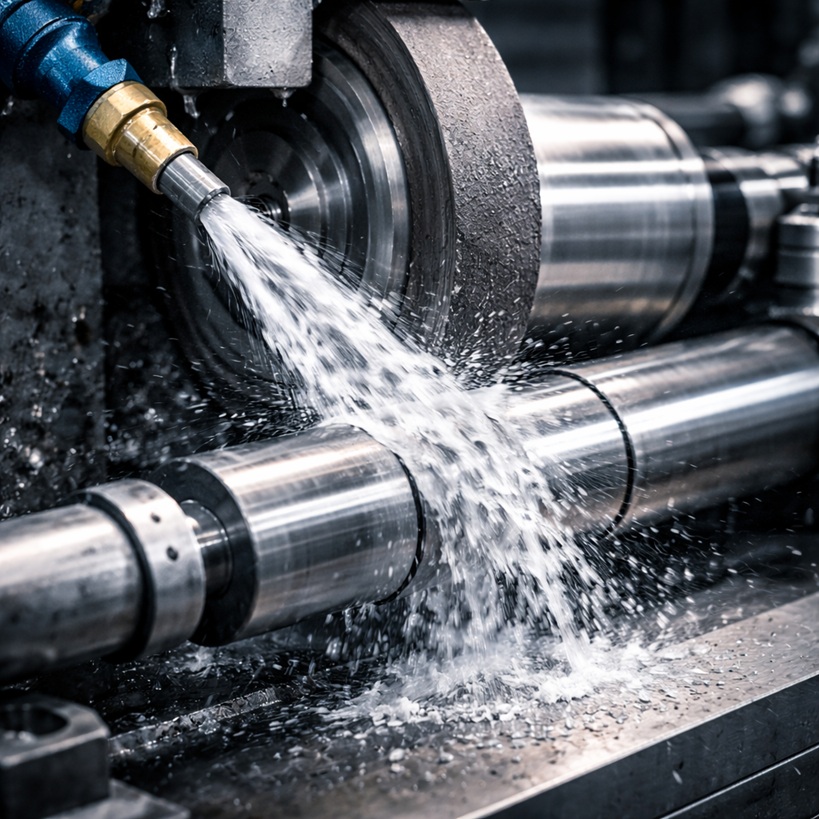
The Functional Triad of Metalworking Fluids (MWF)
Optimizing delivery requires a fundamental understanding of what the fluid must achieve within the millisecond of contact between the grit and the workpiece. The system must fulfill three primary roles simultaneously:
- • Lubrication: Reducing the friction coefficient (μ) at the grain-workpiece interface to lower the specific grinding energy (u).
- • Heat Dissipation: Absorbing and transporting the thermal energy generated by plastic deformation and friction before it conducts into the workpiece.
- • Chip Evacuation (Cleaning): Physically flushing swarf out of the wheel pores to prevent “loading,” which leads to catastrophic wheel glazing.
Systemic Improvement as a Quality Lever
System improvement is not just about using more water; it is about Energy Management. A poorly aimed, low-velocity stream of coolant will simply splash off the rotating wheel’s surface, acting only as a bulk coolant for the machine environment rather than a process coolant for the cut. By optimizing nozzle geometry and flow dynamics, we can transform the coolant from a simple auxiliary fluid into a precision “Invisible Tool” that enables higher removal rates and deterministic quality.
To close the delivery gap, we must first address the physical barrier that prevents fluid from entering the cut: the high-pressure air envelope generated by the wheel’s rotation. In the next section, we will analyze the fluid dynamics required to “Break the Air Barrier” and ensure reliable penetration.
2. Fluid Dynamics: Breaking the Air Barrier
As a grinding wheel rotates at high peripheral speeds (typically 30 to 120 m/s), it acts as a centrifugal fan, dragging a boundary layer of air along its circumference. This Air Barrier creates a high-pressure zone and extreme turbulence that can deflect low-energy coolant streams away from the grinding zone. Without addressing this aerodynamic phenomenon, the contact area remains essentially dry, even if the machine is “flooded” with fluid.
The Aerodynamic “Stagnation” Effect
When a coolant jet approaches the wheel, it encounters a stagnation point where the air pressure is at its maximum. If the Kinetic Energy of the fluid jet is lower than the static pressure of the air boundary layer, the fluid will atomize or splash off prematurely. To penetrate this barrier, the fluid must be delivered as a Coherent Jet with sufficient momentum to displace the air and wet the wheel surface.
Operators often describe it in plain words: “The coolant is there, but it won’t go in.” What they’re noticing is that the wheel is basically wearing an invisible air jacket. Unless the jet has enough momentum—and arrives as a clean, tight stream—the fluid gets shredded into mist and never reaches the interface where it actually matters.
Mechanical Suppression: The Scraper Plate Strategy
A highly effective method to assist fluid penetration is the use of a Scraper Plate (or air deflector). By positioning a physical barrier a few millimeters away from the wheel face upstream of the nozzle, the air boundary layer is disrupted. This creates a localized low-pressure zone, significantly reducing the energy required for the coolant jet to reach the grinding interface.
The Bernoulli Relationship in Delivery
To calculate the necessary pump pressure to overcome this barrier, we utilize the relationship between pressure (P) and velocity (vj). The goal is to ensure the jet velocity is capable of displacing the air mass while maintaining its integrity.
Jet Velocity Calculation (Bernoulli Principle)
vj = Cv × √( 2 × P / ρ )
Breaking the air barrier is only the first half of the challenge. Once the fluid reaches the wheel, it must be synchronized with the wheel’s movement to avoid immediate rejection. In the next section, we look at the Velocity Matching Strategy and how it prevents “Film Boiling” in the grinding zone.
3. Engineering the Jet: Velocity Matching Strategy
To ensure that the metalworking fluid actually enters the contact zone rather than merely splashing off the wheel face, the Coolant Jet Velocity (vj) must be synchronized with the Grinding Wheel Speed (vs). This synchronization is the cornerstone of “high-efficiency” delivery. If the fluid moves significantly slower than the wheel, the wheel simply “kicks” the fluid away, creating a dry contact zone despite a high volume of pump flow.
The 0.8 to 1.0 Matching Rule
Industry research and empirical data suggest that for optimal penetration, the ratio of vj to vs should be as close to 1.0 as possible, with 0.8 being the absolute minimum threshold. When the velocities are matched, the fluid is carried into the interface with minimal turbulence and maximum kinetic efficiency.
The Risk of “Film Boiling”
When velocity matching fails (i.e., vj << vs), the fluid spends too much time in the pre-contact zone, absorbing heat before it reaches the actual cutting point. If the temperature of the fluid exceeds its saturation temperature (approx. 100°C – 130°C for water-based emulsions), it undergoes Film Boiling. The resulting vapor layer acts as a thermal insulator, preventing any further heat transfer and leading to immediate Grinding Burn.
Kinetic Energy and Penetration Power
The “power” of the jet to reach the contact zone is a function of its kinetic energy. Higher pressures allow for smaller nozzle orifices while maintaining the same mass flow rate, which creates a “sharper” jet capable of slicing through the air boundary layer. However, high pressure alone is insufficient if the jet is not Coherent.
Kinetic Power of the Delivery Jet
Pjet = 0.5 × ρ × Q × vj2
Velocity matching ensures the fluid arrives at the right speed, but Nozzle Design ensures it arrives in a stable, concentrated form. In the next section, we will explore the geometric engineering required to maintain jet coherence over distance.
4. Nozzle Design: Geometry and Coherence
Even with the correct pump pressure, a poorly designed nozzle will produce a turbulent, divergent spray that loses its Coherence before reaching the wheel. A coherent jet is a solid column of fluid with minimal air entrainment and dispersion. In high-precision grinding, the ability of the nozzle to maintain this laminar-like profile is the difference between a controlled process and a thermal failure.
The Internal Geometry: Maximizing Laminar Flow
Internal turbulence is the enemy of jet coherence. Nozzles with sharp internal corners or sudden changes in diameter induce vortex formation. High-performance nozzles utilize a Concave or Conical Internal Profile designed according to fluid dynamics principles to accelerate the fluid smoothly toward the orifice. This reduces the Turbulence Intensity and ensures the jet remains concentrated over the “stand-off distance.”
The Impact of Stand-off Distance
As the distance between the nozzle and the grinding zone increases, the jet naturally begins to break up due to air friction. A high-quality coherent nozzle can maintain its diameter for up to 100 times the orifice size. However, to maximize the Impact Pressure, the nozzle should be positioned as close to the contact point as mechanically possible—typically within 20mm to 50mm—to minimize the loss of kinetic energy.
The Air Deflector Integration
Advanced nozzle systems often incorporate a built-in Air Deflector. This physical shield sits just ahead of the jet, stripping the boundary layer of air from the wheel pores. This allows the coherent jet to hit a “clean” surface, maximizing the Wetting Action. Without this, the jet must waste its energy pushing through the air before it can perform its lubrication and cooling functions.
While nozzle design ensures the quality of the delivery, the Flow Rate determines the capacity of the system to absorb heat. In the next section, we look at how to calculate the Useful Flow Rate—the actual volume of fluid that survives the trip into the grinding zone.
5. Flow Rate Requirements: The Useful Flow Rate (Quseful)
In high-productivity grinding, there is often a massive discrepancy between the Pump Flow Rate and the Useful Flow Rate (Quseful). The useful flow rate is defined as the volume of fluid that actually passes through the grinding zone. Most of the fluid pumped toward a wheel is rejected by centrifugal forces and air pressure, splashing into the machine bed without performing any work. Optimizing the system means maximizing the ratio of useful flow to total flow.
Calculating the Energy-Based Requirement
The minimum required Quseful is dictated by the Grinding Power (Pc). Since the fluid’s primary job is to carry away heat, the flow rate must provide enough thermal mass to prevent the temperature from reaching the “Film Boiling” point. A standard industrial rule of thumb is to provide 1.5 to 2.0 Liters per minute for every kilowatt of grinding power consumed.
Minimum Useful Flow Rate Calculation
Quseful ≥ ( Pc × ε ) / ( ρ × Cp × ΔT )
Porosity and Fluid Transport
The amount of fluid that can physically travel through the contact zone is limited by the Wheel Porosity. The pores in the wheel act as “buckets” that carry fluid into the cut. If the required Quseful for cooling exceeds the pore volume capacity of the wheel at a given RPM, the process will inevitably burn, regardless of how much external fluid is sprayed. In such cases, switching to a Vitrefied Bond with induced porosity is the only path to higher productivity.
The Nozzle/Wheel Width Match
A critical error in system design is using a nozzle that is narrower than the grinding wheel. This leads to “Dry Edges” where the center of the cut is cooled, but the edges reach critical temperatures, causing localized thermal cracks. The nozzle width should always be slightly larger (approx. 2-5mm) than the wheel width to ensure a complete Fluid Envelope around the cutting zone.
Once the flow requirements and nozzle geometries are optimized, the reliability of the entire process depends on the Infrastructure—the pumps, filtration, and piping that maintain these conditions. In the next section, we analyze how to build a robust delivery backbone.
6. System Infrastructure: Pumps, Filtration, and Piping
The most sophisticated nozzle design is useless if the underlying infrastructure cannot maintain the required pressure and fluid cleanliness. In high-productivity grinding, the delivery system’s backbone—comprising the Pump Capacity, Pipe Architecture, and Filtration Quality—must be engineered to handle the high energy and swarf loads generated at the interface.
Pressure Drop and Piping Efficiency
A frequent bottleneck in system optimization is the loss of pressure between the pump and the nozzle, known as Frictional Head Loss. Every 90-degree bend, reduction in pipe diameter, or flexible hose adds resistance. For high-pressure systems (> 20 bar), rigid piping with large radius bends is preferred. Any significant pressure drop reduces the Jet Velocity (vj), potentially dropping it below the critical matching threshold for the wheel speed.
The Role of Fine Filtration
As we move toward high-velocity coherent jets, nozzle orifices often become smaller and more precise. Recirculating “dirty” coolant containing grinding swarf acts like a sandblaster, eroding the internal geometry of the nozzle and destroying jet coherence. Furthermore, micro-particles trapped in the fluid can be dragged back into the grinding zone, causing “Comet Tail” scratches. For finishing operations, a 5-micron to 10-micron filtration system is the industrial standard for maintaining surface integrity.
Pump Selection: Centrifugal vs. Positive Displacement
For standard flood cooling, Centrifugal Pumps are common due to their high volume and low cost. However, for high-pressure optimization where a constant vj is required regardless of nozzle wear or minor clogs, Positive Displacement (Screw or Piston) Pumps are superior. They provide a deterministic flow rate, ensuring that the velocity matching strategy remains consistent throughout the entire wheel life.
A robust infrastructure ensures the fluid arrives as intended. However, the system must also be monitored to ensure the chemical and physical health of the fluid doesn’t degrade over time. In the next section, we examine Advanced Diagnostics for maintaining a high-performance coolant environment.
7. Advanced Diagnostics: Monitoring Coolant Health
Optimizing the delivery system is a futile exercise if the fluid itself has degraded. In high-precision grinding, the Physical and Chemical Health of the Metalworking Fluid (MWF) directly influences the lubrication threshold and the heat-carrying capacity. Advanced diagnostics allow engineers to move from periodic sampling to a deterministic understanding of the fluid’s state within the process.
Concentration Control and Lubricity
For water-based emulsions, the Concentration (measured via Brix refractometer) is the primary lever for lubricity. If the concentration drops below the recommended 7–10%, the Specific Grinding Energy (u) increases due to higher friction at the grain tip. Conversely, excessively high concentration leads to foaming and reduced cooling efficiency. Maintaining a tight ±0.5% Brix tolerance is critical for high-MRR processes where the margin between stable cutting and thermal burn is thin.
Thermal Stability and Viscosity
As the coolant temperature rises, its Viscosity decreases. While this may slightly improve flow in some cases, it drastically reduces the load-carrying capacity of the lubricant film. In high-productivity grinding, a 10°C rise in bulk coolant temperature can lead to a 15% increase in wheel wear. Integrating a High-Precision Chiller that references the machine bed temperature ensures thermal equilibrium and prevents “dimensional drift” in the workpiece.
Real-Time Flow Monitoring
Advanced delivery systems now utilize Inline Flow Meters and pressure transducers at the nozzle manifold. This allows the machine controller to detect Nozzle Clogging or pump degradation immediately. By correlating flow data with spindle power, the system can provide a “Health Score” for the cooling process, alerting operators to intervene before the first part is scrapped.
Maintaining the fluid’s integrity completes the delivery cycle. In the final section, we summarize the shift in mindset required to treat the cooling system not as a utility, but as a critical machining tool.
8. Conclusion: The “Invisible Tool” Optimization
Coolant delivery optimization represents one of the highest returns on investment in precision manufacturing. By transitioning from a “Flood and Hope” mentality to a “Strategic Jet” approach, manufacturers can unlock latent capacity in their existing machinery. The cooling system should no longer be viewed as a secondary utility, but as an Invisible Tool—one that must be designed, aimed, and maintained with the same rigor as the grinding wheel itself.
The good news is that coolant optimization is one of the rare improvements that you can feel immediately—sound, sparks, odor, and part temperature all change before you even measure anything. When the jet is right, the process stops behaving like a gamble and starts behaving like a system.
Summary of Systemic Improvements
To achieve a truly optimized cooling environment, engineers must integrate the three pillars of delivery:
- • Kinetic Matching: Synchronizing jet velocity (vj) with wheel speed (vs) to pierce the air barrier.
- • Geometric Precision: Utilizing coherent, laminar-flow nozzles positioned for maximum impact and minimal stand-off distance.
- • Volumetric Efficiency: Calculating and delivering the Useful Flow Rate based on the actual grinding power consumed.
The Path to Industrial Stability
As the industry moves toward Industry 4.0, the integration of smart sensors and adaptive pump controls will allow for autonomous delivery optimization. However, the fundamental fluid dynamics remain constant. A well-designed nozzle manifold and a robust filtration system are the bedrock upon which high-performance grinding is built. Without these, the process will always remain vulnerable to the thermal limits of the material.
Optimization Maturity Rule
“High pump pressure is a cost; high jet coherence is a capability; matched jet velocity is a Requirement.”
References & Further Reading
Technical Publications & Industrial Standards
- • Webster, J.A. (1999). “Optimizing Coolant Application Systems for High Productivity Grinding”. Abrasives Magazine. (Discusses coherent jet coolant and fluid delivery strategies).
- • Webster, J.A. (2007). “Improving surface integrity and economics of grinding by optimum coolant application” in Proceedings of the Institution of Mechanical Engineers, Part B: Journal of Engineering Manufacture. (Focus: coolant penetration and surface quality).
- • Webster, J.A. (2008). “Improving grinding process economics through more effective coolant application”. Inderscience International Journal of Manufacturing, Materials, and Mechanical Engineering. (Focus: cooling and lubricity optimization in grinding).
Curated Internal Resources: Precision Fluid Dynamics Series
To implement a high-performance cooling infrastructure and solve thermal instability, explore our specialized engineering deep-dives:
Industrial Research & System Providers
- The Grinding Center (TGC): Specialized research on fluid-dynamic nozzle optimization for creep-feed and CBN grinding.
- Standardization for Lubricant Health: Guidelines for MWF management, filtration standards, and pH/Brix monitoring protocols.
© 2026 Advanced Machining Intelligence | Strategic Resource for Deterministic Grinding and Coolant Delivery Engineering