1. Introduction: The Thermodynamic and Economic Symbiosis
In the modern manufacturing landscape, precision is no longer a luxury but a baseline requirement. However, achieving sub-micron accuracy in a cost-effective manner remains a formidable challenge. Among all subtractive processes, Grinding occupies a unique position. Unlike turning or milling, which rely on geometrically defined cutting edges, grinding is an inherently Stochastic Multi-point Process. This randomness, governed by the chaotic distribution of abrasive grains on a wheel, creates a direct link between the Thermodynamics of the contact zone and the Economic Viability of the production run.
The Energy Paradox: Specific Grinding Energy (us)
The primary technical barrier to grinding efficiency is the Specific Grinding Energy (us). While conventional machining processes dissipate energy through plastic deformation and chip formation, grinding consumes vast amounts of energy through Rubbing and Ploughing before any actual material removal occurs. This relationship is mathematically expressed as us = Pc / Qw, where Pc is the spindle power and Qw is the material removal rate.
This high energy consumption leads to an intense thermal flux. Approximately 60% to 90% of the energy consumed in grinding is converted into heat at the Grinding Interface. If this heat is not managed strategically, it leads to metallurgical damage—commonly known as Grinding Burn—and tensile residual stresses that compromise the Surface Integrity of the component. From a production strategy standpoint, every joule of wasted energy represents a direct increase in the Unit Cost (Cunit), especially when dealing with expensive superalloys like Inconel or Titanium.
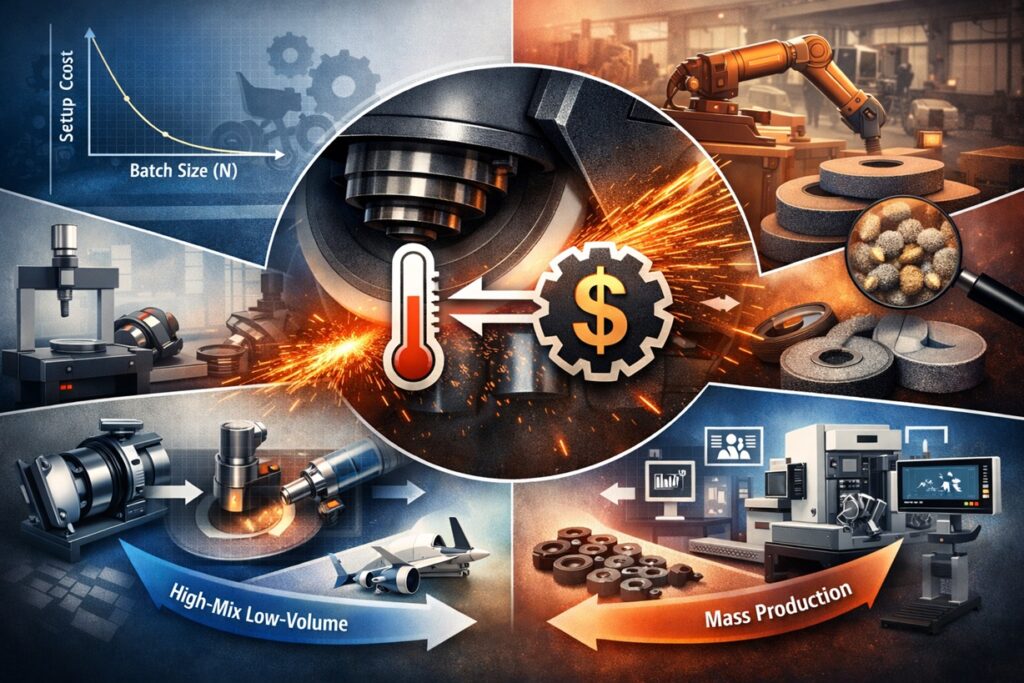
The Volume-Stability Nexus: Shifting to HMLV
Historically, grinding was optimized for mass production where Thermal Steady-State could be achieved over thousands of parts. However, the macro trend of High-Mix, Low-Volume (HMLV) manufacturing has disrupted this equilibrium. In HMLV environments, the batch size (N) is often too small for the machine to reach thermal stability, forcing engineers to fight Transient Thermal Flux for every single part.
This shift necessitates a new Strategic Objective: the transition from empirical, operator-dependent processes to Deterministic Manufacturing. To remain profitable, a production manager must understand how the “Energy Paradox” scales with volume. Whether producing one aerospace turbine blade or ten thousand automotive valves, the goal is to align the machine’s structural rigidity with the abrasive’s thermodynamic behavior.
The Strategic Axiom: “Grinding economics is a battle between the stochastic nature of the abrasive grain and the deterministic needs of the balance sheet. To master the cost, one must first master the heat.”
2. The Setup Threshold: Fixed Cost Dominance in Small Batches
In the aerospace, medical, and high-precision tooling sectors, the economic gravity of the manufacturing process shifts dramatically as the batch size (N) decreases. This phenomenon is defined as the Setup Threshold. In mass production, the cost of preparing the machine is negligible when amortized over thousands of units. However, in High-Mix, Low-Volume (HMLV) environments, the Non-Productive Time (NPT)—the period when the spindle is not cutting material—often accounts for more than 70% of the total lead time, making it the dominant driver of the Unit Cost (Cunit).
The Non-Productive Time (NPT) Breakdown
A precision grinding setup is far more complex than a standard milling or turning operation. The NPT for a high-precision 5-axis grinder involves several critical technical stages that cannot be bypassed without sacrificing quality:
- Wheel Mounting & Dynamic Balancing: Any residual imbalance (Ub) at high RPMs leads to centrifugal vibrations that degrade the Surface Finish (Ra).
- Truing & Dressing: The wheel must be trued to the exact geometry of the CAD/CAM model, a process that consumes both time and expensive diamond tools.
- Coolant Vector Alignment: Precision grinding requires the Coolant Jet Velocity (vj) to be perfectly synchronized with the Wheel Speed (vs) to prevent thermal damage.
[Image: A multi-stage breakdown of grinding setup tasks: Balancing, Truing, and Nozzle Alignment]
The Metrological Bottleneck: First-Part Approval (FPA)
The most significant bottleneck in small-batch grinding is the First-Part Approval (FPA) process. Because the grinding machine has not yet reached its Thermal Equilibrium, the first component produced is rarely within the nominal tolerance. This triggers a “Grind-Measure-Compensate” cycle. The operator must stop the machine, clean the part, transport it to a CMM (Coordinate Measuring Machine), and analyze the Dimensional Drift before applying a software offset to the CNC. In a batch of N=5, if the FPA cycle takes 3 hours and the actual grind takes 12 minutes, the process efficiency is mathematically unsustainable.
Mathematical Modeling of Setup Amortization
To quantify this, we model the Total Unit Cost (Ctotal) as:
Ctotal = (Csetup / N) + Cvariable + Coverhead
As N approaches 1, the Csetup term becomes the “Fixed Cost Monster” that consumes all potential profit. Production strategy in HMLV must focus on reducing the numerator (Csetup) through advanced automation or Quick-Change Tooling systems to lower the economic threshold of precision.
The Setup Axiom: “In small-batch grinding, you are not selling the material removed; you are selling the hours spent in preparation. The battle for profitability is won or lost before the first spark is generated.”
3. Large-Scale Manufacturing: Variable Cost and Process Stability
As the batch size (N) moves into the thousands, the economic narrative of the grinding process undergoes a radical transformation. The “Fixed Cost Monster” of setup time is amortized to near-zero, and the strategic focus shifts to Variable Cost Optimization and long-term Process Stability. In mass production, the primary enemies are no longer the clock and the CMM, but the cumulative effects of Abrasive Wear and Structural Thermal Drift. Managing these variables is the key to maintaining a high Process Capability Index (Cpk) over 24/7 operations.
The G-Ratio Mechanics: Predictive Wear Modeling
In large-scale manufacturing, the G-Ratio—the ratio of the volume of material removed to the volume of wheel wear—becomes the most critical financial metric. Mathematically, G = Vw / Vs. A low G-ratio indicates rapid wheel erosion, which leads to frequent dressing cycles and increased tool costs. Predictive modeling of Bond Erosion and Grain Fracture is essential for determining the optimal dressing interval. In mass production of automotive components, a 5% improvement in the G-ratio can translate into hundreds of thousands of dollars in annual savings by reducing abrasive consumption and downtime.
[Image: G-ratio vs. Material Removal Rate (MRR) efficiency envelope showing the trade-off between speed and wheel life]
Dimensional Drift and CNC Compensation
Continuous grinding at high Material Removal Rates (MRR) inevitably leads to a reduction in wheel diameter. In a mass production line, this results in a progressive Dimensional Drift. Modern CNC controllers manage this through In-process Gauging and Adaptive Compensation. By measuring the part in real-time or calculating the wear based on the Specific Energy (us), the controller applies a micron-level offset to the machine’s axes. This ensures that the Mean Shift remains within the Upper Control Limit (UCL) and Lower Control Limit (LCL) throughout the entire production week.
The Thermal Equilibrium Strategy
Unlike small-batch processes, mass production allows the machine to reach a Thermal Steady-State. However, reaching this state requires a strategic “Warm-up” period. Once the machine bed, spindle, and coolant reach a constant temperature, the Thermal Expansion (α) becomes linear and predictable. The challenge for production managers is to maintain this equilibrium; even a 15-minute break in production can cause the machine to cool, leading to “Cold Start” rejects. 24/7 operations utilize Refrigerated Chiller Systems and Software Compensation to “lock” the machine into its optimal thermal window.
The Stability Axiom: “Mass production is not a sprint of speed, but a marathon of consistency. The most profitable machine is the one that stays in thermal equilibrium and minimizes the entropy of abrasive wear.”
4. ELID (Electrolytic In-process Dressing): The Game-Changer
The traditional dichotomy between Precision and Productivity has long plagued the grinding industry. Conventional dressing methods require the machine to stop periodically, causing thermal fluctuations and significant downtime. Electrolytic In-process Dressing (ELID) disrupts this limitation by enabling a continuous, self-regulating sharpening of the wheel during the grinding cycle. This technology is not merely a technical upgrade; it is a Strategic Enabler that allows for mass-production efficiencies even in ultra-precision, small-batch scenarios.
The Electrochemical Mechanism: Passivation & Self-Regulation
At the heart of ELID is the formation of a Passive Insulating Layer (typically Fe2O3) on the surface of a metal-bonded superabrasive wheel. As an electrolytic current passes between the wheel (anode) and a specialized electrode (cathode), the bond material is ionized. This process exposes fresh diamond or CBN grains. However, the unique advantage of ELID lies in its Self-Regulating Nature: as the abrasive grains protrude, the insulating layer grows, naturally reducing the current density and preventing excessive bond erosion.
Faraday’s Law and Precision Control
The rate of bond removal in ELID is governed by Faraday’s Law of Electrolysis, allowing for deterministic control over the wheel’s sharpness. By adjusting the Duty Cycle and Peak Voltage of the power supply, engineers can maintain a constant Active Grain Density. This is critical for achieving sub-micron surface finishes (Ra < 10nm) in hard-to-machine materials such as silicon carbide, ceramics, and optical glass. Without ELID, these materials would require frequent, manual dressing cycles that destroy the Thermal Steady-State of the machine.
[Image: Diagram of the ELID system circuit showing the power supply, electrode gap, and the Fe2O3 passivation layer formation on the grinding wheel]
Economic Disruption: Eliminating the Dressing Tax
In traditional high-precision grinding, the “Dressing Tax”—the loss of wheel material and productive time—can account for 20-30% of the total manufacturing cost. ELID eliminates this tax by performing dressing “in-shadow” of the cutting time. For small-batch precision parts, this means the first part (FPA) can be produced with the same wheel condition as the last, significantly reducing the Metrological Bottleneck discussed in Chapter 2. This makes ELID the primary tool for Profitability in the manufacturing of high-value, low-volume components like surgical implants or specialized optical lenses.
The ELID Axiom: “Technology is the only antidote to the economic erosion caused by downtime. ELID transforms the grinding wheel from a static tool into a dynamic, self-sharpening system that defies the limits of the batch size.”
5. The Economic Decision Matrix: A Strategic Framework
For the production manager, the ultimate challenge is not just technical excellence, but the alignment of technical capability with financial viability. Selecting the wrong grinding strategy can lead to either Over-Engineering (wasting high-cap cost machines on simple parts) or Under-Engineering (causing high scrap rates on precision components). The Economic Decision Matrix provides a deterministic framework to navigate the trade-offs between Batch Size (N), Surface Integrity (Si), and Total Cost of Ownership (TCO).
The Break-Even Analysis: Conventional vs. ELID-Assisted
A strategic procurement decision begins with a Break-Even Analysis. While ELID systems require a higher initial CAPEX due to the specialized power supply and metal-bonded wheels, their OPEX per part is significantly lower in precision applications. When the batch size is small but the quality requirement is high, the elimination of manual dressing cycles allows ELID to reach the break-even point much faster than conventional vitrified grinding. The matrix evaluates the Cost-Per-Part (CPP) as a function of the Material Removal Rate (MRR) and the frequency of Non-Productive Time (NPT) interruptions.
[Image: Cost-Per-Part (CPP) curve comparison between Conventional Grinding and ELID-assisted processes across varying batch sizes]
Total Cost of Ownership (TCO) and Energy ROI
In modern 24/7 manufacturing, the initial machine price is often less than 20% of the Lifecycle TCO. The matrix accounts for the Hidden Costs: (1) Coolant management and filtration, (2) Power consumption per cm³ of material removed, and (3) The opportunity cost of machine downtime. By integrating the Specific Grinding Energy (us) into the financial model, we can calculate the Energy Return on Investment (EROI). A machine that maintains Thermal Stability with less energy is strategically superior to a high-power machine that requires excessive chilling to prevent drift.
The Decision Logic Flowchart
To assist in Strategic Procurement, the manager must answer three binary questions:
1. Is the material hardness > 50 HRC?
2. Is the required tolerance < 2μm?
3. Is the batch size intermittent?
If the answer to all three is “Yes,” the decision matrix dictates the use of ELID-assisted grinding on a thermally compensated platform. This logic path minimizes the risk of Part Scrappage and maximizes the Yield Ratio, which is the ultimate arbiter of manufacturing success.
The Matrix Axiom: “The most advanced technology is a liability if it is mismatched with the production volume. A strategic framework transforms grinding from a reactive workshop art into a proactive financial instrument.”
6. Conclusion: Future-Proofing Precision Production
The strategic landscape of precision grinding has evolved from a skill-based craft into a data-driven engineering discipline. As we have analyzed, the Batch Size (N) is the primary determinant of cost structure, but it is no longer a static constraint. Through the integration of Electrolytic In-process Dressing (ELID) and Deterministic Thermal Management, the historical trade-off between the high fixed costs of small batches and the stability requirements of mass production is being dismantled.
The Digital Twin: Predictive Abrasive Intelligence
Looking forward, the next frontier in grinding economics is the Digital Twin. By mapping the Stochastic Nature of the grinding wheel into a virtual environment, manufacturers can predict Grain Wear and Surface Integrity before the first spark is generated. Real-time sensor fusion—combining acoustic emission, spindle vibration, and power consumption—allows for Predictive Maintenance, shifting the paradigm from “reactive repair” to “proactive optimization.” This digital layer ensures that the Yield Ratio remains at 100%, even when dealing with exotic, high-value materials.
The Synthesis of Material Science and Finance
Strategic procurement in the 2020s requires an interdisciplinary approach. A machine is no longer just a piece of capital equipment; it is a Thermodynamic Processor that converts energy into high-value geometry. The production manager must act as a systems integrator, ensuring that the Mechanical Soul of the spindle and the Chemical Intelligence of the ELID system are aligned with the Financial Architecture of the company. Success in the precision market belongs to those who view the grinding contact zone not as a source of heat, but as a source of competitive advantage.
Final Strategic Proclamation: “Precision is the currency of the future. Whether you are navigating the high-fixed costs of a single aerospace prototype or the low-variable costs of a million automotive valves, the winners will be those who master the delicate symbiosis of force, heat, and batch size.”
References & Technical Resources
Primary Engineering References
- • Malkin, S., & Guo, C. (2008). Grinding Technology: Theory and Applications of Machining with Abrasives. Industrial Press. (Fundamental energy partition and us modeling).
- • Ohmori, H., & Nakagawa, T. (1995). Analysis of Mirror Surface Grinding of Ceramics by ELID Grinding. CIRP Annals. (The electrochemical mechanisms of passivation layers).
- • Rowe, W. B. (2014). Principles of Modern Grinding Technology. William Andrew. (Comprehensive analysis of batch effects and thermal stability).
- • Marinescu, I. D., et al. (2006). Handbook of Machining with Grinding Wheels. CRC Press. (Economic modeling and G-ratio analysis).
Internal Technical Deep-Dive
For further exploration of the engineering principles discussed in this report, please refer to the following internal technical modules:
COST ARCHITECTURE:
Why Grinding Costs Vary So Widely: Hidden Factors Beyond Wheel Price
PROCESS STABILITY:
Grinding Process Stability: Why Stable Processes Reduce Total Manufacturing Cost
STRATEGIC ROI:
Grinding Automation ROI: When Does Automation Actually Pay Off?
QUALITY & YIELD:
Process Capability (Cp, Cpk) in Grinding: Why Surface Integrity Matters for Yield