1. Introduction: The Eyes and Ears of the Grinding Zone
For decades, precision grinding was considered a “black box” process—a domain where quality was dictated by the intuitive experience of a master operator who could “hear” the wheel or “feel” the vibration through the machine bed. However, in the modern Smart Factory, intuition is no longer a scalable or reliable asset. As tolerances tighten and material costs rise, the industry is moving from “blind” manufacturing to Sensor-Based Awareness. This shift transforms the grinding machine from a passive tool into an intelligent system capable of real-time self-diagnosis.
The Mandate for Real-Time Intelligence
In high-stakes industries such as Electric Vehicle (EV) drivetrains and aerospace turbine manufacturing, the cost of a single defect can be catastrophic. Traditional post-process inspection—where a part is measured after it leaves the machine—is a reactive strategy that often leads to mass scrap. Sensor-Based Monitoring provides a proactive alternative. By capturing high-frequency data from the contact zone, sensors allow engineers to visualize the Specific Grinding Energy (us) and thermal flux as they happen, intercepting defects at the microsecond level.
Cost vs. Benefit: The Investor’s Perspective
While the technical benefits of sensors are clear, the Cost vs. Benefit Analysis is the ultimate hurdle for implementation. Integrating high-frequency Acoustic Emission (AE) sensors and power monitors requires significant CAPEX. However, the return is found in the stabilization of the Cpk and the drastic reduction of the Cost of Non-Conformance (CONC). This report provides a quantitative framework to determine when the investment in “Smart Sensing” pays for itself by defending the factory’s bottom line against process volatility.
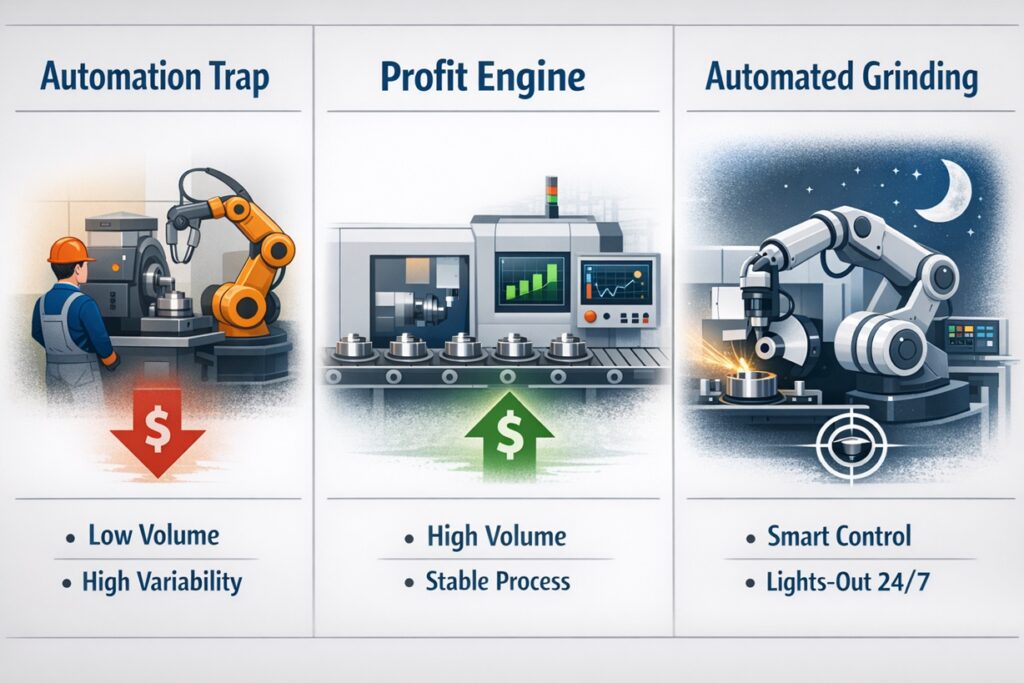
The Smart Axiom: “In a modern precision environment, what cannot be measured cannot be managed. Sensors are not a luxury; they are the fundamental data infrastructure required to survive in a zero-defect marketplace. Profit begins with awareness.”
2. The Primary Sensor Array: Capabilities and Implementation Costs
Building a “Smart” grinding process begins with selecting the right hardware. Not all sensors are created equal; while some provide a broad overview of machine health, others offer a surgical look into the metallurgical state of the workpiece. To optimize your investment, you must match the Sampling Frequency (fs) and sensitivity of the sensor to the specific failure modes of your production line.
Acoustic Emission (AE): The “Micro-Contact” Specialist
Acoustic Emission (AE) sensors detect high-frequency stress waves generated by the interaction between the abrasive grains and the material. Operating in the 50 kHz to 1 MHz range, AE is the fastest way to detect “First Contact” (gap elimination), which slashes cycle times by up to 20% by reducing “air-grinding.”
Cost vs. Benefit: AE systems are moderately expensive due to the high-speed data processing required. However, for Dressing Control, they are indispensable. They can detect the exact moment a wheel is “clean,” preventing over-dressing and extending the life of a $10,000 CBN wheel by months.
Spindle Power & Torque: Monitoring the Energy Partition
Monitoring Spindle Power is the most cost-effective sensing strategy. By measuring the current draw, we calculate the Specific Grinding Energy (us). A sudden spike in power indicates that the wheel is “glazing” or loading with metal chips, which directly leads to thermal damage.
Cost vs. Benefit: Low CAPEX. Most modern CNCs have built-in power monitoring. The benefit is found in “Crash Protection” and identifying macro-level process drift before it causes catastrophic machine failure.
Vibration & Accelerometers: Fighting Chatter
Vibration sensors (Accelerometers) monitor the structural harmonics of the machine. They are essential for identifying Chatter—low-frequency instabilities that create visible “waves” on the part surface.
Cost vs. Benefit: Affordable and easy to integrate. The primary benefit is the stabilization of Surface Finish (Ra) and the protection of spindle bearings, which reduces long-term maintenance OPEX.
Thermal Sensors: The Heat Flux Guard
Thermal sensors, including infrared pyrometers or embedded thermocouples, track the temperature at the grinding interface. Since Grinding Burn is a thermal event, these sensors provide the most direct correlation to metallurgical integrity.
Cost vs. Benefit: High CAPEX and high integration difficulty due to the harsh environment (coolant mist). However, in aerospace applications, the benefit is the total avoidance of scrap for parts that may have an accumulated value of over $50,000.
The Hardware Insight: “You don’t need every sensor for every machine. The secret to a high ROI is deploying ‘Precision Sensing’ where the scrap risk is highest, and ‘Macro Sensing’ where the machine protection is the priority.”
3. Benefit 1: Scrap Reduction and Quality Assurance
In high-precision grinding, the “Cost of Quality” is often the largest variable in the profit-and-loss statement. Traditional manufacturing relies on post-process inspection—a method that essentially catalogs failures after they have occurred. Sensor-Based Monitoring flips this paradigm by providing real-time Quality Assurance (QA). By monitoring the physics of the cut as it happens, sensors act as a digital gatekeeper, ensuring that only parts meeting the “Invisible Specification” of metallurgical integrity proceed to the next stage of assembly.
Predictive Burn Detection: Intercepting Thermal Drift
The most destructive defect in grinding is Grinding Burn. Since burn is a thermal event caused by excessive Specific Energy (us), it is often undetectable by physical gauging. A part can be dimensionally perfect but metallurgical “scrap.”
Power and Acoustic Emission (AE) sensors detect the subtle increase in friction and heat flux that precedes a burn event. When the power signature deviates from the Golden Curve (the signature of a perfect part), the system can trigger an immediate feed-rate reduction or a “Retract” command. This Active Interception prevents a localized soft spot from becoming a batch-wide failure, directly preserving the yield of high-value components.
Shifting from 100% Inspection to Statistical Confidence
Manual inspection is expensive, slow, and prone to human error. When a process is monitored by sensors, every part is essentially “inspected” during the grinding cycle. By logging the Process Fingerprint (vibration, power, and AE peaks) for every serial number, manufacturers can implement Exception-Based Inspection.
Only parts whose data signatures fall outside the established 6σ control limits are sent for manual CMM or Nital Etch testing. This reduces the laboratory workload by up to 80% and slashes the lead time from grinding to shipping. The ROI here is realized in the form of reduced labor overhead and lower Work-in-Process (WIP) inventory.
Protecting the Accumulated Value
Grinding is the “Final Arbiter.” A part reaching the grinder has already incurred costs from material, forging, turning, and heat treatment. If that part is scrapped at the grinding stage, 100% of that Accumulated Value is lost. Sensor integration is, therefore, a Value-Protection Strategy. For a $5,000 aerospace component, preventing just four scrap parts per year pays for a sophisticated $20,000 sensor array. In this context, the sensor is not an expense; it is an asset-protection tool.
The Quality Axiom: “The most profitable part is the one you only make once. Sensors transform quality from a ‘hope’ into a ‘calculation,’ ensuring that your yield is a reflection of your data, not your luck.”
4. Benefit 2: Tool Life and Dressing Optimization
In precision grinding, the abrasive wheel is not just a tool; it is a significant Operational Expense (OPEX). Traditional manufacturing relies on “Conservative Dressing”—reshaping the wheel at fixed time intervals to ensure it remains sharp. However, this often results in the premature removal of perfectly good abrasive material. Sensor-Based Optimization allows for “Dressing on Demand,” ensuring that the wheel is only conditioned when the physics of the process—not the clock—demands it.
Transitioning to “Dressing on Demand”
By utilizing Acoustic Emission (AE) and Spindle Power monitoring, the system can track the “Dullness Index” of the wheel. As the abrasive grains glaze or the bond becomes loaded with chips, the friction increases, causing a specific power signature shift.
Instead of dressing every 10 parts (a typical manual safety buffer), the sensors might reveal that the wheel remains capable for 15 or 20 parts under current conditions. This extension directly reduces the consumption of the wheel. For a facility running multiple shifts, extending wheel life by 30% through sensor-driven dressing can save tens of thousands of dollars annually in abrasive costs alone.
Superabrasive Longevity: Protecting CBN and Diamond Assets
High-performance wheels (CBN/Diamond) are precision assets that can cost over $10,000 each. The greatest risk to their Return on Investment (ROI) is “Over-Dressing.” An AE sensor can detect the exact micron at which the dresser makes contact with the wheel and the exact moment the wheel profile is restored.
By preventing “Air Dressing” and minimizing the depth of the dress to only what is necessary, sensors stabilize the G-Ratio (the volume of material removed relative to the volume of wheel wear). This precision ensures that every millimeter of the expensive superabrasive layer is used for productive grinding rather than being turned into dust by the dresser.
Minimizing Downtime and Setup Variations
Every dressing cycle is a non-productive event that stops the machine. By optimizing dressing frequency, sensors increase the machine’s Availability. Furthermore, because the dressing is triggered by actual wheel condition, the “Setup Variation” between different wheels or batches is neutralized. The result is a more predictable Cpk and a more streamlined production flow.
The Tooling Axiom: “In high-precision grinding, the clock is the enemy of efficiency. Dressing should be a response to the material, not a habit of the operator. When you dress only when necessary, your profit is measured in the microns of abrasive you didn’t waste.”
5. The Cost Side: Hardware, Integration, and Data Debt
While the benefits of sensor-based monitoring are technically undeniable, the Return on Investment (ROI) is often threatened by a narrow focus on sensor hardware costs. To build a sustainable financial model, manufacturers must account for the Total Cost of Ownership (TCO), which includes the physical sensors, the high-speed data acquisition (DAQ) infrastructure, and the often-overlooked cost of Data Debt—the resources required to process and store high-frequency grinding signatures.
CAPEX Breakdown: Hardware vs. Integration
In a typical Level 2 sensing project, the sensors themselves (AE, Accelerometers, Power transducers) usually represent less than 40% of the initial Capital Expenditure (CAPEX). The majority of the cost is consumed by the Integration Handshake. Connecting a third-party sensor system to a legacy CNC requires specialized software engineering to allow for Active Compensation—where the sensor signal can actually stop the machine or modify the feed rate in real-time. Without this integration, a sensor is merely a “data logger,” failing to provide the proactive protection required for high yield.
The “Data Debt” Paradox
High-frequency monitoring generates massive volumes of data. An AE sensor sampling at 1 MHz produces 1,000,000 data points every second. This creates the Data Debt Paradox: the more data you collect to increase Cpk, the more you spend on high-speed processors, industrial servers, and cybersecurity.
To mitigate this, efficient systems utilize Edge Computing—processing the raw signals locally on the machine and only uploading the “Critical Features” (e.g., peak power, RMS of vibration) to the cloud. Managing this data architecture is a significant, recurring operational expense (OPEX) that must be factored into the ROI calculation.
Calibration and Maintenance OPEX
Sensors in a grinding machine operate in one of the world’s harshest industrial environments. High-pressure coolant, metallic grit, and extreme temperature fluctuations cause Sensor Drift. To maintain the accuracy of your “Golden Curve,” sensors require semi-annual calibration and hardware replacement. If the maintenance of the sensors is neglected, the “Smart” system will begin providing false positives or, worse, miss a burn event entirely, rendering the initial investment worthless.
The Financial Axiom: “Don’t buy a sensor if you aren’t prepared to buy the logic. A sensor without CNC integration is just an observer; a sensor with integration is a defender of your margin. Invest in the bridge, not just the hardware.”
6. Implementation Strategy: The “Minimum Viable Sensing” Roadmap
To avoid the “Complexity Trap,” manufacturers should not attempt to monitor every variable simultaneously. A successful Smart Process transition follows a tiered roadmap, where each level of sensing maturity pays for the next. By starting with Minimum Viable Sensing (MVS), you can capture the “Low-Hanging Fruit” of process optimization—such as crash prevention and basic cycle time reduction—before committing to the high-CAPEX world of multi-physics Digital Twins.
Level 1: Macro-Sensing (The Foundation)
Level 1 focuses on Internal CNC Signals—primarily spindle and axis power. This level requires zero additional hardware and offers an immediate ROI through Crash Protection. By setting simple power “Envelopes,” the machine can automatically E-stop if the load exceeds a safety threshold (e.g., if a part is loaded incorrectly).
Strategic Goal: Asset Protection. Eliminate high-cost spindle repairs and catastrophic machine downtime.
Level 2: Precision-Sensing (The Yield Protector)
Level 2 involves the integration of external Acoustic Emission (AE) and Vibration Sensors. This is where the Cpk is stabilized. AE sensors are used for “Gap Elimination” (reducing air-grinding) and “Dressing Verification,” while vibration sensors monitor Ra consistency.
Strategic Goal: Yield Optimization. Shift from time-based dressing to condition-based dressing and reduce cycle times by 10-15%.
Level 3: Cognitive-Sensing (The Zero-Defect State)
Level 3 is the pinnacle of the Smart Factory, integrating multi-modal data into a Real-time Digital Twin. This level includes thermal flux tracking and AI-driven “Edge Analytics” that predict subsurface metallurgical damage. At this stage, the sensor data is no longer just monitored; it is used for Autonomous Process Correction.
Strategic Goal: Total Integrity. Eliminate the need for post-process NDT (Non-Destructive Testing) and achieve 100% metallurgical compliance in critical aerospace or medical components.
The Roadmap Axiom: “Don’t try to solve Level 3 problems with Level 1 data, and don’t spend Level 3 money on Level 1 tasks. A phased rollout ensures that your sensing capability grows alongside your data literacy and your profit.”
7. ROI Calculation: Determining the Payback Period
To justify the integration of advanced sensors to executive stakeholders, the technical benefits must be translated into hard currency. In the precision grinding world, the ROI is rarely found in a single metric; rather, it is the Cumulative Savings across three primary financial buckets: Scrap Reduction, Abrasive Optimization, and Machine Availability. By applying a standard Payback Period model, we can determine the exact point at which the sensing system transitions from a capital expense to a pure profit generator.
The Total Annual Savings Formula (Stotal)
The ROI model begins by calculating the Total Annual Savings (Stotal). This is the sum of the following four variables:
- Sscrap: (Annual Volume) × (Scrap Rate Reduction %) × (Cost per Part).
- Sabrasive: (Annual Wheel Spend) × (Dressing Efficiency Improvement %).
- Suptime: (Increased Production Hours) × (Machine Hourly Burden Rate).
- Scrash: (Avg. Spindle Repair Cost) × (Crashes Prevented per Year).
The Payback Period (PBP) Model
The Payback Period (PBP) tells us how many years or months it takes for the savings to equal the initial CAPEX and ongoing OPEX. In precision industries, an PBP of less than 12 months is considered “Excellent,” while 12–24 months is “Standard” for strategic smart manufacturing projects.
For example, a $30,000 Acoustic Emission system that saves 1 part per week (valued at $800 each) in an aerospace line generates $41,600 in annual scrap savings alone. Including tool life gains, the payback is realized in less than 9 months.
Sensitivity to “Yield Gaps”
The ROI is most sensitive to the Value Density of the parts. In high-volume, low-cost commodity grinding, the ROI may be driven by Suptime (seconds saved per part). In low-volume, high-value aerospace grinding, the ROI is driven almost exclusively by Sscrap. Understanding where your “Yield Gap” lies allows you to focus your sensing investment on the variable that recovers the CAPEX the fastest.
The Payback Axiom: “In precision grinding, the most expensive sensor is the one you didn’t buy. The cost of a single missed ‘Burn’ event or a catastrophic spindle crash is almost always higher than the CAPEX of the monitoring system itself.”
8. Conclusion: Strategic Selection Framework
Sensor-based monitoring is no longer an optional “add-on” for high-precision grinding; it is the Digital Foundation required to compete in a zero-defect manufacturing landscape. However, as this cost-benefit analysis has demonstrated, the goal is not to maximize the number of sensors, but to maximize the Actionable Intelligence they provide. A successful implementation requires a strategic alignment between the physical failure modes of the process and the data-driven defensive layers of the monitoring system.
The “Smart Process” Decision Checklist
Before authorizing the CAPEX for a monitoring project, leadership should evaluate the process against these four strategic criteria:
- Yield Risk: Does the cost of a single metallurgical defect (burn) exceed 10% of the sensor system cost? If yes, Level 2/3 Sensing is mandatory.
- Tooling Density: Are you utilizing expensive superabrasives (CBN/Diamond)? If yes, AE-based Dressing Control offers a sub-12-month payback.
- Integration Path: Is the CNC architecture capable of real-time “Active Compensation”? If not, the sensor remains a passive observer with limited ROI.
- Data Maturity: Does the shop floor have the engineering capacity to act on the “Golden Curve” data? If no, start with Level 1 Macro-monitoring.
The Final Verdict: Defending the Margin
In the final analysis, sensors pay off because they convert Process Uncertainty into Financial Predictability. By stabilizing the Cpk and extending tool life, sensors allow a factory to bid on more complex, high-margin contracts with total confidence. The transition from “Blind” to “Aware” is not just a technological upgrade; it is a fundamental shift toward a more profitable, resilient manufacturing business model.
The Final Proclamation: “Sensors do not just provide data; they provide peace of mind. In a world where a single micron or a single thermal event can erase a day’s profit, being able to ‘see’ inside the grinding zone is the only way to guarantee the future of your factory. The cost of knowing is high, but the cost of not knowing is terminal.”
References & Internal Technical Resources
Primary Engineering References
- • Teti, R., et al. (2010). Advanced Monitoring of Machining Operations. CIRP Annals. (Focus: Acoustic Emission and Multi-Sensor Fusion in Grinding).
- • Inasaki, I. (2001). Application of Sensors for Grinding Processes. Workshop on Monitoring and Control of Machining. (Focus: Real-time Burn Detection and Wheel Condition Monitoring).
- • Gawlik, J., et al. (2023). Smart Manufacturing: Sensors and Diagnostics in Precision Engineering. Springer. (Focus: Data Acquisition and Digital Signal Processing for Smart Grinding).
Internal Deep-Dive Series: Smart Process Monitoring
To technically implement the AE sensing, vibration analysis, and condition-based dressing strategies detailed in this report, please refer to the following core modules: