1. Introduction: The Automation Trap vs. The Profit Engine
In the era of “Industry 4.0,” the pressure to automate precision grinding operations has never been higher. From robotic arm loading to AI-driven process compensation, the technology promises a future of “lights-out” manufacturing and infinite scalability. However, many manufacturers fall into the Automation Trap: investing heavily in complex robotics for processes that are inherently unstable or low-volume, leading to a “Negative ROI” where the Capital Expenditure (CAPEX) is never recovered. To succeed, automation must be viewed not as a trend, but as a surgical Investment Decision designed to expand profit margins.
Defining the Strategic Filter
The primary question is not can we automate, but should we? Automation pays off when it solves a specific constraint in the value chain. In grinding, these constraints typically fall into three categories:
- Labor Scarcity: The inability to find or retain skilled operators for repetitive, high-precision tasks.
- Process Variability: Human-induced inconsistencies that cause the Cpk to drift, leading to expensive final-stage scrap.
- Throughput Bottlenecks: Machines that sit idle during lunch breaks, shift changes, and overnight hours.
The Concept of “Smart Automation”
Smart Automation is the integration of physical handling with digital intelligence. It is the difference between a robot that simply moves parts and a system that monitors Acoustic Emission (AE) and adjusts wheel offsets autonomously. This report will analyze the tipping points where these technologies transition from being an overhead cost to a Profit Engine. By the end of this analysis, you will have a quantitative framework to judge if your next $500,000 should go into a robotic cell or toward optimizing your existing manual process.
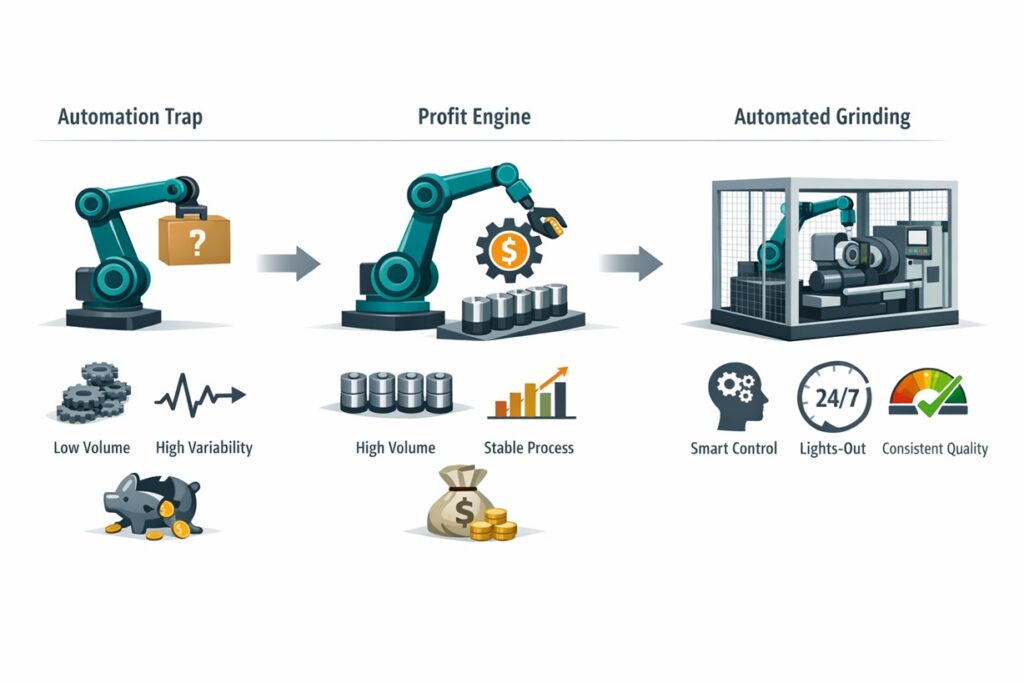
The Executive Axiom: “Automation is not a solution for a broken process; it is an accelerant for a stable one. If your process is out of control manually, automation will only produce scrap at a higher velocity. Profit begins with stability.”
2. The Hidden Costs of Manual Grinding: Quantifying the Baseline
To calculate a meaningful Return on Investment (ROI) for automation, one must first establish a rigorous baseline of the manual process. Most manufacturers make the mistake of only considering direct hourly wages when evaluating labor costs. In the precision grinding industry, however, the “true cost” of manual operation is buried in secondary variables: the Labor Burden Rate, the cost of skilled operator turnover, and the financial erosion caused by human variability. Without quantifying these hidden costs, any ROI calculation will be fundamentally flawed, often making automation appear more expensive than it truly is.
The True Labor Burden Rate
The Labor Burden Rate is the actual hourly cost of an employee to the business, which can be 1.5 to 2.5 times the base hourly wage. For a specialized grinding operator, this includes payroll taxes, healthcare, pension contributions, and mandatory safety training. Furthermore, the Recruitment and Training Cost for a high-precision grinder is exceptionally high; it often takes 6 to 12 months for a new hire to master the nuances of thermal stabilization and dressing compensation. When an experienced operator leaves, the “Institutional Knowledge Loss” represents a massive, unbooked financial hit to the company’s bottom line.
The Fatigue Factor and Cpk Degradation
Unlike a robotic arm, a human operator’s performance is non-linear. Studies in industrial ergonomics show that toward the end of an 8-hour shift, the “Human Standard Deviation” increases. In manual grinding, this manifests as Inconsistent Loading/Unloading and delayed offset adjustments.
While a machine might remain mechanically capable of a Cpk > 1.66, human-induced variability often pushes the actual performance down to Cpk ≈ 1.0 or lower during the late hours of a shift. This shift in the distribution curve increases the probability of producing parts near the tolerance limits, necessitating 100% inspection—a massive hidden overhead cost that automation effectively eliminates.
Quality Debt and Final-Stage Scrap
Grinding is almost always the final operation in the value chain. By the time a part reaches the grinder, it has accumulated costs from raw material, forging, and heat treatment. A manual error at this stage—such as improper part seating or a missed dressing cycle—results in the Total Loss of Accumulated Value.
This “Quality Debt” is the silent killer of manual profitability. If a manual process has a 2% scrap rate and an automated cell reduces it to 0.1%, the savings on high-value components (e.g., aerospace turbine shafts) can easily justify the CAPEX of the automation within the first year. In this context, automation is not just replacing a person; it is protecting the investment made in every previous production step.
The Baseline Principle: “You cannot judge the cost of a robot until you truly know the cost of a human. In precision grinding, the most expensive labor is not the one with the highest wage, but the one with the highest variability. Automation is the purchase of consistency.”
3. Levels of Grinding Automation: Mapping the Investment
Grinding automation is not a monolithic “all-or-nothing” proposition. To achieve a successful Return on Investment (ROI), a manufacturer must select the level of automation that aligns with their specific production volume, part complexity, and tolerance requirements. Over-automating a simple process leads to wasted CAPEX, while under-automating a complex one results in continued quality instability. We categorize grinding automation into three distinct levels, each representing a different leap in capital intensity and operational capability.
Level 1: Kinematic Automation (Part Handling)
Level 1 automation focuses on the physical movement of workpieces—loading and unloading. This is the most common entry point for automation, typically involving a 6-axis robot or a gantry loader. The primary goal here is to maximize Spindle Utilization by eliminating the idle time between cycles and enabling “unattended” operation during breaks or third shifts.
Investment at this level is relatively straightforward and offers the fastest payback for high-volume, low-mix environments. However, it is important to note that Level 1 does not improve the quality of the grind itself; it simply ensures the machine is always running. If the process is thermally unstable, Level 1 automation will merely produce scrap parts more consistently.
Level 2: Metrological Automation (Closed-Loop Compensation)
Level 2 represents a shift from “moving parts” to “managing data.” At this stage, In-process Gauging and post-process measurement stations are integrated into the robotic cell. The system measures the finished part and automatically feeds Offset Data back to the CNC controller to compensate for wheel wear or thermal drift.
This level of automation directly improves the Cpk by narrowing the process distribution. It eliminates the “Human Measurement Error” and ensures that the process mean (μ) remains perfectly centered within the tolerance limits. For industries like EV gear manufacturing or medical device components, Level 2 is often where the most significant ROI is realized through the drastic reduction of scrap and rework.
Level 3: Cognitive Automation (Full Process Autonomy)
The pinnacle of automation is Level 3, where the system makes intelligent decisions based on multi-physics data. This involves Acoustic Emission (AE) monitoring, power signature analysis, and Digital Twins. A Level 3 system doesn’t just compensate for size; it detects when the wheel is dulling, predicts a “burn” event before it happens, and triggers a self-correcting dressing cycle.
Level 3 requires a massive CAPEX investment in sensors, software integration, and high-performance computing. The ROI at this level is not found in labor savings alone, but in the total elimination of Quality Debt and the ability to machine extremely difficult materials (like Inconel or technical ceramics) with 100% confidence. This is the domain of “Smart Factories” where the machine effectively acts as its own engineer.
The Investment Axiom: “Don’t buy a Level 3 brain for a Level 1 task. Mapping your automation needs ensures that every dollar of CAPEX is targeted at your most expensive process bottleneck. ROI is found where technology meets necessity.”
4. The Productivity Multiplier: OEE and Utilization
The most common mistake when evaluating the ROI of grinding automation is focusing solely on individual part cycle times. However, the true financial value of automation lies in the dramatic escalation of OEE (Overall Equipment Effectiveness). In a manual process, machine utilization is restricted by human biological factors—lunch breaks, shift changes, and cognitive fatigue. An automated cell transcends these limits, maximizing the total value extracted from the equipment over its economic life and accelerating the recovery of capital.
The Vanishing of Non-Productive Time: From 8 to 24 Hours
In a manual grinding environment, the actual “spindle-on” time typically plateaus at 60–70% of theoretical capacity. Human-related downtime—such as breaks and shift handovers—results in 2 to 3 hours of lost production every day. Automation, specifically robotic part handling, enables “Lights-out Manufacturing.”
By adding an unsupervised third shift (8 hours of “lights-out” operation), a manufacturer gains over 2,000 additional production hours per year without increasing facility overhead. This is a powerful financial lever that can slash the Amortization Period of a machine from 5 years to under 3 years. When a high-value asset operates around the clock, the fixed cost per minute drops significantly, causing the net profit margin per part to rise exponentially.
Synchronization of Performance and Quality
OEE is built on three pillars: Availability, Performance, and Quality. Automation addresses all three simultaneously. Manual loading introduces microscopic variations in the Load-to-Load Time, creating bottlenecks in the downstream assembly. An automated handling system guarantees a consistent cycle time, ensuring predictable throughput and supporting Just-In-Time (JIT) logistics.
Furthermore, automated dressing and compensation logic allow the machine to run at peak speeds without the “safety buffer” often applied by human operators. By maintaining a deterministic cutting environment, automation achieves a higher Quality Rate alongside higher speeds, eliminating the traditional trade-off between velocity and precision.
The Setup Time Paradox in HMLV Environments
Automation does not guarantee ROI in every scenario. In HMLV (High-Mix, Low-Volume) environments, frequent changeovers can become a “hidden” drain on OEE. If the time required to change robotic grippers and update software exceeds the actual grinding time, the ROI will collapse. Therefore, true financial viability in flexible manufacturing requires Quick-Change Tooling and intuitive programming interfaces to be designed into the automation cell from day one.
The Utilization Axiom: “A machine becomes cheaper every second it is running. The ROI of automation is found not by cutting wages, but by reclaiming the thousands of hours that a manual machine spends in forced idleness.”
5. Quality as a Financial Asset: Reducing the CONC
In the financial modeling of grinding automation, “Quality” is often treated as a binary outcome—pass or fail. However, from an investment perspective, quality is a dynamic asset that directly dictates the Cost of Non-Conformance (CONC). In precision grinding, which usually occurs at the very end of the production value chain, a single quality failure represents the total loss of all accumulated labor, material, and energy from every previous step. Automation pays off by acting as a Financial Insurance Policy, narrowing the variance of the process to ensure that this accumulated value is never discarded.
Consistency is Profit: Narrowing the 6σ Band
Manual processes are susceptible to “operator bias”—the tendency for different workers to apply offsets differently or react to tool wear with varying degrees of aggression. This inconsistency widens the Standard Deviation (σ) of the process. Even if the parts remain “within tolerance,” they occupy a wider distribution, increasing the risk of boundary failures.
Automation utilizes Deterministic Logic. Whether it is the first part of the morning or the last part of a midnight shift, the automated dressing and compensation cycles occur at the exact same physical triggers. By narrowing the 6σ band, automation increases the Cpk, pushing the process toward a “Zero-Defect” state. The ROI here is found in the elimination of 100% inspection costs and the reduction of internal rework, which can account for up to 15% of total operating costs in manual shops.
Eliminating the “Ghost Scrap” of Human Error
A significant portion of grinding scrap is not caused by machine failure, but by Handling Errors: parts seated incorrectly in the fixture, debris on the centers, or improper clamping force. These are “Ghost Defects”—they appear randomly and are difficult to trace.
Automated robotic loading includes Sensing and Validation. Integrated sensors can verify part orientation, detect the presence of chips on the fixture via air-gap sensing, and ensure uniform clamping pressure every time. By removing the “human touch” from the interface, the manufacturer eliminates the random variables that plague manual production. For high-value components like aerospace gears or medical implants, reducing the scrap rate from 2% to 0.1% can yield savings that pay for the robotic integration in mere months.
Data Traceability and Liability Protection
In modern manufacturing, data is a form of currency. Automated cells automatically log every offset, every dressing cycle, and every gauging result for every individual serial number. This Digital Birth Certificate is an invaluable financial asset. In the event of a field failure, this data provides the traceability required to prove process compliance, potentially saving millions in liability and warranty claims. This “Risk Mitigation ROI” is often overlooked but remains a primary driver for automation in high-stakes industries.
The Asset Axiom: “In grinding, the most expensive part is the one you have to make twice. Automation pays off not just by moving faster, but by ensuring you never have to move backward.”
6. Breaking Down the CAPEX: Hardware, Integration, and Software
A frequent cause of project failure is the underestimation of the “True CAPEX.” Many decision-makers look at the price tag of a 6-axis robotic arm and assume that represents the bulk of the investment. In precision grinding, the robot is merely the Kinematic Utility; the real value—and the real cost—lies in the integration of that utility with the machine’s CNC, the custom end-effectors, and the sensing logic. Understanding this cost distribution is critical to avoiding Scope Creep and ensuring that the final ROI is not eroded by unforeseen technical debt.
The 30/70 Rule of Automation Investment
In a typical automated grinding cell, the Hardware (The Robot) usually accounts for only 30% of the total project cost. The remaining 70% is consumed by Systems Integration. This includes:
- Custom End-Effectors (Grippers): Precision-engineered fingers designed to handle abrasive-covered parts without marring or slipping.
- Safety Guarding & PLC Interlocking: Structural enclosures and light curtains required for OSHA/ISO compliance.
- CNC/Robot Handshake: The complex software bridge that allows the machine and the robot to communicate status signals (e.g., “Door Open,” “Cycle Complete,” “E-Stop”).
The Cost of Precision: Metrology Integration
If the goal is Level 2 automation (Closed-Loop Compensation), the CAPEX increases significantly due to the inclusion of Automated Metrology Stations. These stations must be environmentally isolated to prevent grinding mist from interfering with laser or tactile probes. Integrating a metrology station requires specialized software algorithms that translate measurement data into CNC Offset Commands. While this adds 20-30% to the initial CAPEX, it is the primary driver for narrowing the process σ and is the source of the highest long-term ROI.
Software and Lifecycle OPEX
CAPEX doesn’t end at commissioning. A sophisticated automated cell requires a Software Maintenance Plan and specialized training for the internal maintenance team. Sensors (like AE or laser probes) are consumables that drift over time and require recalibration. Failing to account for these recurring costs in the initial ROI model is a major financial risk. To protect the investment, the budget must include a “Year 1 Stabilization Fund” to fine-tune the automation logic as the process reaches its production steady-state.
The CAPEX Axiom: “The cheapest robot is often the most expensive to integrate. When selecting an automation partner, buy the solution, not the hardware. The engineering that connects the robot to the grind is where the profit is made.”
7. The Break-Even Calculation: A Quantitative Framework
The final stage of an automation feasibility study is the Financial Stress Test. To move from a “good idea” to a “board-approved project,” the technical benefits must be translated into a timeline for capital recovery. In precision grinding, this calculation must account for more than just labor replacement; it must include the Productivity Gain from lights-out operation and the Scrap Reduction from Cpk stabilization. Without a multi-variable break-even model, the true ROI of a robotic cell remains hidden in the noise of the balance sheet.
Calculating the Volume Threshold (Qmin)
The most critical metric for any automation project is the Volume Threshold (Qmin)—the minimum annual production quantity required to cover the increased fixed costs of the automated cell. This is calculated by comparing the unit cost of manual production (Cm) against the unit cost of automated production (Ca), including the amortization of the CAPEX.
In high-precision grinding, the “Scrap Savings” often outweighs the “Labor Savings.” If automation reduces the rejection rate of a $400 part from 3% to 0.5%, that $10 per part saving significantly lowers the Qmin, making automation viable even for mid-volume production runs that would otherwise be considered too small for robotics.
Net Present Value (NPV) and the Time Value of Money
While “Simple Payback” (Total Cost / Annual Savings) is easy to calculate, it ignores the Time Value of Money. For a 5-to-10-year automation project, Net Present Value (NPV) is the superior metric. NPV accounts for the fact that a dollar saved in year 5 is worth less than a dollar spent today.
A positive NPV indicates that the automation project will generate more value than the company’s internal Hurdle Rate (typically 10-15%). If the NPV is negative, the investment should be rejected or restructured—even if the payback period is relatively short. This prevents the firm from tying up capital in projects that don’t beat the baseline cost of capital.
Sensitivity Analysis: The “What-If” Scenarios
No financial model is perfect. To protect the investment, a Sensitivity Analysis must be performed on two key variables:
- Volume Variance: What happens to the ROI if the customer reduces their order by 25%?
- Maintenance OPEX: What happens if the integration requires 2x more technical support than originally budgeted?
A “Robust ROI” is one that remains positive even under pessimistic conditions. Automation should only be green-lit if the break-even volume (Qmin) is at least 30% below the forecasted production demand.
The Quantitative Axiom: “In the absence of data, everyone has an opinion. In the presence of a Net Present Value model, everyone has a roadmap. The numbers don’t lie; they simply reveal if your process is ready for the leap.”
8. Conclusion: The Strategic Selection Matrix
The journey from manual grinding to an automated cell is a transition from Human-Centric Craftsmanship to Data-Driven Industrialization. As this report has detailed, the decision to automate is not merely about replacing labor; it is about reclaiming lost capacity, stabilizing quality assets, and protecting the accumulated value of high-precision components. However, automation is a “profit multiplier” only when applied to a stable, high-volume baseline. For low-volume, high-mix shops, the flexibility of a skilled human operator remains an unmatched competitive advantage.
The Final Decision Matrix: Go vs. No-Go
To finalize the investment decision, leadership must evaluate their operation against the Strategic Selection Matrix. This framework weighs the four critical pillars of ROI:
- Market Certainty: Do you have a guaranteed production volume (Q) for at least 3 years to cover the NPV-calculated payback period?
- Process Stability: Is your current manual grinding process under control (Cpk > 1.33)? If not, automation will only accelerate scrap production.
- Technical Readiness: Does your facility have the engineering depth to maintain robotic systems and manage the software-driven “Handshake” between devices?
- Value Density: Is the part high-value? The higher the accumulated cost of the workpiece, the faster the ROI through scrap reduction.
The Future: From Automation to Autonomy
The next frontier of grinding is Self-Optimizing Autonomy. Future investments will shift from Level 1 (moving parts) toward Level 3 (predictive intelligence). Manufacturers who successfully integrate automation today are building the data infrastructure required to leverage Digital Twins and AI-driven compensation tomorrow. In this context, automation is not just a tactical cost-saving move; it is a strategic requirement for surviving in a zero-defect global marketplace.
Final Proclamation: “Automation does not pay off because it is ‘modern’; it pays off when it is ‘mathematical.’ The most successful investors in grinding technology are those who prioritize process stability first and robotic speed second. True ROI is the result of removing the variance, not just the operator.”
References & Internal Technical Resources
Primary Engineering References
- • Groover, M. P. (2019). Automation, Production Systems, and Computer-Integrated Manufacturing. Pearson. (Focus: ROI Modeling and OEE Optimization).
- • Altintas, Y. (2012). Manufacturing Automation: Metal Cutting Mechanics, Machine Tool Vibrations, and CNC Design. Cambridge University Press. (Focus: Automated Compensation Logic).
- • International Federation of Robotics (IFR). (2025). World Robotics Report: Service Robots and Industrial Integration. (Focus: Labor Burden and Automation Payback Trends).
Internal Deep-Dive Series: Automation & Investment Strategy
To technically implement the robotic cells, closed-loop compensation, and lights-out strategies detailed in this report, please refer to the following core modules: