1. Introduction: The Silent Profit Killer in Precision Grinding
In the ultra-competitive landscape of high-precision manufacturing, the Metalworking Fluid (MWF), commonly referred to as coolant, is the functional equivalent of the “Lifeblood” of the grinding machine. It is the primary medium responsible for heat evacuation, lubricity at the grinding interface, and the mechanical transport of metallic swarf. However, a profound Strategic Disconnect exists in most machine shops: while millions are invested in 5-axis CNC grinders and high-end superabrasives, the coolant system is often relegated to a low-priority utility. This neglect transforms the coolant into a Silent Profit Killer, where the cost of filtration failure manifests not as a single line item, but as a pervasive erosion of the entire facility’s Overall Equipment Effectiveness (OEE).
The Economics of the “Coolant Debt”
Most financial controllers view coolant expenses through a narrow Procurement Lens—focusing solely on the cost per liter of concentrate and the immediate labor for tank refills. This limited perspective ignores the Hidden Operational Debt incurred by recirculating contaminated fluid. When a filtration system fails to remove microscopic fines (typically those in the 1 to 15 μm range), the coolant effectively transforms into an Abrasive Slurry.
This “contaminated lifeblood” initiates a destructive feedback loop that attacks the factory’s bottom line in three critical dimensions:
- Instantaneous Quality Loss: Recirculating swarf causes microscopic “comet tails” and surface scratches, leading to immediate rejection of parts due to Surface Roughness (Ra) violations.
- Accelerated Asset Depreciation: Suspended particles act as a grinding medium against the machine’s internal components, leading to premature failure of high-pressure pump seals, spindle bearings, and way-covers.
- Thermodynamic Inefficiency: As oil-to-water ratios drift and contaminants accumulate, the fluid’s Convective Heat Transfer Coefficient (h) drops significantly. This increases the risk of Grinding Burn, effectively shrinking the safe Process Window.
Quantifying the Cost of Quality (COQ) Failure
The true financial impact of an overlooked coolant maintenance program can be modeled through the Cost of Quality (COQ) framework. When a facility saves $10,000 by delaying a filter change or opting for a lower-grade magnetic separator, they are often unknowingly inviting $100,000 in External and Internal Failure Costs. For example, a single batch of precision gears rejected due to bacterial rancidity or pHsub-induced corrosion represents the loss of all cumulative value added in previous turning, milling, and heat-treatment steps. In this context, the coolant is not a consumable; it is a Quality Safeguard.
The Goal of Strategic Coolant Filtration
The objective of this comprehensive analysis is to provide a Financial and Engineering Roadmap for quantifying and mitigating these overlooked expenses. We will move beyond the superficial metrics of fluid procurement and delve into the microscopic interactions between contaminated MWF and grinding kinematics. By implementing advanced Centrifugal Separation or Vacuum Micro-filtration, a facility can achieve a “Steady State” where the coolant remains chemically and physically stable for years, rather than months.
Executive Axiom: “In high-volume grinding, you do not pay for the filtration system you buy; you pay for the one you didn’t buy through every scrap part, every premature wheel change, and every hour of lost spindle time. Clean coolant is the foundation of high-margin manufacturing.”
In the subsequent chapter, we will explore the Physics of Contamination, examining how recirculating fines dictate the friction coefficient at the contact zone and fundamentally alter the surface integrity of the workpiece.
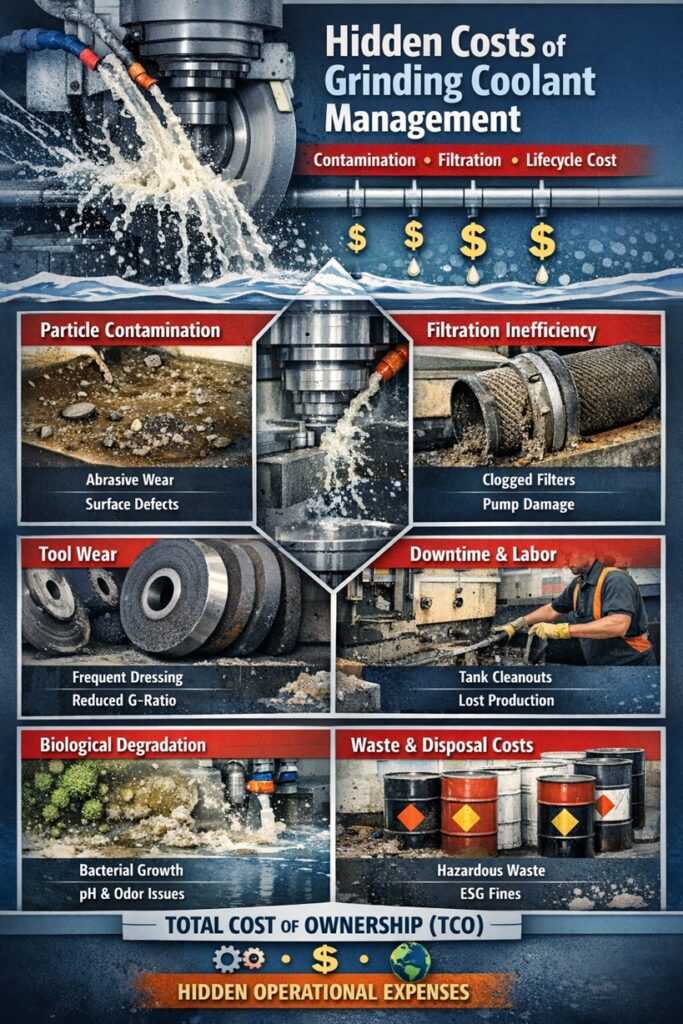
2. The Impact of Particle Contamination on Grinding Physics
To understand the Hidden OPEX of poor coolant maintenance, one must first analyze the microscopic interactions within the Grinding Contact Zone. Grinding is a high-energy process where the fluid is expected to maintain a stable lubricating film between the abrasive grains and the workpiece. However, when the coolant is saturated with recirculating swarf and microscopic fines, its fundamental physical properties are compromised. Instead of a clean cooling medium, the fluid becomes a Multi-phase Slurry that actively interferes with the grinding kinematics, leading to increased power consumption and thermal instability.
Swarf Recirculation and Friction Coefficient Expansion
The presence of suspended metallic particles increases the Coefficient of Friction (μ) at the contact interface. In a clean process, the fluid minimizes rubbing between the bond of the wheel and the workpiece. When particles (often hardened steel or ceramic fragments) are trapped in the gap, they induce Three-Body Abrasion. This secondary abrasive action consumes spindle power that does not contribute to material removal, effectively raising the Specific Grinding Energy (us).
From a financial perspective, this friction expansion is a direct waste of energy. A 10% increase in μ due to contamination can result in thousands of dollars in wasted electricity and, more critically, it forces the machine to operate at lower Material Removal Rates (MRR’) to avoid overloading the spindle.
Thermal Barrier: The Degradation of Convective Cooling (h)
The most dangerous physical impact of contamination is the reduction of the Convective Heat Transfer Coefficient (h). Effective cooling depends on the fluid’s ability to wet the surface and rapidly evacuate heat. Suspended fines and “tramp oil” (leaked hydraulic or way oil) create a Thermal Barrier Layer on the workpiece surface.
When the fluid is contaminated, its viscosity increases, and its Thermal Diffusivity (α) decreases. This leads to a phenomenon where heat is “trapped” within the workpiece rather than being carried away by the fluid. Mathematically, this raises the Energy Partition (Rw)—the fraction of total grinding energy that enters the part. A process that was thermally stable at Rw = 60% can quickly shift to Rw = 85% as the coolant becomes “dirty,” triggering Grinding Burn and the associated scrap costs analyzed in previous reports.
Surface Integrity and Ra Degradation
Contaminants also act as “random cutters” that produce uncontrolled scratches on the finished surface. This is particularly critical in mirror-finishing operations where Surface Roughness (Ra) requirements are below 0.1 μm. Micro-fines recirculating at high pressures (often 20-70 bar) act like a sandblasting medium, eroding the precision-ground peaks and valleys.
The Engineer’s Conclusion: “You cannot control a grinding process if you do not control the fluid’s physical consistency. Contamination turns a precision cooling medium into a chaotic abrasive agent, rendering your high-end machine’s control logic useless.”
In the following chapter, we will examine the direct financial consequence of this physical interference: Quantifying Abrasive Tooling Life Reduction and the hidden costs of premature wheel wear.
3. Quantifying Abrasive Tooling Life Reduction: The Cost of Premature Wear
In the financial hierarchy of grinding consumables, the Abrasive Wheel represents the most significant recurring investment. Whether utilizing conventional Aluminum Oxide or high-performance Superabrasives (CBN/Diamond), the economic efficiency of the tool is measured by the G-Ratio—the ratio of the volume of material removed to the volume of wheel wear. However, the presence of recirculating fines and tramp oil in the coolant acts as a primary catalyst for G-Ratio Degradation. When coolant filtration is neglected, the abrasive tool is subjected to artificial wear mechanisms that can shorten its operational life by 30% to 60%, creating a massive and often untracked operational expense.
Wheel Loading and the Dressing Death-Spiral
The most immediate consequence of contaminated coolant is Wheel Loading. Microscopic swarf particles and oil-bound metallic fines become trapped in the chip-pockets (pores) of the wheel. This prevents the abrasive grains from penetrating the workpiece effectively, leading to increased “rubbing” instead of “cutting.”
To restore the wheel’s cutting ability, operators are forced to increase the Dressing Frequency. Each dressing cycle using a diamond dresser removes a layer of expensive abrasive. In a contaminated environment, a wheel that should ideally be dressed once every 50 parts may require dressing every 15 parts. This “Dressing Death-Spiral” significantly accelerates the reduction of the wheel diameter, effectively evaporating the initial Capital Expenditure (CAPEX) of the tool long before its theoretical end-of-life.
The Economics of G-Ratio Erosion
Mathematically, the tool cost per part (Ctool) can be expressed as:
Ctool = (Vw × Cwheel) / (G × Vremoval)
where Cwheel is the wheel cost, Vw is the wear volume, and G is the G-Ratio. When suspended particles in the coolant reach a concentration of just 500 ppm (parts per million), the G-Ratio can drop by as much as 40% due to increased thermal stress and mechanical grain pull-out. For a vitrified CBN wheel costing $15,000, this 40% reduction in G-Ratio represents a Hidden Loss of $6,000 per wheel in unrealized material removal potential.
Collateral Damage to Dressing Tools
It is not just the grinding wheel that suffers; the Diamond Dressing Tool is also a victim of poor coolant maintenance. When the fluid used to cool the diamond dresser is contaminated, the abrasive fines erode the diamond’s matrix and blunt the cutting edges through Micro-chipping. A dull diamond dresser leads to poor wheel topography, which in turn causes grinding burn—a cascade of quality failures all originating from a poorly maintained filtration system.
The Tooling Engineer’s Rule: “The most expensive wheel you can buy is a cheap one paired with bad coolant. But the most wasteful act is to buy the best CBN wheel and destroy it prematurely by recirculating its own swarf through a clogged filter.”
In the following chapter, we will look beyond tooling costs and address the Maintenance Labor and Machine Downtime caused by sludge accumulation and mechanical failures.
4. Maintenance Labor and Machine Downtime: The Efficiency Drain
While tooling wear is a variable cost, Machine Downtime represents a fixed-cost hemorrhaging that can paralyze a production line. In high-volume grinding operations, the machine is an expensive asset whose Hourly Burden Rate (including depreciation, floor space, and utilities) often exceeds $200-$400 per hour. When this machine is idled for unscheduled coolant-related maintenance, the facility loses not only the labor cost of the maintenance crew but also the Opportunity Value of every part that was not produced. Poorly filtered coolant is the primary culprit behind “Logistical Friction” on the shop floor, manifesting as sludge buildup, blocked lines, and mechanical failures.
The Scourge of Sludge: Tank Clean-out Economics
When a filtration system has a low Removal Efficiency for fine particles, these solids settle at the bottom of the coolant reservoir, forming a dense, abrasive “Sludge.” Removing this sludge is a labor-intensive, hazardous, and non-value-added task.
Consider a standard 2,000-liter tank. A full clean-out typically requires:
- Machine Stoppage: 4 to 8 hours of zero production.
- Labor: 2 technicians dedicated to manual shoveling and vacuuming.
- Re-priming: Time for fresh fluid mixing, concentration balancing, and thermal stabilization (reaching Tambient).
In a reactive maintenance environment, this happens 4 times a year per machine. In a proactive environment with high-efficiency filtration, this interval can be extended to once every 2 years. The Hidden OPEX of these frequent clean-outs over a 5-year machine life can easily reach $50,000 per spindle when accounting for lost throughput.
Mechanical Attrition: Pumps, Seals, and Nozzles
Coolant is pressurized and circulated through complex internal channels. Recirculating fines turn the fluid into a “liquid sandpaper.” The components most vulnerable to this Abrasive Attrition include:
- High-Pressure Pumps: Abrasive particles erode the ceramic seals and impellers, leading to a loss of Discharge Pressure (P). A 15% drop in pressure significantly reduces the cooling efficiency at the contact zone.
- Coolant Nozzles: Swarf accumulation inside the nozzles disrupts the Laminar Flow, causing “dry spots” that lead to instantaneous grinding burn.
- Rotary Unions: Fine particles penetrate the tight tolerances of rotating seals, causing leaks that require expensive, unplanned repairs.
The “Death by a Thousand Cuts” to OEE
In lean manufacturing, Overall Equipment Effectiveness (OEE) is the ultimate metric. Coolant maintenance issues attack all three components of OEE:
- Availability: Reduced by unscheduled tank cleanings and pump repairs.
- Performance: Reduced by operators slowing down feed rates because they don’t trust the dirty coolant to prevent burn.
- Quality: Reduced by surface scratches and dimensional drift caused by thermal instability.
When these factors are aggregated, a “dirty” coolant system can lower a machine’s OEE from 85% to 65%. For a mid-sized factory with 20 machines, this 20% gap represents millions of dollars in Unrealized Revenue.
Maintenance Director’s Insight: “Clean coolant isn’t just about chemistry; it’s about mechanical uptime. If your maintenance team spends more time with a shovel than a precision micrometer, your filtration system is failing your finance department.”
In the following chapter, we will shift from the mechanical to the biological: The Microbiology of Coolant and the costs associated with fluid degradation and health risks.
5. The Microbiology of Coolant: Degradation and Health
While metallic swarf represents a physical threat to the grinding process, the Microbiological Health of the coolant represents a complex chemical and biological risk. Most modern water-miscible grinding fluids are semi-synthetic or synthetic emulsions containing organic compounds that, under certain conditions, serve as an ideal breeding ground for Anaerobic and Aerobic Bacteria. When filtration is poor, the accumulation of “Tramp Oil” (leaked machine lubricants) on the surface of the coolant tank seals off oxygen, creating an environment where bacteria can proliferate at exponential rates. This biological degradation is not merely an olfactory nuisance; it is a catalyst for Fluid De-stabilization and high-cost chemical intervention.
Bacterial Proliferation and pH Drop: The Corrosion Catalyst
The most immediate technical consequence of bacterial activity is the consumption of alkaline components within the fluid, leading to a significant drop in the pHlevel. Ideally, grinding coolants should maintain a stable pH between 8.8 and 9.4 to inhibit rust and maintain emulsion stability.
As bacteria consume amines and other stabilizers, they release acidic byproducts. When the pH falls below 8.5, the fluid loses its Corrosion Inhibition properties. From a cost perspective, this leads to:
- In-process Rusting: Precision-ground parts begin to oxidize (rust) within minutes of leaving the machine, requiring expensive rework or acid dipping.
- Machine Staining: Acidic coolant attacks the cast-iron machine beds and precision ways, leading to permanent pitting and a reduction in the machine’s Resale Value.
The “Monday Morning Smell” and Hidden Labor Costs
The hydrogen sulfide gas (H2S) produced by anaerobic bacteria during weekend machine shutdowns is the source of the infamous “Monday Morning Smell.” While often laughed off in machine shops, this biological rancidity carries a heavy Hidden Labor Cost.
High levels of bacterial contamination are a primary cause of Occupational Dermatitis and respiratory irritation among operators. Economically, this manifests as:
- Increased Absenteeism: Higher rates of sick leave due to skin sensitivity or respiratory discomfort.
- Reduced Productivity: Operators spend significantly more time managing “bad” coolant—adding biocides, pH buffers, and foam suppressants—instead of focusing on part throughput.
- Morale Erosion: A foul-smelling, unhygienic work environment is a major factor in skilled labor turnover, the replacement cost of which can exceed $20,000 to $50,000 per specialized operator.
Chemical “Firefighting” vs. Structural Maintenance
When the fluid is biologically compromised, facilities often engage in “Chemical Firefighting”—the repeated addition of expensive Biocides and Fungicides. These chemicals are not only costly but, when overused, can lead to fluid instability and further skin irritation issues. In contrast, a robust Mechanical Filtration and tramp-oil removal strategy (such as using coalescers or high-speed centrifuges) creates an aerobic environment that naturally inhibits the growth of harmful bacteria.
The cost of biocide additions over a 12-month period for a 2,000-liter system can often reach $2,000 to $4,000. This is a 100% avoidable expense if the Filtration Maturity is improved to eliminate the tramp oil and swarf that feed the bacterial colonies.
EHS (Environment, Health, Safety) Insight: “Coolant microbiology is a mirror of your filtration efficiency. If you are constantly adding biocides, you aren’t fixing the problem; you’re merely treating the symptoms of a failed mechanical separation strategy.”
In the following chapter, we will look at the final lifecycle stage of the fluid: Environmental Compliance and Disposal Expenses, and how maintenance directly impacts the “Green Cost” of the factory.
6. Environmental Compliance and Disposal Expenses
The final stage of the coolant lifecycle is often the most heavily regulated and financially penalizing. In the modern industrial landscape, Waste Metalworking Fluid (MWF) is classified as hazardous waste in many jurisdictions due to its complex mixture of synthetic oils, biocides, and heavy metal contaminants. When filtration systems are inefficient, the fluid reaches its Septic Threshold prematurely, forcing frequent “dump and refill” cycles. This not only increases the procurement cost but also exponentially inflates the Environmental Overhead of the facility. The cost of disposal is no longer a minor utility fee; it is a primary driver of the Total Cost of Ownership (TCO) in grinding operations.
The Economics of Fluid Disposal: Volume vs. Treatment
The expense of disposing of used coolant is calculated based on volume, chemical oxygen demand (COD), and the presence of regulated materials like phenols or chlorinated paraffins. A facility with poor maintenance might dispose of 10,000 liters of coolant four times per year, while an optimized facility using Fine Filtration might only do so once every two years.
Mathematically, the annual disposal cost (Cdisp) can be expressed as:
Cdisp = (Vtotal / Lfluid) × (Chaul + Ctreat)
where Vtotal is the annual volume, Lfluid is the average fluid life, Chaul is the logistics cost, and Ctreat is the chemical treatment fee. By doubling the Fluid Life (Lfluid) through superior filtration, a facility directly reduces its environmental tax burden by 50%. In many high-cost regions, the cost to treat and haul away waste fluid can be 1.5x to 2x higher than the initial cost of purchasing the concentrate.
Sludge Management: The “Dry Weight” Problem
Beyond the liquid waste, the Grinding Sludge—a saturated mixture of metallic chips and coolant—presents a unique logistical challenge. If the sludge is not effectively dewatered (through centrifugal or vacuum separation), the facility pays to dispose of “liquid” at “solid” waste rates.
Modern ESG mandates increasingly require manufacturers to move toward Zero Liquid Discharge (ZLD). Grinding sludge that is 70% liquid is far more expensive to process than “dry” briquettes produced by a secondary pressing system. Efficient filtration not only keeps the coolant clean but also ensures that the separated solids are as dry as possible, reducing the weight-based disposal fees and allowing for potentially profitable Scrap Metal Reclamation.
The ESG Risk and Brand Equity
In the current corporate climate, Environmental, Social, and Governance (ESG) ratings directly impact a company’s ability to secure financing and Tier-1 supply contracts. Frequent hazardous waste generation is a “Red Flag” for auditors. By investing in high-efficiency filtration, a manufacturer transforms an environmental liability into a Sustainable Manufacturing Asset. This “Green ROI” is difficult to quantify on a daily balance sheet but is critical for long-term strategic viability and regulatory compliance.
Sustainability Director’s Takeaway: “Environmental compliance is not just about avoiding fines; it is about resource efficiency. Every liter of coolant you don’t have to dispose of is a liter of profit you keep. High-level filtration is the bridge between profitability and planetary responsibility.”
7. ROI of Advanced Filtration Systems: Technical and Economic Balancing
Investing in advanced coolant filtration is often viewed by procurement departments as a discretionary Capital Expenditure (CAPEX). However, a rigorous Return on Investment (ROI) analysis reveals that high-efficiency filtration is one of the most effective ways to stabilize Operational Expenditure (OPEX). The financial goal of a filtration system is to maintain the coolant in a “Steady State” where the particle concentration and biological activity are kept below critical thresholds indefinitely. Selecting the right technology requires balancing the initial cost against the long-term savings in tooling, labor, and waste disposal.
Gravity vs. Magnetic vs. Centrifugal Separation
The choice of filtration technology dictates the Minimum Particle Size Removal (dp) and the ongoing consumable cost. Traditional paper-band filters rely on disposable media, creating a recurring cost and a secondary waste stream. In contrast, media-free systems like centrifugal separators or permanent magnetic conveyors offer a different economic profile.
- Magnetic Separators: Excellent for ferrous materials with low CAPEX, but limited in removing fine carbide particles or non-ferrous grinding wheel debris.
- Centrifugal Separators: Utilize high G-force to separate particles based on density. While the CAPEX is higher ($15,000 – $30,000), they are media-free and can remove particles down to 2-5 μm, providing the highest G-Ratio protection for superabrasives.
- Vacuum/Pressure Filters: Offer absolute filtration ratings but involve high OPEX due to the continuous consumption of filter fleece and the cost of disposing of saturated media.
The ROI Calculation: A 12-Month Case Study
To quantify the ROI, consider a mid-sized grinding cell processing hardened steel shafts. By upgrading from a standard magnetic separator to a High-Speed Centrifugal System, the facility achieves the following annual savings:
- Tooling Savings: Extending CBN wheel life by 35% through reduced loading (Value: $12,000).
- Coolant Longevity: Reducing dump-and-fill frequency from 4 times/year to once every 2 years (Value: $4,500 fluid + $3,000 disposal).
- Labor/Downtime: Eliminating 24 hours of unscheduled tank cleaning labor and associated lost production (Value: $9,600).
With a total annual saving of $29,100 and an initial investment of $25,000, the Payback Period is less than 11 months. Beyond this point, the system generates pure profit by diluting the manufacturing overhead per part.
Micro-filtration and the Cost of “Clean Enough”
A critical error in ROI planning is settling for “clean enough.” If the required Surface Roughness (Ra) is extremely tight, even a 10 μm particle can cause a scrap event. In high-value sectors like medical implants or fuel injection, the cost of a single scrap part can exceed $1,000. Here, the ROI of Micro-filtration (sub-3 μm) is not just about extending fluid life—it is an Insurance Policy against the variability of the grinding process.
The Financial Engineer’s Advice: “Don’t look at the purchase price of the filter; look at the savings per part. A system that removes the 5 μm fines you can’t see is the system that protects the profit margins you can see.”
8. Conclusion: The Strategic Roadmap for Coolant Management
Throughout this technical analysis, we have established that Metalworking Fluid (MWF) maintenance is not a peripheral utility task, but a central pillar of grinding process economics. The “Overlooked Expenses” identified—ranging from G-Ratio erosion and mechanical attrition to biological degradation and environmental taxes—collectively represent a massive leak in manufacturing profitability. In an era where Total Cost of Ownership (TCO) dictates market leadership, treating coolant as a high-performance asset is no longer optional; it is a Strategic Imperative.
Synthesizing the Economic Impact
The financial data presented in the preceding chapters proves that the initial purchase price of coolant concentrate is merely the “tip of the iceberg.” For every dollar spent on fluid procurement, a poorly filtered system can incur ten dollars in hidden operational costs. By maintaining the fluid’s physical and chemical properties through Precision Filtration, a facility transforms a source of unpredictable liability into a stable engine of productivity.
A Roadmap to “Steady-State” Manufacturing
To reclaim these lost margins, organizations must adopt a phased Coolant Excellence Roadmap:
- Phase 1: Diagnostic Auditing. Implement real-time monitoring of pHlevel, concentration, and particle size distribution to quantify the current “Coolant Debt.”
- Phase 2: Mechanical Stabilization. Invest in media-free, high-G separation technologies (e.g., Centrifugal Separators) to remove micro-fines that drive abrasive wear.
- Phase 3: Biological Control. Implement aggressive tramp-oil removal to maintain an aerobic environment, eliminating the need for expensive chemical “firefighting.”
- Phase 4: Resource Circularity. Optimize the dewatering of sludge to minimize hazardous waste weight and maximize fluid recovery, aligning with ESG and sustainability mandates.
Final Proclamation: The Competitive Advantage of Purity
In the final analysis, the pursuit of “Clean Coolant” is not an act of environmental charity—it is an act of Industrial Cost Leadership. A manufacturing facility that masters its fluid filtration will always outproduce, out-earn, and out-last a competitor struggling with the friction and failure of contaminated systems. By integrating the physical laws of heat transfer with the financial laws of resource efficiency, we transform the grinding operation from a source of hidden liability into a beacon of predictable, high-margin performance.
The Closing Vision: “A factory is only as reliable as its most neglected utility. In the precision world of grinding, that utility is the coolant. Master the fluid, and you master the process. Master the process, and you master the market.”
References & Internal Technical Resources
Primary Engineering References
- • Webster, J., & Tricard, M. (2004). Innovations in Grinding Fluid Application. CIRP Annals – Manufacturing Technology.
- • Brinksmeier, E., et al. (2002). Advances in Grinding Containers and Fluid Delivery Systems. Annals of the CIRP.
- • Byers, J. P. (2006). Metalworking Fluids. Second Edition, CRC Press.
Internal Deep-Dive Series: Integrated Process Optimization
To technically implement the cost-saving strategies detailed in this report, please refer to the following core modules (Click to open in a new tab):